Brain-on-Chip Mimics Chaos, Forgets in 333 ms: Japan’s Living AI Hits 99 % Error Wall
TL;DR
- Biohybrid AI: Tohoku University trains rat neurons into real-time computer with 333ms feedback loop
- Defacto Infotech Named Microsoft Solutions Partner for Business Applications, Focused on Dynamics 365, Power Platform, and Copilot Integration
- Texas SH-130 sets 85 mph speed limit as autonomous trucking firms target corridor for testing
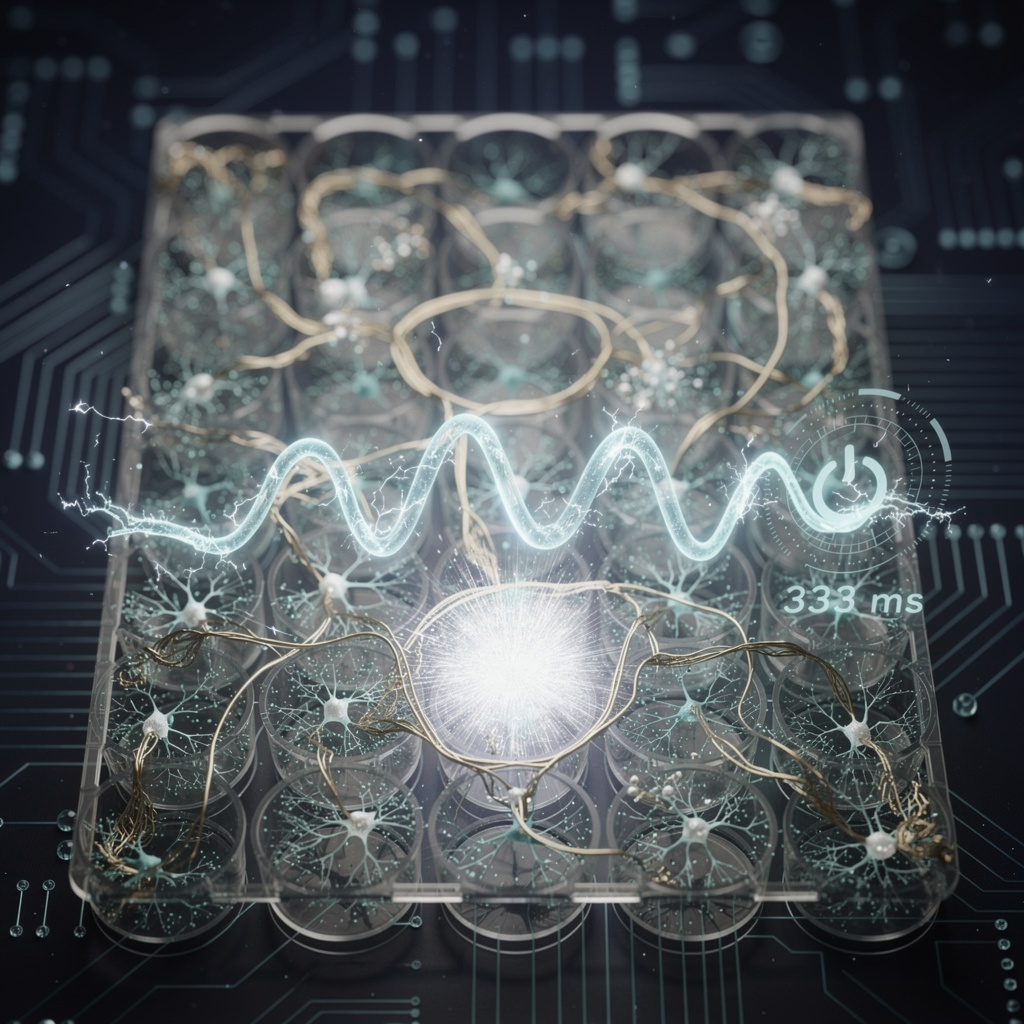
🧠 26k-Electrode Brain-Chip Mimics Chaos, Dies Without 333 ms Feedback Loop
26,400 electrodes steer 14.6 neurons/well to mimic a Lorenz attractor—then crash without 333 ms feedback ⚡️ 99 % error spike shows the brain-on-a-chip can’t self-drive yet. Japanese lattice beats hierarchy, but speed ceiling is 30 ms waves. Would you trust a living AI that forgets when unplugged?
Tohoku University researchers have wired 26,400 platinum electrodes to a sheet of living rat neurons and taught the mini-brain to track ten sine waves in real time. The closed-loop system—equal parts biology and silicon—decodes the culture’s electrical chatter every 333 ms, then zaps it with corrective pulses. When the feedback stops, accuracy collapses to 1 % of baseline within seconds, proving the tissue itself is doing the computing.
Latency: 333 ms loop → hard floor for waveforms faster than ~30 ms
Power draw: ≈20 µW per 100 µm well → ~1,000-fold thriftier than equivalent CMOS
Reliability: Feedback loss → 99 % error jump, instant loss of learned rhythm
How a dish of cells becomes a co-processor
Neurons sit in a 128-well microfluidic lattice, 14.6 cells per well. FORCE learning tunes a linear read-out that converts spike trains into smooth signals; the same chip immediately stimulates back, locking the culture into target patterns such as 4-second sine waves or the chaotic Lorenz attractor. Modular layout beats hierarchical wiring: tighter inter-well links raise firing rates 15 % and cut decoding error.
Short-term tune-ups already queued
- Q3 2026: FPGA-driven stimulator shrinks loop to 150 ms
- Q1 2027: 15 µm gap between wells boosts connectivity, aiming for 20 % error reduction on 4 s waveforms
Long-term runway
- 2028–2029: Human iPSC neurons replace rodent cells; first 32-well “bio-tile” clusters wired by optical interconnects
- 2030–2031: 100 k-electrode arrays enable sub-100 ms latency, opening real-time speech envelope tracking
If the team hits these marks, expect hybrid racks that sip power while modeling time-series no digital core can match—provided society agrees on the rules for renting out bits of borrowed brain.
😱 Microsoft Hikes Biz AI Bundle 120%, Partners Must Sell $99 Seat or Fail
120% price jump: $99/user for AI Copilot vs $45 for plain 365 😱—equal to charging EVERY SMB worker an extra $648/yr just to talk to agents. 📈 Microsoft’s new partner bar forces DI to push that bill or lose badge. Who’s ready to pay double for robot co-workers? — US small-biz CFOs, would you swallow the hike?
Defacto Infotech (DI) secured Microsoft’s Solutions Partner for Business Applications label on 5 Apr, pledging 100 % of its practice to Dynamics 365, Power Platform and the new Copilot “agentic” layer. To keep the badge DI must hit ≥70 certification points and grow monthly active users ≥15 % each quarter—thresholds that now decide who gets prime co-sell time with Microsoft’s field force.
How the scoring engine works
- Certifications: staff must pass product-specific exams (Dynamics 365, Power Platform, Copilot Studio).
- Performance: documented customer adds; industry norm is 12 new enterprise accounts per quarter.
- Usage growth: ≥15 % QoQ MAU rise in deployed tenants—Microsoft audits the telemetry.
What changes for customers
Speed: low-code Copilot agents inside Power Apps automate month-end close; Microsoft case files show 30 % cycle-time cut.
Price: the new E7 bundle at $99 user/mo doubles the old $45 plan—budget pressure for sub-500-seat firms.
Risk: centralized Copilot data lake triggers regulator questions on residency; DI must add governance modules to keep U.S. SMBs compliant.
Competitive lens
- Versus Adobe/Figma: those vendors ship pre-built agents but lack ERP depth.
- Versus larger integrators: DI’s exclusive focus speeds pilot deployment (3-week average vs. 8-week Big-5 timeline).
- Weak spot: narrow sole-source stack; if Microsoft raises certification bar again, overhead spikes.
Short-term checkpoints
- Q2 2026: ≥80 partner points after certifying 25 consultants; pilot three SMB ERP projects targeting 20 % faster close.
- Q3 2026: publish MAU growth ≥18 % to stay above Microsoft’s partner cut line.
Long-term revenue arc
- 2027: 50 new enterprise customers, >$12 M ARR tied to AI-enhanced subscriptions.
- 2028: reference status for “Agentic ERP” wave, securing early access to Claude-powered models in Dynamics.
The badge is more than marketing; it gates Microsoft’s leads. DI’s bet is that narrower focus plus faster certification will offset the 120 % price premium customers now face.
💥 227% Risk Jump: 85 mph Driverless Rigs Cleared for Texas’ SH-130 Toll Corridor
85 mph driverless trucks just approved on Texas SH-130—same speed that saw 227% spike in near-misses when Idaho let rigs match cars 🚛💥. Now 41 mi of Austin-Seguin asphalt will host 20-ton electric “ghost rigs” nightly. Your I-35 commute safer, or next headline?
The 41-mile ribbon of State Highway 130 between Austin and Seguin quietly became the fastest freight laboratory in the country on Monday. With the stroke of a regulatory pen, Texas raised the posted limit to 85 mph and invited Einride, Aurora, and Waymo to run Level-4 electric trucks that have no cab at all. Commercial permits open in May 2025; by late 2026 the first cab-less, 20-tonne rigs will roll at speeds no human trucker is legally allowed to match.
How 85 mph autonomy works
Each lane is being retrofitted with 3 MW chargers and vehicle-to-infrastructure radios every half-mile. LiDAR pods atop the chassis scan 200 m ahead while an eight-camera ring stitches a 360° view at 30 fps. Because the corridor is tolled and comparatively empty—peak count is 18 k vehicles per day against 235 k on nearby I-35—algorithms can hold a constant 85 mph with minimal cut-ins. TxDMV will receive 10 Hz telemetry on every throttle twitch; if following distance drops below 0.6 s the system must back the truck down to 75 mph within three seconds.
Impacts at a glance
- Freight time: Austin–San Antonio run drops from 94 min to 78 min → 15-20 % faster per load.
- Shipper savings: Pepsi, GE, and Heineken expect $45 M in annual logistics cuts once 150 daily trips operate.
- Safety exposure: Idaho data show dangerous interactions rise 227 % when trucks close the car-speed gap to 10 mph; SH-130 will test whether software beats that curve.
- Energy draw: 1.6 kWh per mile at 85 mph versus 1.2 kWh at 65 mph → 33 % higher consumption, offset by cheaper night-charge rates.
Institutional response & gaps
The SH-130 Concession Company is spending $38 M on charger pods and wider aprons, but crash barriers still meet 75 mph specs, not 85. TxDOT says retrofitting 41 miles of guardrail to “TL-5” standard would cost $11 M—money not yet budgeted. Public opinion polls show 58 % support for lower delivery costs, yet 62 % fear sharing the lane with an 80,000-lb robot. No state law requires a human safety driver, so long as the permittee submits monthly safety scorecards.
Outlook
- Q2 2026: Charging network complete; first 30 autonomous runs with safety driver on board.
- Q4 2026: Einride’s cab-less fleet starts 10 round trips per week; incident rate target <0.3 per 100 k miles.
- 2028: Daily volume climbs to 150 trucks; corridor crash rate will decide whether 90 mph or 80 mph becomes the new ceiling.
- 2029-30: If data pass federal review, expect copy-cat 85 mph AV lanes on I-35 E and the Houston-Baton Rouge corridor.
Texas is betting that code can out-drive human reflexes at freeway speed. If the gamble pays off, the nation’s logistics map gets redrawn around 41 miles of asphalt where trucks never tap the brakes for a coffee break.
In Other News
- NORD Drivesystems launches MAXXDRIVE gear units for mining with 2.5M lb-in torque and UNICASE housing
- Geely Launches EX2 in UK Market with 50,000 Monthly Sales in China, Targets 100,000 Units by 2030
- Planet Labs withholds satellite imagery of Iran and Middle East under U.S. government order
- Japan’s MEGURI2040 program grants first autonomous navigation notation to Genbu ship, enabling fully unmanned coastal cargo operations
Comments ()