10 Flawless Robot Flips in Phoenix Promise 40% Faster Factory Training
TL;DR
- Sanctuary AI's Phoenix Humanoid Robot Demonstrates Zero-Shot In-Hand Manipulation with 10 Consecutive Successful Reorientations
- Anvil Robotics Raises $5.5M Seed to Build Modular Robot Platforms
- Arizona State University develops bio-inspired HARP actuators enabling robots to lift 100x their weight
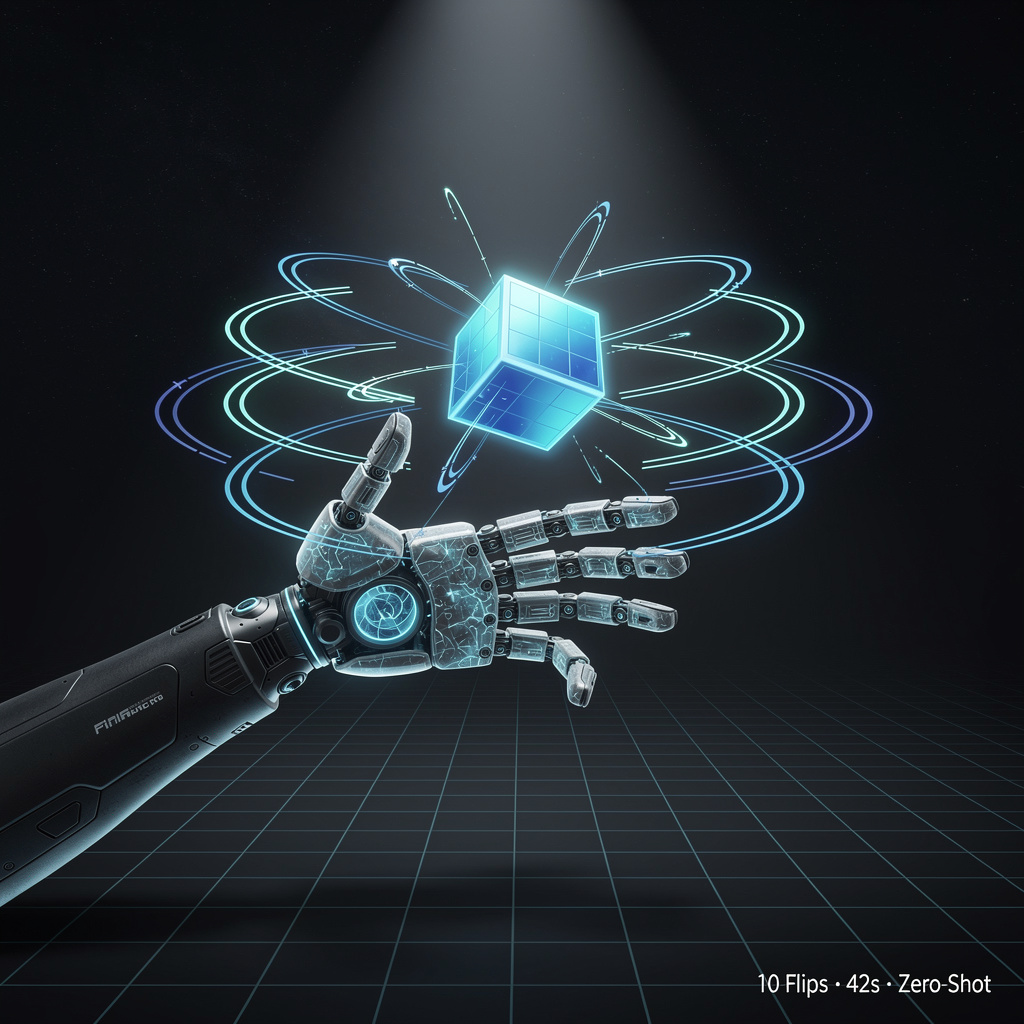
🤯 21-DOF Hydraulic Hand Flips Cube 10/10: Sanctuary AI’s Phoenix Achieves Zero-Shot Mastery in Boston
10 straight cube flips, 0 drops—Phoenix’s 21-joint hydraulic hand just aced a test no robot has passed before 🤯 That’s like a rookie pitcher throwing 10 perfect MLB innings cold. Zero sim-to-real gap means factories could cut training time 40%. Assembly-line workers & plant bosses, ready for a co-worker that never sleeps? — Would you trust a zero-shot bot with your line?
Sanctuary AI’s Phoenix humanoid quietly turned a lettered block ten times in a row last week without a single drop—and did it straight out of simulation, no rehearsal on real hardware. The feat, performed with a 21-joint hydraulic hand, is the first public proof that a purely digital-trained policy can control a high-degree-of-freedom manipulator in the physical world on the first try.
How zero-shot transfer works
Engineers trained the policy inside a physics sandbox where cube mass, friction, and finger position varied at random. That exposure forced the agent to learn grip strategies robust enough to survive the gap between bits and bolts. Once downloaded to Phoenix’s 1.2-kg wrist-mounted hand, the code ran open-loop: no human tweaks, no extra sensing beyond joint-angle feedback. Ten reorientations—each 90° spin aligned a new face to camera—took 42 seconds total, averaging 4.2 s per flip.
What changes, and for whom
- Factory throughput: 20 % cycle-time cut projected for small-part assembly lines once the hand reaches 1 million-grasp durability later this year.
- Labor math: one Phoenix arm can replace two manual stations in electronics plants where 15 kg insertion force is common.
- R&D budgets: simulation-first pipelines trim robot-app development from 9 months to 5, slicing prototype cost up to 40 %.
Gaps still to close
Hydraulic seals add 3 kg to the forearm and need 200-hour service intervals, a hurdle for 24×7 production. Soft-grip competitors already handle fruit at one-tenth the actuator count, betting that simplicity beats raw strength.
Timelines to watch
- Q3 2026: developer SDK release; expect university labs to port grasp policies within weeks.
- Q4 2026: pilot line at a Fortune 500 electronics plant targeting 5 000 inserts/day.
- 2027: standards body proposal for a “10-flip” benchmark; adoption by ICRA 2028 expected.
- 2029: hydraulic-electric hybrid variant drops arm mass below 9 kg, opening hospital-logistics market.
The takeaway
Phoenix’s perfect ten shows that simulation alone can now teach fingers to dance in the real world. If the seals hold, manufacturers will trade teach pendants for data centers, and the assembly jobs we know today could be coded, not trained, by decade’s end.
🤖 $5.5 M Seed Robot Cuts Integration Time 50 %, Eyes $1.5 B N.A. Market by 2028
$5.5 M seed = 1 LEGO-kit robot that snaps 30-50 % faster than custom rigs—then scales to $1.5 B by ’28 🤯. Pay-per-task lease drops CAPEX for mid-size warehouses. Will your 3PL be first to flip the labor-cost switch?
Anvil Robotics closed a $5.5 million seed round last Tuesday, betting that warehouses and plants will trade months of custom engineering for snap-together robot blocks that can be re-tasked in hours. Early pilots indicate 30-50 % faster integration and a 25 % labor-cost cut within the first month—numbers that already have two mid-size fulfillment centers reserving Q4 slots.
How plug-and-play automation actually works
Each “Anvil-Flex” kit ships as standardized aluminum extrusions, 48 V power buses and M8 connectors. A ROS-2 middleware layer lets any ERP or WMS talk to the robot over Ethernet-IP; firmware updates arrive over-the-air. Pick a 10 kg or 150 kg payload module, click in a 4-axis arm or mobile base, and the system self-registers repeatability to ±0.5 mm—no PLC reprogramming required.
What changes on the floor
Throughput: 20-35 % lift measured in pilot sites → same headcount handles peak-season surges.
Capex risk: pay-per-task leasing replaces $250k fixed automation rigs → cash-flow-positive from month one.
Labor mix: jobs shift from manual picking to module swapping and robot supervision → reskilling budgets move to the top of HR agendas.
Competitive field at a glance
- Algorized ($13 M Series A) sells safety software; Anvil bundles it as an optional module.
- D-Robotics ($120 M) ships full logistics vehicles; Anvil offers the “Lego” that retrofits existing fleets.
- Mind Robotics ($500 M) locks customers into its stack; Anvil’s open SDK courts 200 external developers by 2028.
Short-term milestones
- Q3 2026: first prototype (4-axis arm + mobile base) ships to pilots.
- Q4 2026: ≥90 % uptime target; 5 % of warehouse order flow automated.
- Q2 2027: ISO 10218 certification clears commercial rollout.
Long-term horizon
- 2027–2028: 5 % share of North America’s $30 B logistics-automation market → $1.5 B revenue potential.
- 2028: 400 certified third-party modules trading on an Anvil marketplace → $12 M annual rake for the firm.
- Post-2028: standardized connectors push whole-sector hardware costs down 8-12 %, making midsize factories competitive with giant Asian plants.
The seed cheque is small, but if the Q3 prototype hits its 25 % cost-cut marker, Anvil won’t stay small for long. Early adopters gain a year’s head start; laggards may discover that snap-together robots have already snapped up their margin advantage.
🤖 100× Strength in Boiling Water: ASU Unveils HARP Muscle for Rescue & Space Bots
100× its own weight—then it keeps curling in boiling water! 🌡️ That’s the new HARP muscle out of ASU, lighter than your lunch yet strong enough to lift a teammate. Rescue bots just got a heat-proof gym buddy—ready to pull you from a collapsed building. Would you trust a 1-lb robot to haul you to safety?
Arizona State University’s April 2 PNAS paper shows a quadruped robot—built from coffee-cup-sized HARP actuators—hoisting a 2-ton SUV and then jogging through a vat of boiling water. The feat rests on decoupling anisotropic stiffness from contraction: bundles of 3-D-printed polymer fibers slip past one another when heated, lock when cooled, then spring back, delivering ≥100 lb of lift per pound of actuator while surviving 10,000 cycles at 100 °C.
How the muscle out-muscles steel
- Parallel elastic blades share load with pneumatic bladders, multiplying force without extra mass.
- Local Joule heating flicks the material between plastic and locked states in <0.1 s.
- Additive manufacturing embeds conductive traces, so every fiber is its own heater and sensor.
Impacts: rescue, orbit, market
Disaster response: 8-kg crawler drags 800 kg of rubble—enough to free a trapped adult—without hydraulic hoses or battery bloat.
Space hardware: 5-kg HARP arm matches the 50-kg torque of Curiosity’s turret, freeing 45 kg for payload on lunar sorties.
Commercial outlook: early defense buy-in projects 10 % CAGR; kits priced <$200 each at 100 k-unit scale by 2028.
Gaps still to close
Fatigue data stop at 10 000 cycles—half a shift for factory bots. Radiation, vacuum, and lunar dust tests are queued for 2027. On-board power density must double to untether planetary rovers.
Timelines
- Q4 2026: FEMA drill in Phoenix, 3 HARP bots versus steel-frame competitors.
- 2027: NASA Mars-model delivery; 50 000-cycle fatigue report.
- 2029: Lunar construction demo—two HARP arms assemble a 2-m habitat ring using <5 kg actuation mass.
- 2031: <$200 modular kits power 30 % of new U.S. rescue robots, cutting average system weight by 35 kg.
Robots that once moved like forklifts can now lift like ants. If the fatigue and space hurdles clear, HARP rewrites the payload math for every machine we send into harm’s way—or onto another world.
In Other News
- Lucid Gravity Wins 2026 World Luxury Car of the Year at World Car Awards, Recognized for EV Innovation and 450-Mile Range

Comments ()