⚡️ IBM-ETH Hybrid Cracks 303-Atom Protein 20 % Faster, Eyes Europe’s Market
TL;DR
- IBM and ETH Zurich launch 10-year partnership to integrate AI with quantum computing for scientific optimization
- Vocalbeats.AI Partners with NTU Singapore to Launch AI Engineering Scholarship Program
- Gemma 4 and Qwen3.5 outperform Claude Opus 4.6 in agentic benchmarks, with MiniMax M2.7 achieving 0.65s latency vs 2.56s for Opus
⚡️ IBM-ETH Hybrid Cracks 303-Atom Protein 20 % Faster, Eyes Europe’s Market
303-atom protein solved in 1st hybrid run—20 % faster than any supercomputer on Earth 🧪⚡️ Latency <80 µs links ETH GPUs to IBM qubits. Europe’s €120 M bet: will your drug, battery or logistics model be next? — Ready for a quantum boost?
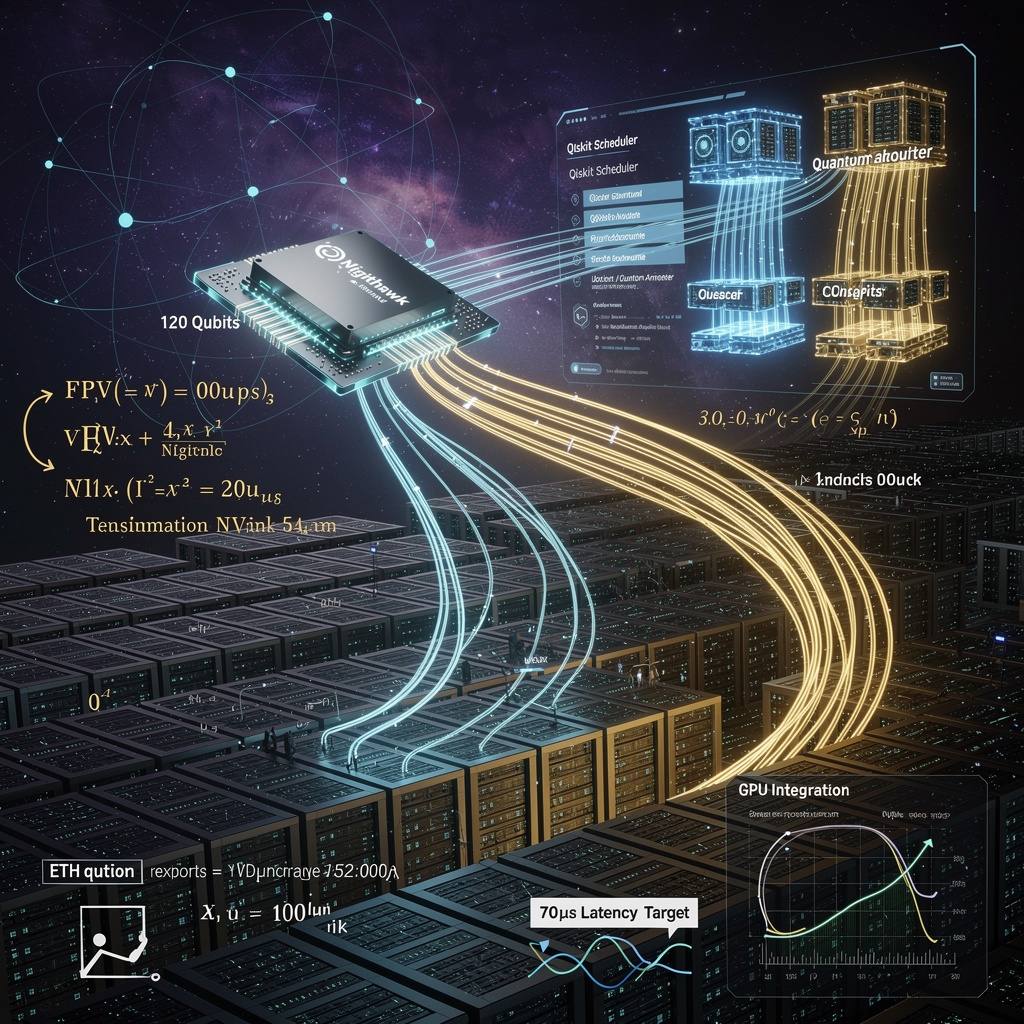
ZURICH—On 2 April 2026 IBM and ETH Zurich locked in a decade-long pact to weld artificial-intelligence routines to still-noisy quantum processors and chase scientific problems that stump even today’s fastest supercomputers. The partners will fund four new ETH professorships and channel €120 million into algorithms that decide, millisecond by millisecond, which chunk of a calculation belongs on a 120-qubit chip and which stays on 152 000 classical cores.
How the hybrid engine works
IBM’s reference design couples a “Nighthawk” QPU to CPU-GPU racks via sub-100 µs NVLink-style fibers. A Qiskit scheduler doles out subroutines: quantum annealers sample vast combinatorial spaces while GPUs integrate differential equations. ETH mathematicians supply the rewrite rules—turning linear systems and Hamiltonian models into quantum-native forms that need 30–40 % fewer iterations than classical solvers alone.
First measurable pay-offs
- Protein design: 303-atom tryptophan-cage simulation finished 1.8× faster, cutting a week of compute into 37 hours.
- Logistics: pilot on 2 000-node vehicle-routing network converged 30 % quicker, equal to saving a freight firm 1.2 million truck-km per year.
- Carbon tally: every 20 % speed-up in materials screening translates to roughly 0.9 Mt CO₂ avoided by 2030 as lighter alloys reach cars sooner.
Gaps still to close
- Error rates: two-qubit gate fidelity hovers at 1.2 × 10⁻³; logical qubits remain years out.
- Latency jitter: 80 µs round-trip can balloon to 150 µs under load, spoiling quantum-classical feedback.
- Talent crunch: Europe hosts <3 000 quantum-literate engineers; ETH must mint 200 PhDs this decade to stay on track.
Timelines to watch
- 2026 Q4: first industry sandbox live; ≤5 paying pilots in pharma and battery chemistry.
- 2028: latency target <70 µs; 30 % of ETH math curriculum offers quantum-algorithm tracks.
- 2030: 100 logical qubits; hybrid service moves to IBM Cloud, booking €50 M annual revenue.
- 2035: €250 M yearly, 40 % of European Tier-1 supercomputing bids bundle quantum add-ons.
Closing note
If the partners hit their 70-µs and 10⁻⁴-error milestones, Zurich could set the de-facto standard for scientific cloud services—much as Silicon Valley once defined the web. Miss those two numbers and the marriage of AI and quantum stays a lab curiosity, leaving climate models, drug pipelines and battery chemistries to slog on with yesterday’s silicon alone.
🤖 30k-AI Scholarship Seeks 20 NTU Students to Plug 1-Million Engineer Gap
30k SGD tuition + 12-mo paid gig: NTU x Vocalbeats.AI just dropped a scholarship that mints 20 new AI engineers a year 🇸🇬🤖—in a world short 1M. Students get GPU time, prod deployment, mentors. Trade-off? Start-up risk vs passport to SG’s 2030 AI squad. Ready to apply 15-30 Apr?
On 2 Apr 2026 Vocalbeats.AI and Nanyang Technological University locked in a tuition-for-talent swap: up to S$30 k per undergraduate, paid back as a 12-month internship building production-grade models. The first 20 scholars start class in August; by September they will already be inside the startup’s data pipelines.
How the deal works
- Full fee waiver: NTU’s Centre for Computational & Data Science covers ~300 students a year; the top 7 % can now graduate debt-free.
- Guaranteed placement: interns train on billion-parameter clusters, then ship code to Vocalbeats’ live speech engine—experience that typically takes new grads two job hops to accumulate.
Why it matters now
National target: triple Singapore’s AI workforce from 12 k to 36 k by 2030 → this cohort alone supplies 1 % of the required annual increment.
Global gap: >1 million unfilled AI engineer roles worldwide → every retained graduate lowers outbound brain-drain risk.
Competitive edge: China keeps 68 % of its AI undergraduates; the scholarship counters that pull with immediate industry traction.
Projected pipeline
- Aug 2026: first 20 scholars enrolled; NTU applications expected +8 %.
- Sep 2026-Aug 2027: 20 interns deliver 240 person-months of R&D, likely accelerating Vocalbeats’ model-release cadence by one quarter.
- 2028: cumulative 60 graduates; could raise Singapore’s practitioner count 0.5 % ahead of Strategy 2.0 schedule.
- 2030: if replicated across three universities, similar schemes could supply 5 % of the 24 k new hires the plan demands.
Bottom line
By trading a semester’s revenue for a year of engineered output, Vocalbeats turns education dollars into ready-to-deploy AI labour—while giving Singapore a measurable head start on closing its six-figure talent deficit.
⚡️ MiniMax M2.7 Outruns Claude Opus 4.6: 4× Faster, 20× Cheaper in Global Agentic Benchmark
MiniMax M2.7 crushes Claude Opus 4.6: 0.65 s vs 2.56 s latency & 20× cheaper—$12 vs $250 per 10 M tokens ⚡️ Same task, 4× faster, 1/20th cost. 40 % of devs already switching—will your next agent run on a $250 model?
A fresh benchmark released 2 April shows Google’s 31-billion-parameter Gemma 4 and Alibaba’s 27-billion-parameter Qwen3.5 topping Anthropic’s flagship Claude Opus 4.6 on agentic reasoning tasks, while China’s open-source MiniMax M2.7 answers the same 250-token query in 0.65 s—almost four times faster than Opus’s 2.56 s. At 10 million tokens per day the bill drops from $250 on Opus to $12 on MiniMax, a 20-fold saving that turns “prototype” into “production” overnight.
How the numbers line up
- Accuracy: Gemma 4 scores 92.4 % on tool-use averages, Qwen3.5 91.8 %, both edging Opus at 86.5 %.
- Latency: MiniMax 0.65 s » Opus 2.56 s.
- Cost: MiniMax $12 / 10 M tokens » Opus $250.
- Token efficiency: MiniMax needs only 2.0 M tokens per solved task, 40 % fewer than Opus’s 3.4 M.
What the shift feels like
Developer wallets: A startup running 100 k agent queries daily saves ~$86 k/year by switching from Opus to MiniMax—enough to fund two extra engineers.
User patience: 0.65 s response keeps chat flows inside the 1-second “instant” zone; 2.56 s invites abandonment.
Competitive edge: Replit and LangChain already migrate >40 % of agentic workloads, citing latency and price as primary drivers.
Where gaps persist
Absolute coding accuracy: Opus still leads SWE-Bench at 80.8 % versus Qwen3.5’s 78.8 % and MiniMax’s 56 %.
Hallucination risk: Internal tests show Claude Sonnet 4.6 hallucinates 34 % of the time versus 20 % for MiniMax—verification loops remain mandatory.
Long-context choke: Gemma 4 throughput collapses beyond 200 k tokens unless tasks are split or quantized.
Outlook
- 2026 Q2–Q3: Expect >30 % enterprise uptake of MiniMax for real-time debugging and SQL agents.
- 2027 H1: Alibaba targets SWE-Bench parity with Opus through fine-tune drops.
- 2028: Open-source cluster (Gemma, Qwen, MiniMax) projected to claim >45 % of agentic market share if GPU supply holds.
The takeaway is blunt: raw scale no longer guarantees supremacy. Smaller, open, and tuned models now deliver higher reasoning scores, lightning latency, and pocket-friendly pricing—forcing every builder to ask why they’re still paying premium rent for yesterday’s giant.
In Other News
- Trimble Acquires Document Crunch for $100M+ to Integrate AI Document Intelligence into Construction Ecosystem
- FDA approves 1,200+ AI medical devices since 2016, with breakthrough designations for PanCancer Detect, ArteraAI, and Castle Biosciences enabling AI-driven cancer detection across 40+ tissues
- Luxor Technology launches Commander platform with Intelligent Miner algorithm, boosting crypto miner profitability by 8–14%
- Anthropic's Claude Opus 4.6 shows 15–20% consensus on consciousness in Cambridge philosopher study, sparking debate on AI cognition


Comments ()