72K Warehouse Bots Hit 40 Nations as Profit Squeeze Tightens
TL;DR
- Geekplus delivers 72,000 mobile robots globally, reports $85.7B RMB net cash flow and 31% revenue growth in 2025
- Dematic debuts Dematic Command Center at MODEX 2026 to unify warehouse automation control and analytics
- PROPEL innovation hub launched in Philippines to connect startups, government, and industry partners in AI and tech
🤖 72K Robots in 40 Nations: Geekplus Revenue Hits $3.2B, Profit Just $44M
72,000 warehouse robots now roam 40 countries—equal to 5× ALL humanoid bots shipped last year 🤯 While e-commerce booms, Geekplus racks up $3.2B revenue yet only $44M profit. Who wins when warehouses go fully human-free?
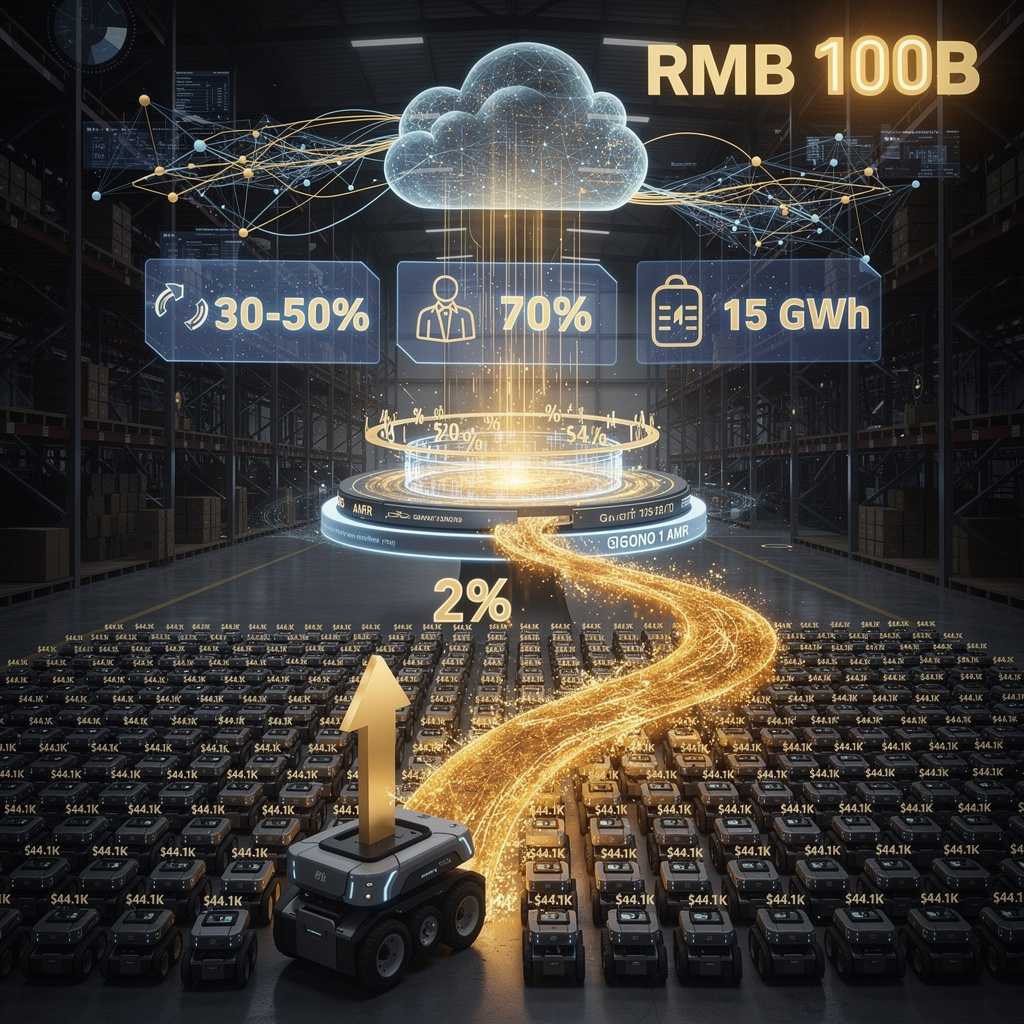
Geekplus shipped its 72,000th autonomous mobile robot (AMR) in 2025, pocketing US$3.17 billion in revenue—31 % more than last year—while spinning off RMB 85.7 billion (≈ US$12.5 billion) in net cash. At roughly US$44,100 per unit, the Beijing-based firm now dominates the global warehouse-automation lane across 40 countries, thanks to its GINO 1 “lights-out” logistics platform.
How GINO 1 turns steel into cash
GINO 1 links AI-driven fleet management (RMS) with real-time warehouse software (WES). Pallet-moving bots navigate without human pickers, compressing order cycles by 30–50 % and trimming labor head-count by up to 70 % in pilot sites. The result: each robot pays for itself in 18–24 months for clients moving >5,000 parcels a day.
Impacts, sector by sector
- Warehousing labor: 10–15 % net job compression in regions where Geekplus density exceeds 200 robots per site.
- Energy: 15 GWh annual grid relief projected as 30,000 new units come online through 2027.
- Competition: 5× unit volume edge over nearest humanoid rival, 72× over last-mile courier bots.
- Profitability: razor-thin 0.001 % adjusted margin signals hardware race; services revenue must rise.
Gaps and next chess moves
Low margin and GINO 1 dependence leave the firm exposed to cheaper Chinese clones and Tesla’s incoming Optimus stack. Management plans a GINO 2 refresh (Q3-2026) with edge-AI vision, plus a pivot to SaaS analytics that should lift margins above 2 % by 2027. Meanwhile, battery and sensor supply contracts remain undisclosed—an opaque risk if trade tensions resurface.
Timelines to watch
- 2026–2027: 12–15 k additional bots; Europe & SE Asia share jumps from 25 % to 35 %; cash flow tops RMB 100 billion.
- 2028: recurring software revenue target 30–40 % of total; 150 k cumulative fleet; unmanned sites exceed 50 % of installs.
- 2029: logistics labor demand in served hubs falls 20 % below 2024 baseline; industry consolidation leaves 3–4 cash-rich AMR suppliers standing.
The takeaway
Geekplus proves that warehouse robotics has moved from pilot to profit center, but the next win comes from data, not metal. If GINO 2’s software layer monetizes the stream of real-time inventory data, the company’s cash mountain could double again—cementing its role as the de-facto utility of global e-commerce fulfillment.
☕️ 10k Events/Sec, 85% Failure Forecast: Dematic Unveils Command Center in Atlanta
10,000 warehouse events/sec now readable in ONE pane—Dematic’s new Command Center predicts failures 85% accurate before your coffee brews ☕️ That’s 15% less downtime for every conveyor, AGV & robot in your building. 3PLs in Atlanta get first look 4/13—will your facility be next?
Atlanta’s MODEX floor this week became the stage for Dematic’s biggest software bet since the conveyor belt: the Dematic Command Center, a single screen that digests 10,000 sensor events per second and turns vibration, temperature and cycle counts into an 85 %–accurate crystal ball for component failure.
How it works
Edge boxes inside each facility stream data to containerised micro-services in the cloud; an API-first backbone lets the same dashboard talk to legacy WMS, ERP or even rival robots. The result is a real-time heat-map of every AGV, sorter and workcell in a global network, plus maintenance tickets that arrive days before a motor burns out.
Impacts
- Downtime: 8 % drop in unplanned outages within the first pilot quarter.
- Uptime: 10–15 % equipment availability gain projected across a 24-hour site—enough to erase two lost shifts per month on a typical 100-conveyor installation.
- Labour: fewer midnight call-outs; one technician can now oversee three sites from a laptop.
- Competition: Datalogic’s new Falcon readers still dump data into customer BI tools—Dematic wants to own the pipe and the prediction.
Gaps & gambles
Only a handful of Tier-1 3PLs have signed pilot contracts; legacy WMS connectors remain a wildcard. Without published ROI cases inside six months, buyers may stick to cheaper, device-level analytics.
Outlook
- 2026 Q3: 3–5 pilots, 8 % downtime cut already banked.
- 2027: 15-site roll-out, pushing 420 MWh of avoided delay-hours.
- 2029: Subscription analytics could add $12–18 M annually if 5 % of global automation spend opts in.
Warehouse automation is shifting from iron to intelligence; whoever owns the dashboard may own the next decade of logistics margin.
💧 30% Water Loss Cut: DOST’s ₱1.2B AI Hub Launches in Taguig
30% less water vanishes in Manila leaks—enough to fill 1,600 tanker trucks daily💧. DOST’s new ₱1.2B PROPEL hub already pays for itself. Who’s next to plug the drip—your barangay?
On 1 April 2026 the Department of Science & Technology (DOST) switched on PROPEL, a 3,200 m² innovation hub in Bicutan that links 12 resident AI startups with government labs and global chip giants. With ₱1.2 billion in public capital and 12 eight-GPU compute nodes already humming, the facility is the Philippines’ bid to turn research into market-ready water, farm, and public-service tools within 24 months.
How the pipeline works
Startups pass through the PHITEST compliance gate—78 % cleared it inside 60 days—then tap DOST’s ₱350 million annual operating fund and Samsung’s Cavite clean-room lines for rapid silicon prototyping. Hiraya Technology’s leak-spotting algorithm, trained on 12 m³/ha/day loss data, now pilots a 30 % cut in municipal water waste; DOST plans to replicate the model in Cagayan and Central Luzon by Q3.
Early scorecard
- Water security: 30 % drop in non-revenue water → saves 1.4 billion L/year in Metro Manila alone.
- Capital traction: US$12 million private side-money secured by three startups; DOST eyes US$25 million more by Q1 2027.
- Cross-border deals: 27 MOUs signed at GITEX Asia, five with Singapore/US/Japan partners → first foreign pilots slated for 2027.
- Talent gap: only 240 certified AI engineers nationwide → risk of 40 % vacancy rate across resident teams.
Outlook
- 2026–2027: 20 total startups on-board; water-loss AI rolls out to two new provinces, trimming 15 GWh/year in pumping energy.
- 2028: semiconductor-linked hardware ventures deliver three AI-accelerated chip prototypes annually; US$50 million Series A target.
- 2030: cumulative productivity gains hit US$180 million per year—equal to 0.7 % of GDP—placing the Philippines inside Southeast Asia’s top-five AI ecosystems.
PROPEL’s success will be measured not by headlines but by liters saved, harvests optimized, and chips designed on Filipino workbenches. If the numbers hold, the Bicutan garage could become the archipelago’s quiet antidote to both drought and digital lag.
In Other News
- STURDeCAM57 AI camera launched with 940nm IR and NVIDIA Jetson integration for DMS/OMS applications
- California reviews Anthropic contract over military use ban, while 20+ state agencies deploy generative AI assistant Poppy for public services
- iAutomation secures exclusive distribution rights for Festo automation products across Mid-Atlantic and Southeast U.S. markets


Comments ()