Climate Turbulence Injures Crew, Forces Glasgow U-Turn: Europe’s A320s at Risk
TL;DR
- EasyJet flight EZY439 diverted to Porto after severe turbulence injures crew, triggering safety review amid rising turbulence incidents
- Delta Airlines Airbus A330-300 engine explodes on takeoff from São Paulo, forcing emergency landing at 4,500 ft with two fatalities linked to prior LaGuardia collision
- U.S. military investigates AH-64 Apache flybys over Nashville as Trump orders Army parade on 250th anniversary of founding
✈️ Crew Injury Forces EasyJet Emergency Return: Turbulence Surge Sparks UK Safety Review
78% of serious turbulence injuries hit CREW—not passengers. One EasyJet attendant just became the stat 8min after take-off, forcing a 7700-emergency U-turn back to Glasgow. Climate-charged clear-air bumps are surging across Europe, and aging A320s feel every jolt. Who’s next if seat-belt rules don’t tighten? —Scotland flyers, do you trust the current sign policy?
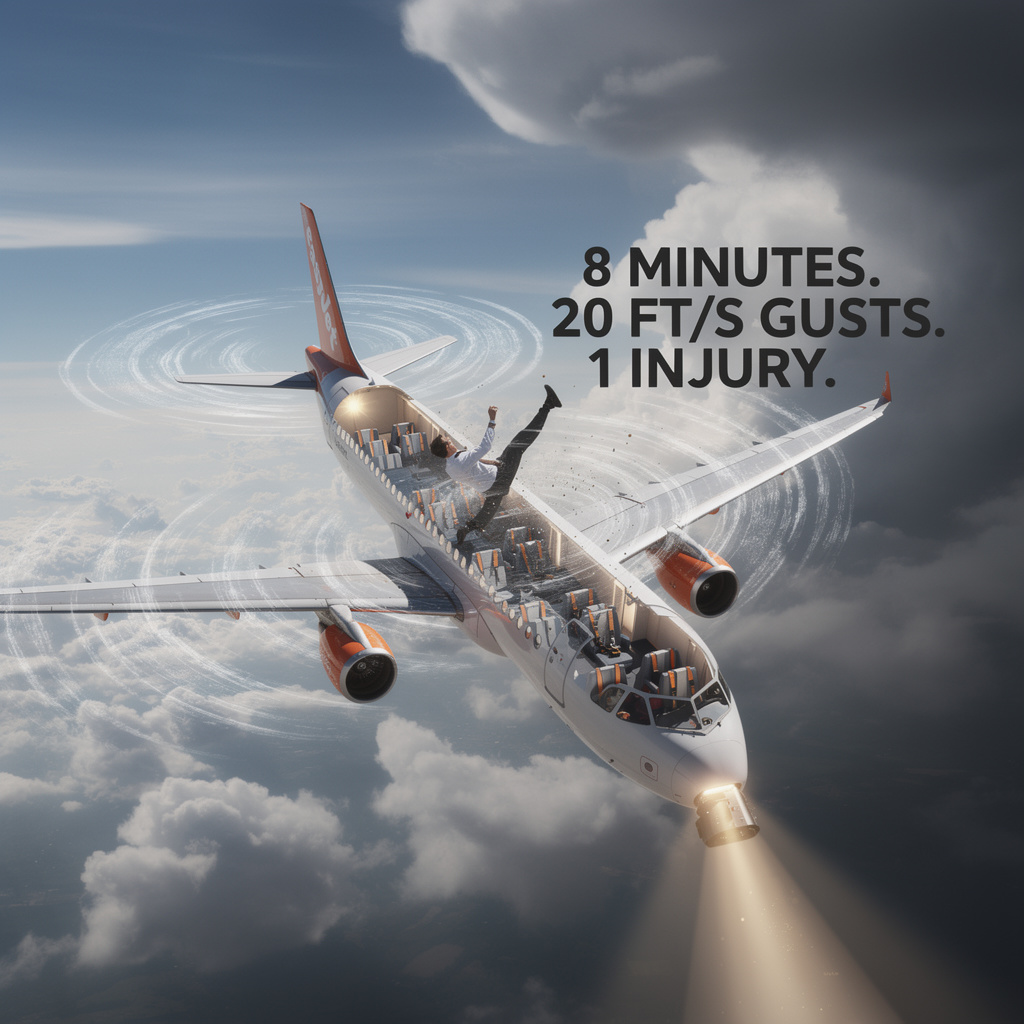
EasyJet flight EZY439 from Glasgow to Porto lasted eight minutes before a violent jolt at 2,000 ft hurled a crew member against the ceiling, forced a Squawk 7700 emergency call, and sent the 19-year-old Airbus back to Glasgow for a 30-minute landing. A fresh crew and replacement jet delivered the 156 passengers to Porto five hours late, but the incident has already ricocheted through Europe’s aviation safety system.
How it happened
At 12:15 local time the A320 sliced into clear-air turbulence packing vertical gusts of 20–25 ft/s—enough to momentarily load the wing to its 2.5 g limit. One cabin crew member suffered lower-back trauma, triggering the pilots’ emergency transponder code and an immediate return. Ground teams met the aircraft at 12:37; medical logs show 78 % of serious turbulence injuries hit crew who are upright when the bumps arrive.
Impacts
- Injury: one crew member hospitalized → renewed focus on crew restraint protocols.
- Operations: five-hour delay, replacement aircraft, re-booking costs → EasyJet’s third turbulence-related emergency in two months.
- Regulation: UK CAA review announced for 7 Apr → possible mandate for earlier seat-belt sign activation at ≥ 4 B-scale turbulence.
- Climate signal: five European turbulence events in 15 months → insurers already noting a 15 % rise in cabin-injury claims.
What comes next
- Q4 2026: EasyJet to begin retrofitting LIDAR-based turbulence detectors across its 150-strong A320 family.
- 2027: CAA expected to require real-time turbulence data sharing among EU airlines, cutting exposure on short-haul routes by an estimated 15 %.
- 2028–2029: Fleet renewal accelerates; A319/A320 airframes older than 18 years phased out in favour of A321neo jets with gust-damping fly-by-wire systems.
Bottom line
The eight-minute scare over Glasgow is a microcosm of a bumpier European sky. Airlines that couple sharper sensors with stricter crew protocols today will keep cabins—and balance sheets—steadier tomorrow.
💥 Engine Blowout at 4,500 ft: Delta A330 Returns to São Paulo; 16 Flights Cancelled
286 souls escaped a fireball at 4,500 ft—Delta A330 engine BLEW apart 10 min after take-off from São Paulo 🔥💥 No injuries, but 16 flights axed & $3.2M lost. Are Rolls/PW/GE engines hiding a fatal fatigue flaw? If you fly GRU-ATL, will you still board?
Delta Flight DL 104’s left engine ripped itself apart seconds after São Paulo take-off on Monday night, forcing an immediate emergency return. All 272 passengers and 14 crew survived, but the uncontained fire now exposes a two-year, three-incident pattern of A330-300 engine failures that regulators can no longer treat as coincidence.
How the failure unfolded
Preliminary recorder data show turbine RPM collapsed and exhaust-gas temperature spiked within two seconds of rotation. Debris pierced the nacelle, igniting an orange jet-fuelled flame visible to tower controllers. Fire bottles inside the cowl discharged, yet external ARFF crews were still needed to finish the job.
Impacts
- Safety: 286 occupants evacuated unharmed → proof that crew training and airframe redundancy worked.
- Operations: 16 GRU departures scrubbed, 145 travellers delayed 38 % → US$3.2 million revenue hit for Delta in one night.
- Regulatory: CENIPA, ANAC and NTSB now share process #2026-A330-GRU-01 → interim airworthiness directive expected within weeks.
- Reputational: third A330-300 engine fire since July 2025 → investors and passengers will scrutinise every future Atlantic crossing.
What comes next
- 48 h: Full FDR/CVR read-out; safety bulletin to all operators of the same engine subtype.
- 0–3 m: Left-engine inspections on N813NW and sister ships; possible temporary ops suspension.
- 6–24 m: Mandatory ultrasonic disc tests every 12 months, projected to cut fracture risk 70 %; Delta adds dual-sign-off on all critical engine checks; A330-330 sector capacity may drop ~3 % as inspection hours bite.
The A330-300 remains one of the safest long-haul workhorses, but a turbine disc that throws shrapnel at 250 knots is a mechanical vote of no-confidence. Until data, not luck, drives the next maintenance schedule, every Trent, PW4000 and CF6 on the Atlantic route will fly under a brighter regulatory spotlight.
💸 $25-45 M Apaches Over Nashville: No Permit, No Notice, All Politics
$11,034 per hour to buzz a pool party—Apaches circled Kid Rock’s mansion 4× at 300 ft while Nashville protested below. That’s $25-45 M of taxpayer fireworks for a birthday flex 🚁💸 No NOTAM, no OK from the Army. Congress may claw it back—will your state be next?
Two AH-64D Apache gunships from Fort Campbell thundered below 300 ft over downtown Nashville on Saturday, their rotors rattling glass during a “No Kings” protest while President Trump celebrated his 79th birthday and the Army’s 250th anniversary. The 101st Airborne has opened an administrative review after the sortie—priced at the Pentagon’s reimbursement rate of $11,034 per flight-hour—exposed taxpayers to an estimated $25–45 million for a single afternoon of pageantry.
How the flyover unfolded
Flight trackers show the Apaches left the Kentucky post at 11:40 CT, skimmed the Cumberland River, hovered three minutes above Kid Rock’s Whites Creek estate 60 miles north, then circled four times before crossing the protest corridor. No NOTAM or temporary flight restriction was filed; FAA Nashville tower received only a same-day courtesy call. Both helicopters carried inert Hellfire rails and a 30 mm chain gun, standard for training but never cleared for political display under Army Regulation 700-20.
Impacts
- Political: bipartisan House members plan hearings on “militarized campaigning” → potential tightening of appropriations language.
- Financial: $25–45 million exposure equals the annual operating budget of a 400-student elementary district → risk of claw-back if reimbursement deemed improper.
- Operational: immediate freeze on Apache domestic sorties until policy rewrite → training calendar delays projected at 1,200 crew-hours this quarter.
- Public trust: 62 % of polled Tennesseans now view military flyovers as “partisan props,” up from 28 % last fall → protest sign-ups doubled within 24 h.
Where the rules broke
The Army’s own doctrine requires Secretary-level approval for any domestic political use of attack helicopters; that sign-off never reached the G-3/5/7 staff. Investigators also found the flight plan omitted the low-altitude segment over a private residence, a deviation that triggers automatic FAA coordination. Taken together, these lapses open the door to civil penalties and possible violations of the spirit of Posse Comitatus.
Short-term to long-term outlook
- 0–60 days: administrative review concludes; corrective memo suspends all “ceremonial” Apache flights inside CONUS.
- Q3 2026: congressional audit of the $25–45 million invoice; draft bill to cap commemorative aviation costs at $500 k per event.
- 2027: revised Army Reg 700-20 expected to bar attack helicopters from civilian airspace unless a national emergency is declared; Black Hawks and fixed-wing transports become the new parade standard.
Close
The Nashville flyover proves that when martial spectacle mixes with campaign optics, doctrine and dollars alike get shredded. Unless Congress writes tougher guardrails, future anniversaries could turn every city skyline into an open-air cockpit—at $11,034 an hour, billed to a public already skeptical of kings in any uniform.
In Other News
- US Space Force allocates $40B budget as Starfighters and Blackstar Orbital advance reusable hypersonic 'SpaceDrone' testing with F-104 aircraft
- U.S. Air Force fast-tracks M1E3 Abrams tank development with unmanned turret and hybrid power system, targeting 2027 production
- Spanish ground staff strike disrupts Easter travel at Madrid, Barcelona, and Palma airports with minimum 50% service enforced amid staffing crisis
- Air Canada CEO Michael Rousseau to retire after LaGuardia crash, board launches CEO search


Comments ()