7,800 Airstrikes in 32 Days Flatten 3 Manhattans Yet 90% of Iran Oil Still Flows
TL;DR
- Trump administration escalates military action against Iran, deploying troops and targeting infrastructure
- Hungary faces €1 million/day fines as EU triggers Article 7 over migration pact violations and Orbán’s fifth term looming
💥 7,800 Strikes Later: Kharg Island Still Bleeds Oil as 5,000 Marines Wait Offshore
7,800+ airstrikes in 32 days—enough to level 3 Manhattans—yet 90% of Iran’s oil still flows. 13 US troops gone, 1,443 Iranian civilians gone, and Kharg Island’s storage tanks are now bonfires you can see from space. 65% of Americans expect boots on the ground; only 7% want them. So, Gulf friends: if the Strait of Hormuz becomes a parking lot, who pays your next gas bill?
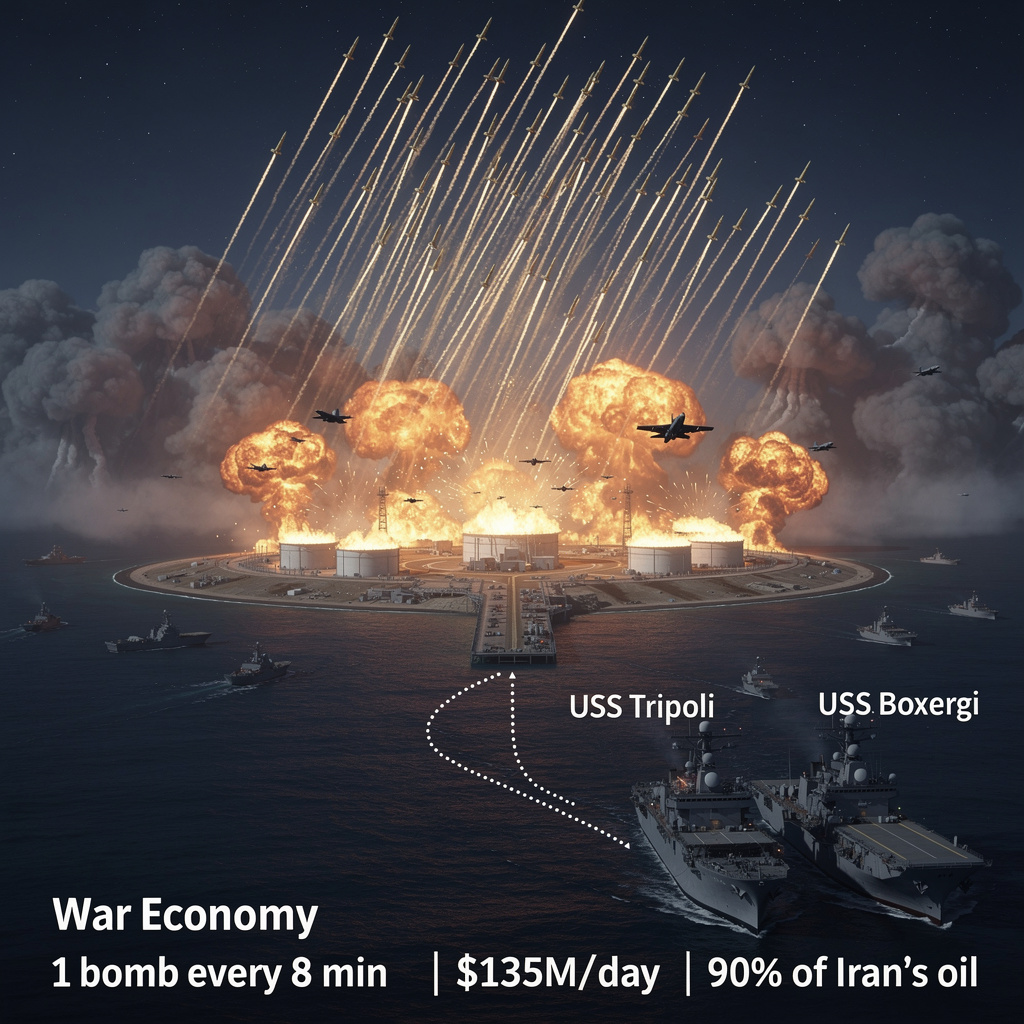
Picture 7,800 smart-bombs falling in five weeks—that’s one every eight minutes, day and night. Most of them have been aimed at a tiny speck in the Persian Gulf called Kharg Island, the single pipe through which 90 % of Iran’s oil (about 1.5 million barrels a day) gushes onto the world market. Knock Kharg offline and you squeeze roughly $135 million a day out of Tehran’s wallet. That, in a sentence, is “Operation Epic Fury.”
How big is the fist?
The Pentagon has already parked two floating airports—USS Tripoli and USS Boxer—within helicopter range of Iranian beaches. Together they carry 2,500 Marines; another 5,000 are packing sea-bags for a 30-day sail. Add 2,000 paratroopers from the 82nd Airborne plus “hundreds” of special-ops door-kickers already prowling the coastline and you get the largest U.S. amphibious shadow-boxing match since 2003. Jets, tankers and supply ships are burning through $200 billion Congress hasn’t even approved yet, while a supplemental request races the fiscal clock.
Who’s bleeding?
- U.S. troops: 13 killed, 200 wounded—think of a packed regional high-school football stadium suddenly missing an entire row of seniors.
- Iranian civilians: at least 1,443 dead so far; 217 were kids. One air-strike turned a Minab school into rubble, taking 12 little lives with it.
- Your wallet: every time Kharg’s storage tanks ignite, Brent crude spikes 4–6 %. With 90 % of Gulf oil sailing past the same narrow strait, that risk premium shows up at your neighborhood pump within days.
Why Kharg matters more than Tehran
The White House hasn’t ordered a full ground invasion—yet. But briefing slides show a dotted line labeled “limited amphibious raid: 2,000 Marines, 4–6 weeks.” Translation: seize the island, hold it long enough to crater every pipeline and berth, then hand the smoking remains to diplomats as leverage. It’s faster, cheaper and politically tidier than marching on the capital—unless Iran’s proxies turn the region into a fireworks factory.
What happens next?
- April: Congress is expected to sign the $200 B check within two weeks; expect another 2,500 Marines to flow in alongside extra air wings.
- May–June: If talks stall, planners say a 48-hour lightning grab on Kharg is “executable,” projecting 3–4 U.S. fatalities per month afterward.
- Summer: A prolonged blockade could slash Iranian oil income by 30 %, but also risks Houthi missile spam on Saudi plants and a 50 % jump in shipping-insurance rates.
Bottom line
For now the war is being fought with wallets and Wi-Fi-guided bombs, not boots in downtown Isfahan. Whether that holds depends less on generals than on how much economic pain American voters—and global gas gauges—are willing to tolerate while the island of Kharg smolders in the background.
🔥 €1M-a-Day EU Fine Looms Over Hungary as Migration Pact Ultimatum Tightens
€1M-a-day for saying “nope” to migrant quotas? That’s €30M/month—enough to build 3 new hospitals. Budapest’s wallet is about to feel the burn 🔥. Orbán bets voters will cheer the defiance, but your taxes foot the bill. Ready to pay €3 extra per person every month just to keep the fence up?
Picture a club bouncer named Brussels. At 00:01 on some night in April he will start charging Viktor Orbán €1,000,000 cover charge—per sunrise—until Hungary lets in the share of asylum-seekers it promised back in 2024. That is not a typo; the tab is seven zeros long and it ticks daily.
How did we get to “pay-per-veto”?
The EU’s 2024 Migration Pact set numeric quotas; Hungary took zero. Since December 2023 Brussels has already frozen €1.2 billion in cohesion pocket money and now wants a cash register that rings every 24 hours. The draft penalty regulation needs only a qualified-majority vote, so Orbán can’t block his own fine. Meanwhile, he is two weeks away from an election that polls suggest he could still win, meaning the meter could keep running straight into a fifth term.
Who hurts, who shrugs
- Hungarian wallet: €30 million a month lopped off a fiscal surplus that was only €4.4 billion last year—think of it as losing the cost of a 200-bed teaching hospital every thirty days.
- Ukraine’s repair fund: €90 billion stuck because one vote (Budapest) says nyet; that is roughly the price tag of rebuilding half of Kyiv’s pulverised power grid.
- EU law-making speed: Switching to qualified-majority voting would accelerate budget files by about 13 %, the difference between finishing a legislative semester before or after summer recess.
- Orbán’s opposition: United, they lead Fidesz by nine points; split, they trail each other by the same margin—EU pressure is their only shared campaign prop.
What happens next
- 12 Apr 2026: Ballot boxes decide whether Orbán returns—and whether Brussels keeps the cash register ringing.
- May 2026: EU Council expected to rubber-stamp the daily fine; first €30 million siphoned automatically from EU funds owed to Hungary.
- Q2 2026: Draft law to expand qualified-majority voting to foreign-policy and budget issues; adoption would clip Hungarian veto power to under 5 %.
- Late 2026: If no compliance, Article 7 could suspend Hungary’s Council vote for up to two years—imagine being the only kid in class without a chair when the rules are rewritten.
Bottom line
The EU is testing a new formula: disobedience costs exactly €1 million a day, payable in real time. If the bill survives court challenges, every future hold-out will know the price of a veto before they even raise their hand. For Budapest, the election is no longer just about left versus right; it is a referendum on whether sovereignty is worth a million-euro daily drip—or, by Christmas, the equivalent of an entire new metro line poured down the drain.



Comments ()