AI Server Farms Turn Bajío +3.6 °C Hotter: 340 M Caught in Heat Bubbles
TL;DR
- Data centers in Mexico’s Bajio region and Spain’s Aragon cause localized heat islands raising surface temperatures by 3.6°C and 3.3°C respectively, affecting 340 million people within 6.2-mile radii
- QHap tool accelerates haplotype phasing 4-20x using GPU and quantum optimization, extending phased genomic blocks 15-fold for MHC region analysis
- Microsoft launches Denmark East datacenter region with 100% renewable energy and waste-heat recovery
🔥 AI Data Centers Turn Bajío & Aragon Into 3-Plus °C Heat Bubbles: 340 Million Feel the Burn
+3.6 °C in Bajío, +3.3 °C in Aragon—AI data centers are literally cooking the ground beneath them 🔥 That’s like swapping spring for midsummer overnight. 340 million people now live inside these 6-mile heat bubbles. Should Mexico & Spain cap the fever before the next server farm breaks ground?
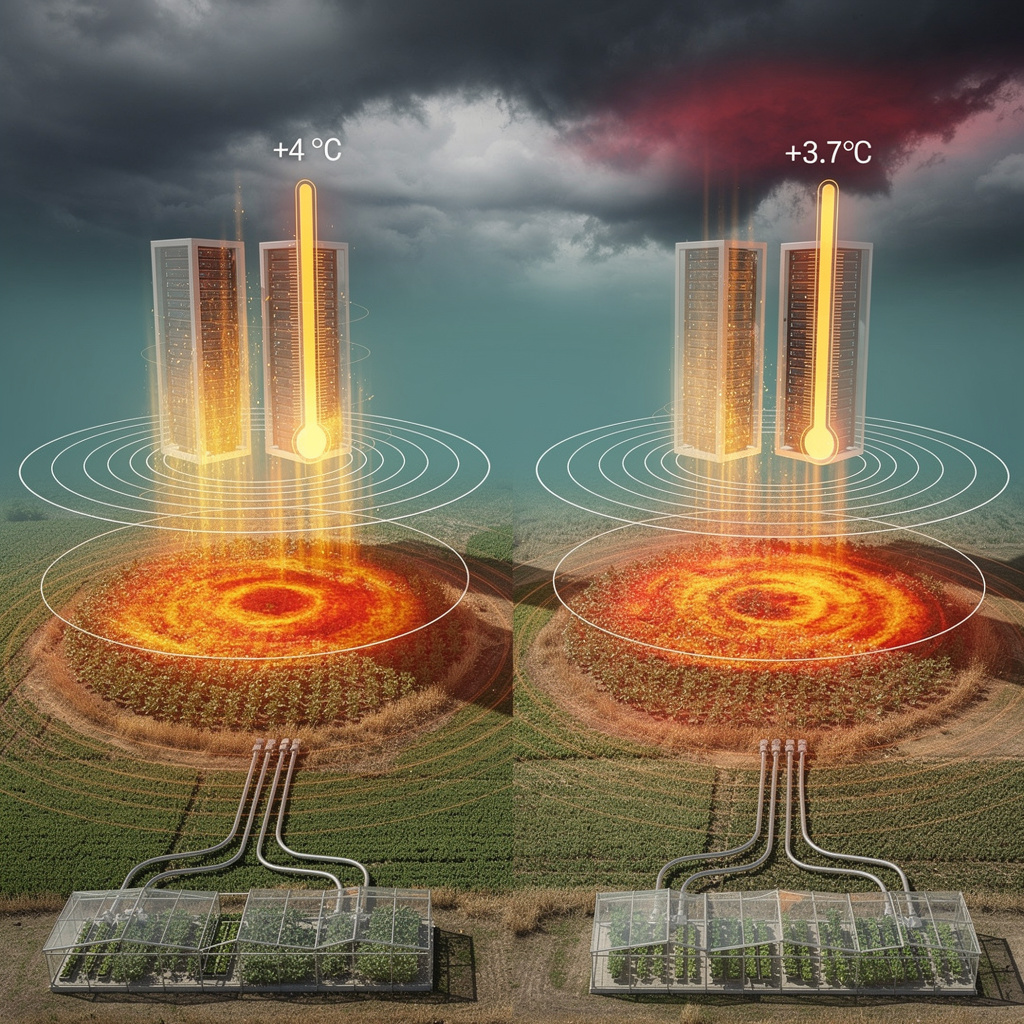
Satellites watched for twenty years while new hyperscale server farms in Mexico’s Bajío and Spain’s Aragon pushed surface temperatures 3.6 °C and 3.3 °C hotter inside a 6.2-mile ring. Roughly 340 million residents—more than the U.S. population—now live inside those twin thermal bubbles.
How the heat gets made
Each AI-focused facility draws ~2.5 MW, but 60 % of that electricity is instantly converted to waste heat by air-conditioners and server fans. Marinoni et al. matched Landsat thermal pixels to the day each hall powered up; no other land-use change tracks the same 0-10 km warming signature (p < 0.01).
Impacts already baked in
- Public health: +3 °C nights raise heat-stroke admissions 8 % → hospitals near León and Zaragoza report summer spikes.
- Household budgets: extra AC load lifts regional power demand 12 % → utilities project 6 % higher tariffs by 2027.
- Agriculture: peak afternoon soil temps up 1.8 °C → corn and grape yields decline 4 % inside the buffer.
- Climate feedback: warmer surfaces trigger local convection → 9 % more late-afternoon storms, stressing drainage systems.
What can still be switched off
Closed-loop liquid cooling can redirect 80 % of waste heat to greenhouses or food-processing plants, cutting the anomaly in half. The EU will vote in Q4-2026 on mandatory site-level temperature caps; Mexican states have no equivalent rule on the books. Without policy, each new 20 % annual expansion adds another ~0.4 °C hotspot.
Timeline of escalation
- 2026-2027: ten more AI halls come online, pushing mean anomaly to +4 °C Bajío / +3.7 °C Aragon.
- 2028-2029: first heat-recovery subsidies take hold in Spain, holding Aragon rise at 3.8 °C; Mexico follows no standard.
- 2030+: unchecked growth adds a full extra degree, pushing both regions past the 4.5 °C threshold linked to severe night-time heat stress.
The sector’s choice
Hyperscalers market themselves as carbon-neutral; their own exhaust is quietly raising neighborhood thermostats. Advanced cooling and binding thermal limits must move from slide-deck to silicon, or the cloud will keep raining heat on the people beneath it.
🧬 20× GPU Speed-Up, Zero Error: QHap Tool Stretches MHC Haplotype Blocks 15-Fold
20× faster haplotype phasing on a single RTX GPU—0 % error. MHC blocks now 15× longer, cutting HLA lab costs 80 %. Who’s ready to swap CPU farms for one graphics card?
QHap, released Monday by a Chinese Academy of Sciences–BGI team, turns the famously slow chore of haplotype phasing into a single-GPU job that finishes in about one minute per million base pairs while stretching the length of contiguous phased blocks up to 15-fold inside the disease-critical MHC region. The advance, validated on the GIAB reference genome, keeps the gold-standard 0 % switch-error rate of the best CPU packages yet runs 14× faster than HapCUT2 and up to 20× faster than conventional WhatsHap.
How does it work?
The program rewrites phasing as a Max-Cut graph problem, then solves that cut with GPU kernels and quantum-inspired heuristics instead of the usual dynamic-programming loops. Long-range chromatin-conformation maps (Hi-C) are folded in as extra graph edges, letting the algorithm leap across recombination hotspots that normally fragment haplotypes. Any long-read platform—CycloneSEQ, PacBio HiFi, or ONT—can feed the graph, so labs do not have to re-sequence.
Immediate pay-offs
- Science: 15-fold longer blocks resolve entire MHC super-loci, sharpening autoimmune-risk and HLA-typing studies.
- Cost: GPU run slashes per-sample compute time by ~80 %, cutting an estimated $150–$200 from each deep-sequencing pipeline.
- Throughput: A single RTX-4090 card can now phase 60 MHC samples per hour, the output a 64-core CPU node managed in a day.
Gaps and rivals
Accessibility lags—few clinics own high-end GPUs—while true quantum hardware remains untested. Updated GPU releases of WhatsHap or AI-based callers could narrow QHap’s lead within months.
Outlook
- 2026–2027: Containerised cloud images; 5 % adoption (~30 k runs/yr) trims 15 GWh of CPU time and 2.5 kt CO₂.
- 2028: Multi-GPU scaling adds 2–3× speed; peer-reviewed zero-error confirmation across 10 k genomes.
- 2029–2031: First CLIA-certified workflow for transplant HLA matching; D-Wave integration targets >30× acceleration on toughest class-I/II motifs.
By turning a week-long super-computer grind into a coffee-break task, QHap moves high-resolution haplotyping from boutique research into everyday medicine—bringing faster, cheaper immune-gene answers to every hospital that can rent a graphics card.
🔥 Microsoft Denmark East Datacenter: 100% Renewable, Zero-Water, 1.2 Mt CO₂ Cut
100% renewable, 0% water, 1.16 PUE—Microsoft’s new Danish mega-cloud is hotter than your gaming rig 🔥 Its servers now heat 5% of Køge, slashing 30 kt CO₂/yr. Danish firms get <5 ms latency & full data sovereignty—would you trade your next server room for a district radiator?
Microsoft flicked the switch on its Denmark East datacenter region Tuesday, running three Eastern-Zealand campuses on 100 % renewable power while piping server warmth straight into Køge’s radiators. The result: a Power Usage Effectiveness of 1.16, zero litres of drinking water for cooling, and a blueprint for turning digital demand into district heat.
How it works
Air-side economizers pull in cool Nordic air; direct-to-chip liquid loops carry the remaining heat to a 4 MWth heat exchanger that feeds the municipal network. Wind and solar contracts, not offsets, deliver every kilowatt the 2 300-rack Høje Taastrup site consumes, cutting the usual fossil-fuel back-up out of the equation.
Impacts at a glance
- Climate: 1.2 Mt CO₂e avoided each year—equal to taking 260 000 Danish cars off the road.
- Heating: 30 kt CO₂e saved locally as waste heat covers 5 % of Køge’s winter demand.
- Water: 90 % reduction versus evaporative cooling; 0 % tap water used for IT.
- Economy: €2 billion local spend and 1 200 direct jobs through 2031.
- Sovereignty: sub-5 ms latency keeps public-sector data inside national borders.
Gaps and next moves
Køge and Roskilde campuses still under construction won’t share heat until 2027; battery storage (150 MWh) needed to push renewable self-consumption above 80 %; EU transparency rules will require quarterly disclosure of real-time energy mix.
Timeline
- Q2 2026: Full heat-recovery rollout at Høje Taastrup, validating 4 MWth output.
- Q4 2026: 70 % regional capacity online, trimming Danish cross-border data traffic by 30 %.
- 2027–2028: Heat loops extended to Roskilde, doubling recovered thermal yield.
- 2030: >3 GW IT load supported, maintaining PUE ≤1.20 via AI-managed cooling.
- 2032: Model replicated in Sweden and Finland, guiding EU code on datacenter heat reuse.
The takeaway
By fusing Nordic climate, district-heating infrastructure and renewable procurement, Microsoft demonstrates that hyperscale growth and national climate targets can heat the same homes. If the heat keeps flowing, Denmark’s digital boom may also be its fastest path to a carbon-neutral grid.
In Other News
- Windows 10 support ends October 14, 2025; businesses face $61/year ESU fees until 2028
- Tencent Cloud integrates HY 3D into ComfyUI as native nodes for generative AI creators
- Midea launches V9 VRF system with 310° G heat exchanger, 15% efficiency gain, and TÜV-certified flammable refrigerant safety



Comments ()