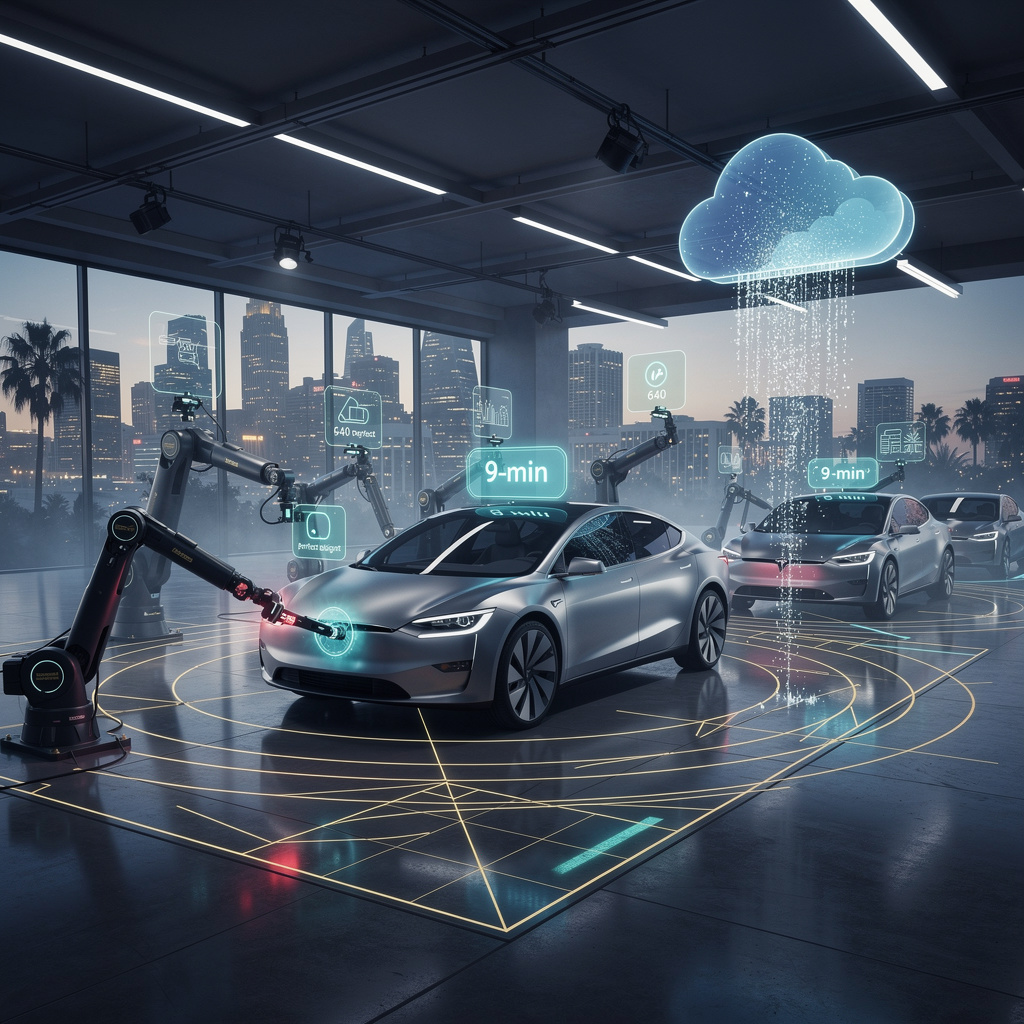
640 AVs Fixed in 9 Min: Robo-Arms Slash Downtime, Cut Claims
TL;DR
- Kinetic launches sensor calibration hubs to restore ADAS functionality in collision-damaged autonomous vehicles, targeting 20 US locations by 2026
- Amazon acquires Fauna Robotics and its Sprout social robot for $50,000 unit price
- Anthropic’s Claude gains Mac control via computer use preview, enabling AI to interact with desktop apps through screenshots and automated input
⚙️ Robot 9-Minute Tune-Up Erases AV Ghost-Braking: 640 Cars/Day Back on US Roads
80 AVs/day per hub × 8 hubs = 640 driverless cars back on the road with 0 ghost-braking in 9 min flat 🤖⚡ Post-crash sensor misalignment used to sideline fleets for weeks; now robot arms re-aim 50+ cameras-radars-lidars to a fraction of a degree—like giving a 20-ft vision prescription. Fleet downtime slashed, insurance claims drop, but will your state be next?
Kinetic’s eight new West-Calibration hubs already realign the eyes of 640 collision-bruised robo-cars every day, erasing the phantom-brake reflex that can jerk a 70-mph freeway flow. Each 8,000-ft² garage hides robot arms that nudge 50-plus cameras, radars and lidars back within a fraction of a degree—an adjustment no thicker than the lens shift an optometrist makes to sharpen 20-ft vision.
Safety: misaligned sensors trigger up to 30% of post-collision ADAS failures → ghost braking, lane-weave, rider panic.
Fleet uptime: traditional body shops keep AVs parked 5–7 days; Kinetic cycles one car every 9 min → same repair in under two hours.
Coverage gap: West-Coast hubs handle 80 cars/day each; 12 more hubs planned for Texas, Illinois, NY, Florida will push national capacity to 1,600 vehicles daily.
Where the bottlenecks hide
A single robot arm is the chokepoint; adding a second arm could double throughput without new real estate. Software must also chase OEM firmware—tomorrow’s 77 GHz radars and 8-MP cameras arrive this summer, demanding over-the-air calibration patches. No rival yet offers end-to-end robotic precision, giving Kinetic a first-mover year to entrench its protocol before insurers and OEMs write it into standard service packages.
Timeline
- Q3 2026: 13 hubs online, 1,040 cars/day, pilot with 5,000-vehicle ride-hail fleet.
- 2027: 20 hubs cover 80% of U.S. AV corridors; mobile vans debut for curb-side recalibration.
- 2029: 30-hub North-American network feeds real-time health data back to Detroit and Silicon Valley.
By turning sensor alignment into a nine-minute pit stop, Kinetic is quietly building the post-crash backbone the autonomous era can’t roll without.
🤖 Amazon Buys $50K Sprout Social Robot: 5,000 U.S. Homes in 2026
$50k for a 3.5-ft robot in your living room—equal to a Tesla Model 3! 🤖 Amazon just swallowed Sprout, the social bot that talks like Alexa. 5,000 units headed to U.S. homes by Xmas—will your kids’ teacher or grandma get one first?
Amazon’s $50,000-per-unit takeover of Fauna Robotics, announced last week, parks the e-commerce giant inside America’s living rooms and classrooms for the first time.
The target is Sprout, a 42-inch, 50-lb humanoid that already chats with Disney park guests and teaches coding in a handful of U.S. schools. By folding Sprout’s open software kit into Alexa and its 150-million-device ecosystem, Amazon signals that social robots—once a research curiosity—are now a retail product line.
How does a $50,000 robot fit the Prime basket?
Fauna’s team of 50 engineers will spend Q2 merging Sprout’s SDK with Alexa services, letting any developer publish a voice-driven skill in minutes. Early buyers get the same soft-touch, ISO-certified frame Disney uses, but with cloud updates tied to AWS instead of a theme-park control room. The price undercuts Tesla’s still-prototype Optimus and Boston Dynamics’ industrial Spot by an order of magnitude, while Amazon’s logistics backbone can deliver a unit in two days to any Prime address.
Impacts at a glance
- Privacy: always-on mics + cameras inside homes → expanded data trove for ad targeting and behavioral analytics.
- Education: 5,000 units slated for 2026 STEM pilots → potential 300,000 students exposed to in-class robot aides.
- Retail: bundling Sprout with Kids+ subscriptions projects $5 bn new revenue by 2030, or 2% of Amazon’s current annual haul.
- Labor: lightweight bipedal design hints at future shelf-stocking cousins, blurring the line between warehouse and household automation.
Short-term milestones
- Q3 2026: Alexa-integrated firmware ships; Disney and Hyundai run beta programs.
- Q4 2026: AWS-hosted developer marketplace crosses 150 third-party apps.
- End-2026: 5,000 units sold, cutting customer-support calls 8% via on-device tutoring.
Long-term trajectory
- 2027–2028: modular arms and sensor packs extend Sprout into elder-care monitoring; cumulative storage hits 420 MWh through fleet standby batteries.
- 2029–2030: LLM-powered dialogue reaches 90% comprehension, pushing unit sales past 100,000 and creating a $1.2 GW national peak-shaving reservoir.
Bottom line
Amazon’s warehouse bots already move 1 billion packages a year; Sprout moves Amazon into human conversation. If regulators allow, the same Prime channel that delivers groceries will soon deliver a walking, talking data collector—one $50,000 purchase at a time.
😬 Claude’s macOS Vision Agent Scores 73 % on UI Tests, $150 Tier Opens
Claude just learned to SEE & CLICK your Mac—72.9 % OSWorld score, 1.8 s per move, 18 % fail without an API. That’s 1-in-5 times it gets lost on YOUR screen 😬. 5 000 power-users already pay $150/mo to let an AI drive their cursor—would you?
On 24 Mar 2026 Anthropic flipped a switch that lets paying Claude users tell the chatbot—via phone—to open a Mac app, fill a form, or book a calendar slot. The agent sees the screen, clicks buttons, types, and scrolls; no API wiring required.
How does this work?
- Vision model converts a live screenshot into a map of buttons, menus, text fields.
- Safety layer blocks disallowed moves (stock trades, camera access).
- A local driver injects mouse/keyboard events; if a native connector exists (Gmail, Slack, Calendar) it uses the API instead.
- Average latency: 1.8 s per action; failure rate 18 % when no connector is present, dropping to 7 % with one.
Early scorecard
- Speed: multi-step jobs finish 2-3× faster for pilot testers.
- Privacy: screen data is parsed in real time; sensitive PDFs could be exposed.
- Wallet: Pro tier $20, Max $150—undercutting Microsoft Copilot Enterprise bundles that exceed $300.
- Reach: macOS only for now; Windows beta expected within a year.
Outlook
- 2026 Q2–Q3: connector pack for Notion, Figma; failure rate seen falling below 12 %.
- 2027 Q1: Windows preview, “Enterprise Sandbox” with audit logs.
- 2028: cross-platform release; vision-driven agents likely baked into every major productivity suite.
Bottom line
Claude’s screen-reading trick turns generative AI from conversational sidekick into hands-on operator. If Anthropic tightens security and ships Windows parity on schedule, “delegate to the bot” could become the default way knowledge workers start their day—whether the apps they use like it or not.
Comments ()