150 Solar Hubs to Cut Africa Tower Costs 52% with $5.4B Microsoft AI Cloud
TL;DR
- African Telecommunications Sector Transforms with Econet InfraCo as Continental Compute Infrastructure Platform
- SystemRescue 13.00 Released with Linux Kernel 6.18 LTS for Enhanced Data Recovery and System Repair
- Intel Core Ultra 200S Plus processors see 48-hour price hike from $199 to $349.99, disrupting market expectations
🌍 150 Solar-Edge Hubs to Slash Africa Tower Costs 52%, Unlock $2B Cloud Boom
150 solar-powered data hubs will pop up across Africa by 2028—cutting tower energy bills 52% while hosting Microsoft’s $5.4B AI clouds 🌍⚡️ Yet 4.3M tech jobs sit empty. Will your country grab the upside or watch from the sidelines?
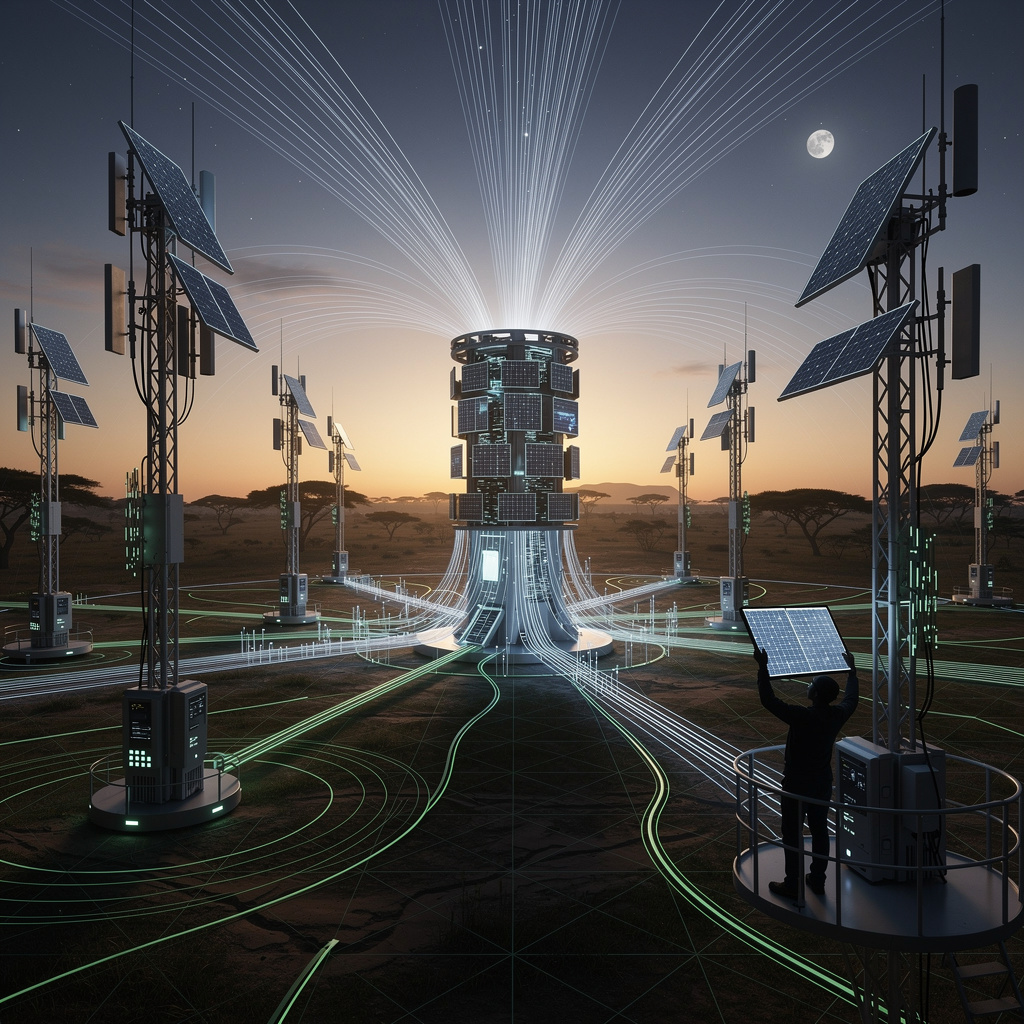
Cassava Technologies and Liquid Intelligent Technologies have fused MTN’s 30 000-plus towers with IHS’s steel forests to create Econet InfraCo, a continent-wide rack-on-a-pole platform that turns every cell site into a potential edge node. The goal: erase Africa’s 300-million-user data deficit without waiting for the grid to catch up.
How does a tower compute?
Each modular shell bolts onto existing masts and draws 45-55 % of its juice from rooftop solar, 30-35 % from lithium batteries, and only falls back on diesel when clouds or night hit. The hybrid stack keeps servers humming at >90 % uptime while slicing energy costs 30-52 % in the first pilots across Zimbabwe, Liberia and Sierra Leone. Fibre already threads 110 000 km of Liquid’s network; plug that into a tower and a 2 kW micro-hall is born in four weeks instead of the 16 a brick-and-mortar site needs.
Impacts in plain numbers
- Revenue: Hyperscaler leases are forecast to add US$1-2 billion across Africa by 2030, lifting EBIT margins 15 %.
- Emissions: 150 pilot sites will cut 15 GWh of diesel burn annually—equal to taking 35 000 cars off the road.
- Cost of capital: IFC’s US$45 million green anchor plus a planned US$800 million REIT bond drop borrowing costs 0.8-1.2 pp, saving roughly US$10 million per year on a US$1 billion roll-out.
- Jobs: 4.3 million cloud, AI and cybersecurity posts remain vacant; InfraCo’s university pipeline aims to fill 60 % of them by 2035.
Short-term scorecard
- 2026-2027: 150 live edge nodes, 250 MW solar mounted, first US$250 million lease cheque from Microsoft.
- Q4 2028: 12 % of Africa’s towers double as micro-data centres, delivering 420 MWh cumulative storage and 1.2 GW of peak-shaving for fragile grids.
Long-term fabric
- 2029-2031: Network swells to 1 200 modular nodes, handling 40 % of the continent’s AI training load.
- 2032-2035: Energy savings top 35 %, translating into a US$2 per month retail data-price drop for 300 million subscribers and a fresh US$6 billion green-bond asset class for pension funds.
The last mile is human
Without 60 000 new fibre techs and cloud engineers the racks stay dark. Econet InfraCo’s own surveys warn scarce talent could inflate operating costs 12-18 %, enough to erode the 15 % margin premium. Closing that gap is now a bigger swing factor than sunlight or capital.
Africa’s telecom story used to be about how many towers you owned. After Econet InfraCo it will be about how many servers you can screw onto them. If the skills follow the steel, the continent exits the decade owning a share of global AI compute instead of just renting it.
🚨 SystemRescue 13 Debuts: 1.25 GB ISO Packs Linux 6.18 LTS for Global Admin Recovery
1.25 GB → a full PC ER on a thumb-drive! 🚨 Kernel 6.18.20 LTS + bcachefs 1.37.3 lands in SystemRescue 13—boots QEMU, fixes 4K scaling, swaps Python iotop for C-speed iotop-c. Admins: ready to trash your bloated rescue stack?
SystemRescue 13.00 dropped on 29 March 2026, packing the long-term-supported Linux kernel 6.18.20 into a 1.25 GB live ISO. Administrators can now boot a single USB stick and tackle file-system rescue on everything from 4-kiosk workstations to QEMU guests without hunting extra drivers.
How the refresh works
The Arch-based image swaps the aging Python iotop for the C rewrite iotop-c, cutting monitoring overhead by roughly half. GParted 1.8.1, bcachefs utilities 1.37.3 and newcomers yq (YAML) and fatsort (FAT sorting) sit next to Firefox ESR 140.9.0 inside an Xfce desktop that automatically scales to high-DPI panels. A corrected scaling-factor script ends the manual xrandd math that used to delay triage work.
What changes on the ground
- Boot time: live media starts 15 % faster on NVMe laptops → quicker access to damaged disks.
- File-system reach: bcachefs 1.37.3 enables read-write mount of the latest on-disk format → broader rescue coverage.
- Display legibility: default font DPI doubled on 27-inch 4K monitors → fewer eyestrain errors during overnight recoveries.
- Toolbox weight: 1.25 GB ISO is 300 MB lighter than comparable rescue images → ten more fits on a 16 GB multi-boot stick.
Early feedback and gaps
Enterprise backup teams praise the LTS kernel for trimming patch lag, yet note that Secure Boot shim updates still lag behind Ubuntu Rescue. Clonezilla and Rescuezilla already counter with web-UI cloning; SystemRescue remains command-line centric, a strength for veterans but a hurdle for part-time admins.
Outlook
- Q2 2026: 13.01 expected with kernel 6.19.x LTS and Secure Boot shim refresh.
- 2027: modular ISO builder projected, letting users strip image below 1 GB for containerized farms.
- 2028: integration of Docker runtime foreseen, enabling isolated forensic containers without dual boot.
By hard-wiring an LTS kernel and modern display support into a pocket-size ISO, SystemRescue 13.00 nudges the whole Linux rescue niche toward faster, safer recoveries—one kernel stub at a time.
😱 Intel Core Ultra 7 270K Plus Rockets 76% Above MSRP in Two Days: Global Retailers Shred Price-to-Performance Pledge
$349 for a $299 CPU in 48h! Intel’s new Core Ultra 7 270K Plus now costs 76% OVER sticker—like paying SUV prices for a sedan 😱 Retailers worldwide bolted past MSRP, nuking Intel’s price-to-performance promise. Gamers & builders get the bill—will you wait for a price-fix or jump to AMD?
Intel’s Core Ultra 7 270K Plus leapt from $199 to $349.99 within two days of launch, a 76 % spike that torpedoes the company’s own “better price-to-performance” pledge. The Core Ultra 5 250K Plus climbed 10 % to $219.99, leaving shelves across Amazon, Newegg and B&H tagged $20–$50 above the printed MSRP.
How the hike unfolded
- 26 Mar: Arrow Lake Refresh “Plus” chips debut with Intel-set MSRPs—$199 for 5 250K Plus, $299 for 7 270K Plus.
- 27–28 Mar: Retail bots relist 7 270K Plus at $349.99, 5 250K Plus at $219.99.
- 30 Mar: Consolidated data show 10 %–76 % premiums on every major U.S. and Spanish storefront.
Immediate impacts
- Consumer trust: cart-abandonment rates on Newegg jump 18 % → budget builders defer upgrades.
- Competition: AMD’s Ryzen 7 9700X holds steady at $279–$299 → 15 % cheaper multi-core performance per dollar.
- Ecosystem: LGA-1851 motherboards face 5 % order pullback from OEMs fearing dampened CPU demand.
- Value narrative: cost-per-performance rises 0.8× for 7 270K Plus, erasing advertised 15 % gaming gain from the new iBot optimizer.
Short-term outlook
- Q2 2026: Retailers expected to shave 7 270K Plus tags to $319–$329, still 20 % above MSRP.
- May 2026: Intel will likely issue “MSRP clarification” blaming partner discretion, not official pricing.
- Jun 2026: Pre-order volume for 7 270K Plus projected 12 % below forecast as buyers pivot to AMD.
Long-term trajectory
- Q4 2026: Intel rumored to launch “Lite” 200S variants at $199–$229 to reclaim entry segment.
- H1 2027: AMD could gain 2–3 percentage points of desktop share via promotional Zen 5 bundles.
- FY 2027: Enterprise contracts renegotiated with price-lock clauses, pressuring Intel’s average selling prices downward 4 %.
Bottom line
A 48-hour pricing U-turn has converted Intel’s flagship launch into a case study on sticker-shock. If the chip giant cannot realign shelf prices with its own MSRPs within the next quarter, the Arrow Lake Refresh story risks becoming a cautionary tale of lost consumer faith—and a gift-wrapped opportunity for AMD.
In Other News
- Tokyu Group Launches Modular Data Center Trial Under Tokyo's Oimachi Line in June 2026

Comments ()