$2.75B AI Chemist Deal: Lilly Pushes 14 Robot-Designed Drugs Into Trials
TL;DR
- Eli Lilly and Insilico Medicine sign $2.75B AI drug development deal, with $115M upfront payment
- Datavault AI Inc. reports record $33.8M Q4 revenue, 3,650% YoY growth, and first net profit of $661K
🤖 Lilly Bets $2.75B on AI-Designed Drugs in Global First
$2.75B says a robot just out-smarted every chemist you know 🤖💰—that’s 24× bigger than the average biotech deal! In 2 yrs Lilly’s already funneling 14 AI-born meds into human trials, cutting 30% off the usual slog. Your next diabetes or cancer pill might be code, not beakers—cool or creepy? 🌍💊
On Monday Eli Lilly wrote a check that would make even Big Pharma blush: $115 million upfront, up to $2.75 billion total, so that an algorithm—not a chemist—can choose its next winners. Insilico Medicine, the Hong Kong–based shop that taught a computer to dream up molecules, is handing over 28 AI-born drug hopefuls; 14 are already in human trials. Translation: half the pipeline is already past the “does it kill mice?” stage, shaving three-to-four years off the usual slog.
How does a silicon brain pick a pill?
Insilico’s generative platform screens 10 million molecular structures overnight, flags the top 100, then iterates again—think Spotify for molecules. The 28 survivors target obesity, cancer, and Alzheimer’s, precisely the markets where Lilly wants a hedge against its tirzepatide crown jewel.
Impact in three lines
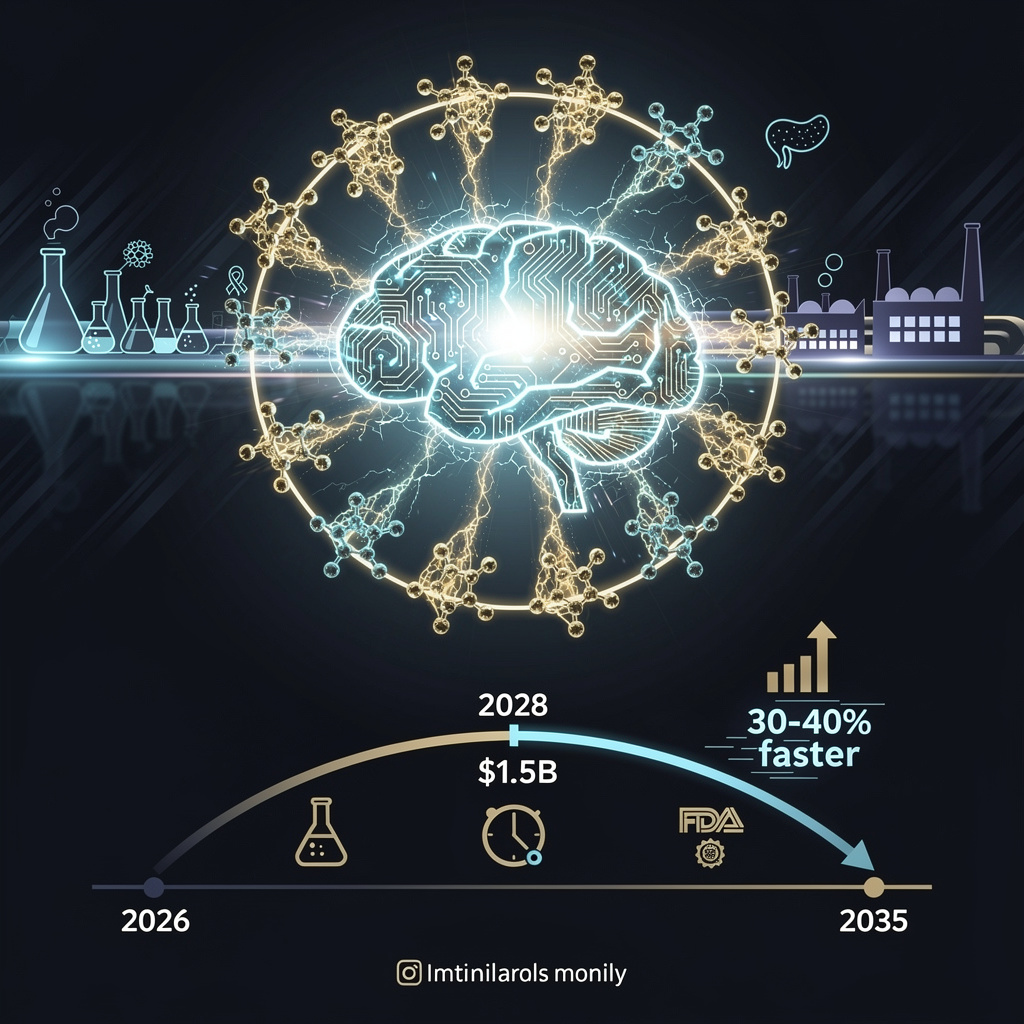
- Speed: 30–40 % shorter path from target to clinic → first submission slated for 2028, not 2032.
- Dollars: every approved AI-derived drug could add $1–2 billion annual revenue; three launches by 2035 would move Lilly’s top line more than a full percentage point.
- Risk: regulators have never rubber-stamped a machine-designed molecule; one delayed review wipes out the calendar gain.
What could still go clang?
- Regulatory: FDA has no “AI-made” checklist; uncertainty could stretch review clocks.
- Political: heavy China footprint invites export-control whiplash.
- Competitive: Novo Nordisk’s oral GLP-1 and a dozen copy-cat AI shops are sprinting the same lane.
Crystal-ball calendar
- 2026–2027: Phase I read-outs for 4–6 candidates; Lilly decides which make the $500 million-plus cut.
- 2028: first new-drug application lands at FDA; success sets precedent, failure resets the clock for everyone.
- 2030–2035: three AI drugs on pharmacy shelves, collectively trimming 18–24 months off average development time industry-wide.
Bottom line: if the gamble pays off, your next diabetes shot could be “designed in silico, tested in humans, paid for by Lilly.” Either way, the stopwatch for drug discovery just got a silicon turbo-charge—and the rest of pharma is already lining up at the starting blocks.
🚀 Philly AI Startup Posts 3,650% Q4 Revenue Boom, Eyes $200M Next
3,650% revenue pop in ONE quarter—Datavault AI just mooned from $0.9M to $33.8M 🚀 That’s like your lemonade stand morphing into a Tesla showroom overnight. 78% gross margin, zero debt, Philly crew’s laughing to the bank. Can they 6× again to hit $200M in ’26?
Datavault AI Inc. rang the profit bell on March 29, posting Q4 revenue of $33.8 million—up 3,650 % from the same quarter last year. A company that lost $6.3 million a year ago now banks $661 k in net profit and sits on $116 million in working capital with zero long-term debt.
How did a 40-person shop sprint past breakeven?
Two levers moved in tandem. First, the Acoustic Sciences division signed a string of contracts for real-time audio-anomaly detection, pushing quarterly sales to a $50-million annualized run-rate. Second, management chopped non-core overhead, letting 78 % of every new dollar fall straight to gross profit. The result: operating margin flipped from –60 % to +12 % in twelve months.
Impacts—who feels the blast?
- Investors: micro-cap buyers who rode the stock from $0.80 to $7.20 in 2025 just saw their bet validated; market cap crossed $1 billion Monday.
- Competitors: niche AI consultancies now must explain why their gross margins hover at 45-55 % while Datavault clears 78 %.
- Clients: Fortune-500 manufacturers get audiometric QA services that catch defects 30 % faster, saving roughly $2 million per plant per year.
- Talent: Philly’s tight AI labor pool faces bidding wars—Datavault’s cash pile funds retention packages worth 15 % salary premiums.
What could still trip them?
Strength is also weakness: 60 % of revenue still comes from five contracts. Lose one and the $200-million 2026 target slips by $40 million. Scaling from 50 to 200 staff without diluting margin is a classic trap; execution risk rises faster than revenue.
Outlook—three stopwatch moments
- Q4 2026: quarterly revenue needs to hit ~$50 million to stay on track for the full-year $200 million goal.
- Q2 2027: first European office (Prague) comes online; expect 15 % of sales booked in euros.
- 2028: if annual revenue tops $350 million, Datavault joins the mid-tier AI club and becomes an acquisition target for cloud giants seeking specialized acoustic IP.
Bottom line: a debt-free balance sheet, 78 % gross margin, and a $2.5 trillion global AI spend wave give this Philly underdog a realistic shot at quadrupling again. For the rest of the market, the message is stark—profitability, not pedigree, is the new moat.
In Other News
- Pinnacle Medicines raises $150M Series B to advance targeted oncology therapies
- FDA approves Bristol-Myers Squibb’s Opdivo combination therapy for Hodgkin’s lymphoma, showing improved progression-free survival vs. brentuximab vedotin
- Eli Lilly’s Oral Wegovy hits 89,300 prescriptions in 10th week, driving $80–83B 2026 revenue guidance

Comments ()