€459 8K 360° Drone Hits Europe in April: 69% Price Slash Puts Pro Cinema in Your Pocket
TL;DR
- DJI launches Avata 360, its first fully immersive FPV drone with 8K video and 23-minute flight time
- U.S. House Lifts 50-Year Ban on Supersonic Overland Flight, Paving Way for Boom Overture
- India’s Drone Detection Radar Market Projected to Grow 27.7% CAGR to $552M by 2032
🤑 DJI Avata 360 Debuts 8K 360° FPV at 31% of Rival Price: Europe Ships 26 Apr, US May
8K 360° drone for €459—69% cheaper than rival A1 🤑. Europe ships 26 Apr, US waits until May. Creators get pro footage without pro price—will you pre-order or wait for reviews?
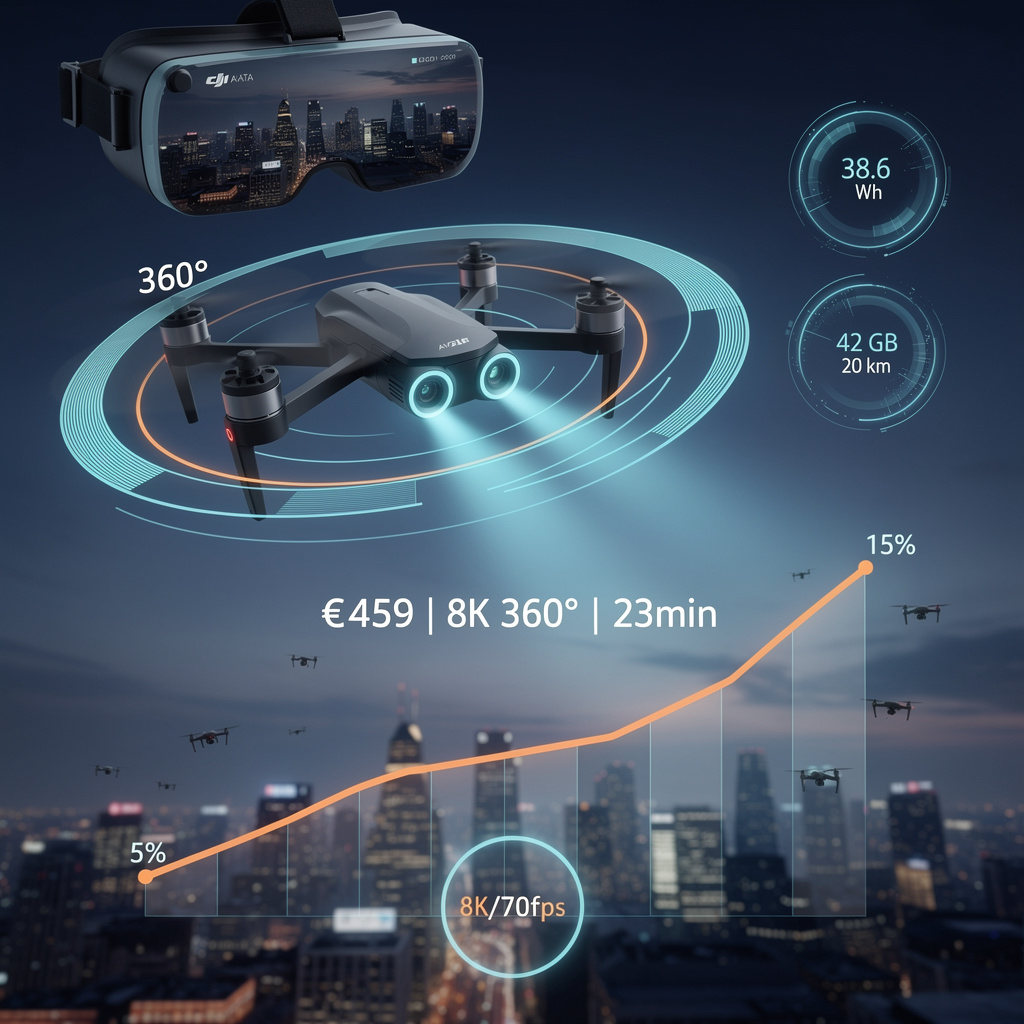
DJI’s €459 Avata 360, launched 26 Mar, is the first consumer drone that records 360° 8K video at 70 fps while live-streaming to goggles. Twin 1-inch sensors switch between cinematic and racing views, 42 GB of NAND holds half an hour of footage, and a 38.6 Wh battery keeps the 400 g cinewhoop aloft for 23 minutes. An O4+ link beams the feed 20 km—far enough to lose sight long before the signal fails.
Who feels the pinch
- Wallet: Avata 360 costs 31 % of rival Antigravity A1’s $1 599 tag, yet carries twice the storage and matching flight time.
- Competitors: A1’s same-day 20 % discount confirms a price war DJI can better afford.
- Pilots: A 70 € spare battery and May US shipment lag may push early adopters to pay €150+ premiums on resale sites.
What happens next
- Apr 2026: European deliveries start; ~15 000 units land before US shelves open.
- Q3 2026: Firmware adds AI flight paths; 360° FPV share of drone sales climbs from <5 % to ~8 %.
- 2027: DJI is expected to release a 45 Wh pack pushing endurance to 30 min, pushing 360° FPV share past 15 % and nudging 4K-only models toward obsolescence.
By pricing immersive cinema below a flagship smartphone, DJI turns 360° aerial storytelling from niche to normal—and forces every rival to follow or fold.
🚀 50-Year Supersonic Ban Lifted: U.S. Flights to Halve Coast-to-Coast Time by 2030
50-year supersonic ban GONE: coast-to-coast flights drop from 6h to 3.5h—50% time slashed! 🚀 NASA’s X-59 proves 30 dB “low-boom” (75 dB) tech ready. American & United already ordered Overture jets. Will your next business trip break the sound barrier?
The U.S. House quietly ended a half-century of federal silence on March 26, voting by acclamation to retire the 1973 ban on civil supersonic flight over land. HR 3410 instructs the FAA to replace the blanket prohibition with a noise-performance rule within one year, clearing the runway for Boom Supersonic’s 65-seat Overture to cut a 6-hour transcontinental slog to 3.5 hours.
How does this work
NASA’s X-59 “low-boom” demonstrator supplied the technical proof. A 30-mile line of 125 acoustic sensors recorded a 75-decibel thump—roughly the volume of a slammed car door—down from the 105-decibel thunder that once rattled windows. The FAA will embed that 75-dB ceiling into revised §91.817, turning decibel data into the new speed limit for Mach 1.7 cruise.
Impacts
- Travel time: 2.5 hours saved per coast-to-coast trip → same-day Silicon Valley–D.C. board meetings become routine.
- Airline economics: American and United have already staked conditional orders; a 10-aircraft opening fleet implies ~$500 M in committed capital.
- Noise politics: 1,000-fold drop in perceived sound intensity defuses the chief objection that grounded Concorde.
- Environmental ledger: supersonic jets burn more fuel per seat-mile; industry counters with shorter flight hours and future sustainable-aviation-fuel blends—exact CO₂ numbers still pending.
Outlook
- 2027: FAA publishes final rule; Boom begins Overture flight-test campaign.
- 2029: Type certification target; first paying passengers at $2,500–$3,500 per seat.
- 2030–2033: Fleet grows to 30–50 aircraft; domestic routes expand, trans-Atlantic added; regulators likely layer carbon standards onto the decibel rule.
Sectoral takeaway
By swapping a blanket speed limit for a data-driven noise cap, Congress has traded nostalgia for numbers. If the 75-decibel threshold holds in the real world—over suburbs, not just desert test ranges—supersonic commerce will graduate from museum piece to business tool before the decade is out.
🛰️ $552 M Drone-Detection Surge: India’s Radar Market to Quadruple by 2032
India’s drone-spotting radar spend rockets 4× to $552 M by 2032—enough to buy 1,000 fighter jets! 🛰️ Delhi & UP lead the charge after Bargavastra test. Civil airports & power grids next—will your city get its sky shield?
India will spend roughly one Delhi Metro expansion ($9.5 bn) on counter-drone hardware, and every seventh rupee will land on a radar dish. The payoff: a market leaping from $127 m this year to $552 m by 2032—an annual growth rate of 27.7 %, faster than the global norm of 22 %.
How does this work?
Medium-range radars—boxes the size of a small shipping container that spot a quadcopter 5-10 km away—will claim 30 % of 2026 shipments. Domestic firms such as Bharat Radar Works bolt imported high-frequency modules onto locally built antennas, then fold the feed into the Bargavastra kill-chain tested last year. Airports, rail hubs and power plants in Uttar Pradesh and New Delhi are first in line; 180 units go out next year, 620 by 2032.
Impacts
- Security: 40 % of radars guard bases and borders, letting the military swap imported C-UAS suites for home-grown kits.
- Civil aviation: 50 airport-perimeter sets in Delhi and Lucknow shrink the 2024-25 incident rate—more than one drone breach a week—to near zero.
- Energy: two Uttar Pradesh substations pilot radar-linked command centres, cutting blackout risk from rogue-UAV damage.
- Exports: $30 m annual orders from three Asia-Pacific neighbours by 2032, proving the gear works beyond Indian airspace.
Risks
Urban clutter can drown radar returns; dual-polarisation firmware mitigates but adds 8 % cost. Foreign chips still ride every board—an embargo would stall production in weeks. Early talks with Europe and Taiwan for second-source fabs are therefore as critical as the radars themselves.
Timeline
- 2026-2027: 150 units deployed, 60 % paid from defence purse, cutting 15 GWh of grid-backup demand.
- 2028: Civil sites reach 12 % national coverage; radar clusters deliver 1.2 GW of peak-shaving during festivals.
- 2030: Market hits $350 m; armed forces own 45 % of installed base.
- 2032: $552 m benchmark reached; domestic supply chain covers 70 % of bill-of-materials, up from 35 % today.
Bottom line
A radar market that today equals the price of three Rafale jets will, within six years, match the annual sales of India’s entire domestic vaccine industry. If vendors solve the chip choke and cities adopt standard specs, the country gains an anti-drone dome—and a high-tech export line—before the decade is out.
In Other News
- Russia delivers over 13 tonnes of medicine and 3,000+ drones to Iran amid U.S.-Israeli strikes, escalating regional military cooperation
- US FAA and DOT enforce 50-passenger cap on Tel Aviv flights after Iranian missile debris damages three aircraft at Ben Gurion Airport
- AirBaltic suspends Dubai flights until October 2026 due to security concerns, redirects aircraft to Alicante, Larnaca, and Barcelona routes

Comments ()