195M Mexico Tax Files Leaked in 29 Min as AI Chips Promise $200M Cloud Savings
TL;DR
- Tenable unveils Tenable Hexa AI, an agentic AI engine for automated exposure management across IT, cloud, and OT environments
- Enablence Technologies Appoints AI-PhD James Gyarmathy as CIO to Advance Optical Chips for AI
- Barracuda Networks deploys AI-powered shadow AI detection to monitor unauthorized enterprise AI usage
🚀 Hexa AI Cuts Breach Fix Time 75% in Europe
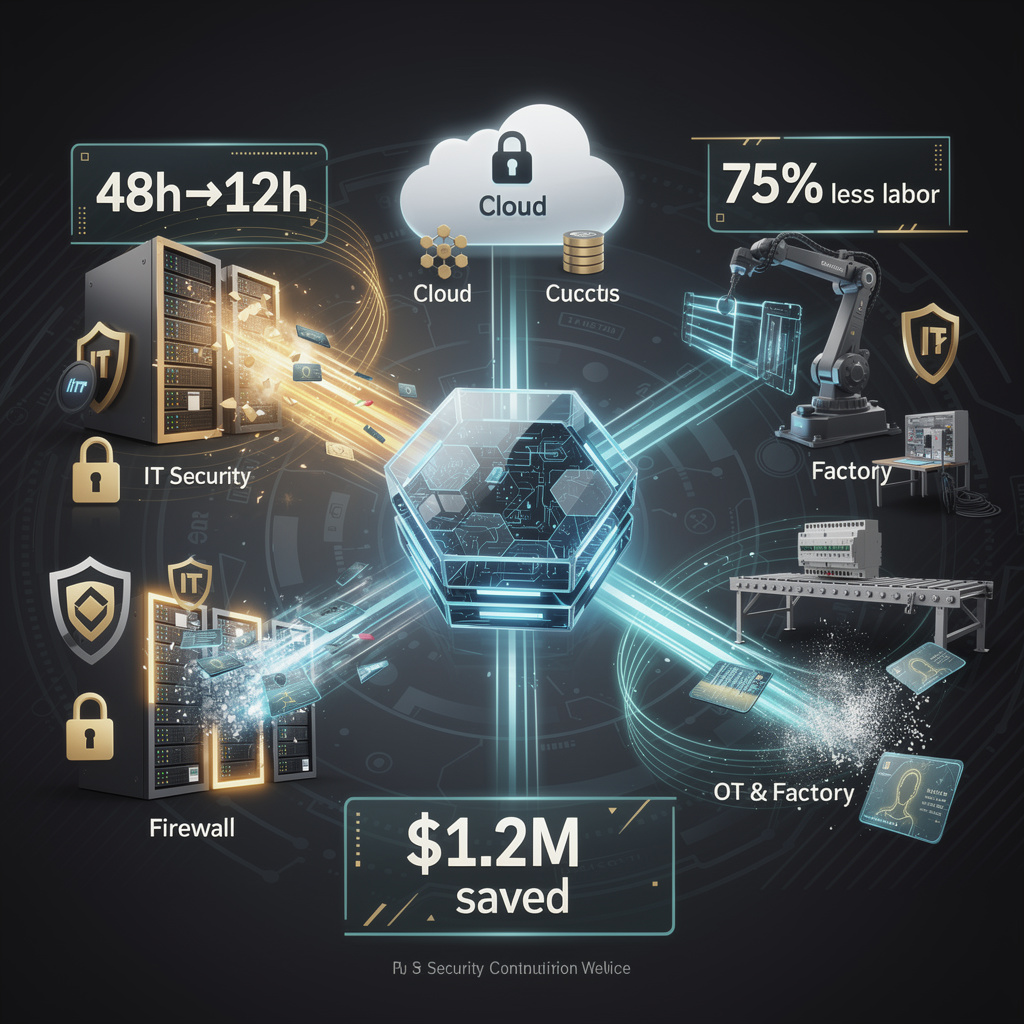
75% less grunt-work: Tenable Hexa AI slashes asset-tagging from 2 days/month to 2 days/week 🚀. 48h→12h fix times, $1.2M saved per 10k assets. Europe’s CISOs get first dibs—will your SOC be next to shrink 30%?
On 25 March, Tenable released Hexa AI, an agentic engine inside its One platform that now orchestrates patch, firewall, and identity moves across IT, cloud, and factory-floor gear. A 200-firm pilot shows the bot cuts the average breach-to-fix window from two days to half a day and shrinks manual asset-tagging labor 75 %—freeing two working days every month for teams that guard 10,000-plus devices.
How does an “agent” outrun human triage?
Hexa ingests vulnerability scans, cloud configs, and OT telemetry into an “Exposure Data Fabric,” scores each risk in context, then launches pre-approved playbooks via APIs already wired to Cloudflare, FortiGate, and SentinelOne. Policy guardrails keep the autonomy fenced: block rules for production OT, flag-only for finance subnets, and full auto for dev-test clouds.
Measured impacts after 90 days
- Latency: 48 h → 12 h average remediation
- Accuracy: 42 % better severity ranking versus legacy rule engines
- Cost: $1.2 M annual avoidance per 10 k assets, based on $120 k expected breach saving
- Labor: 16 h/month of tier-2 analyst time returned per 1 k endpoints
Competitive lens
- Anthropic Claude Code: finds code flaws but stops at the PR; Hexa closes the loop to live patching.
- Microsoft Copilot for Security: 365-centric; Hexa spans IT, OT, and cloud from a single console.
- Perplexity Computer: multi-model chat; Hexa is action-biased, not query-biased.
What still needs a human eye?
Agentic drift: a single mis-scoped rule could isolate a plant floor or over-patch a revenue server. Tenable therefore keeps a mandatory weekly human review and encrypts the central data lake with zero-trust micro-segments.
Outlook
- Q3 2026: identity-dark-matter module ships, hunting orphaned tokens in hybrid AD.
- Q4 2026: North-America rollout; Guardian Layer beta adds runtime audit trails ahead of NIST AI-agent standards.
- 2027: Asia-Pacific OT pilots; SOC staffing models project 30 % head-count reallocation toward threat-hunting as Hexa handles routine closures.
By compressing multi-day exposure windows into single-shift cycles, Tenable’s agentic engine doesn’t just speed up security—it redefines what “response time” means for every firm measuring risk in four- and five-figure asset counts.
⚡️ Enablence CIO Hire Targets 80% Energy Cut, 20× Speed Gain in $20B Optical Race
80% less power, 20× more speed: Enablence’s new AI-driven photonic chips could save a single mega-datacenter $200M/yr ⚡️ As copper hits a wall, Fremont start-up targets 10% of tomorrow’s $20B CPO market—will your cloud bill feel the relief?
Enablence Technologies, a Fremont-based supplier of optical “brain-wiring” for AI servers, has named Dr. James Gyarmathy—George Washington University doctorate in AI—as Chief Information Officer. The 25 March move signals intent to turn delicate planar-lightwave-circuit (PLC) chips into mass-market AI fuel before copper interconnects hit their physical wall early next decade.
How light replaces copper inside the rack
PLC chips guide laser pulses through silicon channels, eliminating the electrons that overheat today’s server back-planes. ET’s current designs target 4-20× the data-per-watt of copper, while co-packaged-optics (CPO) versions promise 80 % lower energy and external-light-source (ELS) modules a 40 % cut. The firm now controls design, fabrication, and operations under one roof—an integration Gyarmathy will manage with AI-driven yield analytics.
Impacts—measured in watts, dollars, and carbon
- Throughput: 30 % more wafer output within 12 months → faster delivery to AI builders.
- Energy: 80 % CPO savings could shave $200 million off the power bill of a single mega-datacenter.
- Market: 5-7 % share of the forecast $20 billion CPO pie by 2028 → up to $1.4 billion annual revenue.
- Climate: cumulative 2 TWh annual savings across adopters by 2035 → a 1-million-ton CO₂ cut, equal to taking 220,000 cars off the road.
What happens next
- Q4 2026: first ELS demos in AI racks; defect density down 15 %.
- 2027: 1 million PLC units shipped per quarter; Taiwan and Canada fabs at full stride.
- 2028-2030: ET aims for 12 % of a $40 billion optical-interconnect market as copper nears its last gasp.
The takeaway
By fusing an AI mind with photonic muscle, Enablence is betting that smarter fabrication beats mere miniaturization. If the yields hold, the company’s lasers—not copper traces—will dictate how fast, and how cleanly, the next decade of artificial intelligence thinks.
😱 195 M Records Gone: BarracudaONE AI Spots Shadow AI in 29 Min
195 MILLION taxpayer records leaked by rogue AI—enough to ID every adult in Mexico twice 😱. 89 % jump in AI attacks means your data is out the door in 29 min. Finance & healthcare pilots start NOW. Will your network be next?
Yesterday Barracuda Networks bolted an AI-driven radar onto its BarracudaONE platform that maps every sneaky call employees make to ChatGPT, Claude or any other generative model. The release lands 24 hours after the firm’s own telemetry showed AI-enabled intrusions up 89 % in a year and one breach alone vacuuming 195 million taxpayer records. In short: if your staff are pasting source code into an off-the-shelf bot, Barracuda now flags it in real time.
How does it work?
A dual-layer engine scans all outbound HTTPS traffic for signatures of 15 major LLM endpoints while a machine-learning model—trained on 500 000 benign versus rogue request patterns—scores anomalies. When a match fires, the console paints a live topology: which laptop, which cloud, how much data left. One click can revoke the API key, quarantine the device and push a blocking rule to every firewall or SD-WAN node under management.
Why this matters
- Speed: Average breakout time for e-crime has fallen to 29 minutes; Barracuda projects sub-five-minute containment for AI-specific events.
- Recovery: Only 12 % of firms today recover everything after a breach; early visibility could lift that past 30 %.
- Scale: 500 000 daily public commits of unsecured “OpenClaw” agents show the supply of leaky AI tools is exploding.
Short, mid, long view
- 2026–2027: ~18 % Fortune-500 adoption; detection latency drops below 5 min; 150 GB-scale breaches nudged toward zero.
- 2028: NIST AI-Agent standards due; Barracuda feed baked into Zscaler, Snowflake dashboards; “shadow-AI” audits become routine.
- 2029: Compliance mandates expected in NIST & ISO frameworks; AI-specific network security products claim >25 % of cyber budgets.
Bottom line
The firewall is no longer at the edge of the network—it sits between your data and the next prompt an employee pastes at 2 a.m. Barracuda’s move signals that controlling generative AI usage will soon be as non-negotiable as antivirus updates. Enterprises that wait will play catch-up against both regulators and attackers who already script 80-90 % of their steps.
In Other News
- Infosys acquires Stratus to accelerate AI-driven digital transformation for global P&C insurers, integrating 450+ insurance domain experts
- Akamai launches Akamai Brand Guardian with 99.99% accuracy in AI-powered brand impersonation takedowns
- Anthropic raises $42M Series B to scale autonomous underwriting agents, reducing insurance approval from weeks to minutes using AI-driven behavior-based pricing
- Atlassian lays off 1,600 staff amid AI-driven workforce reduction, shares plunge 8% to $68.17 on NASDAQ
Comments ()