100k Humanoid Robots to Invade US Classrooms for Less Than a Teacher’s Salary
TL;DR
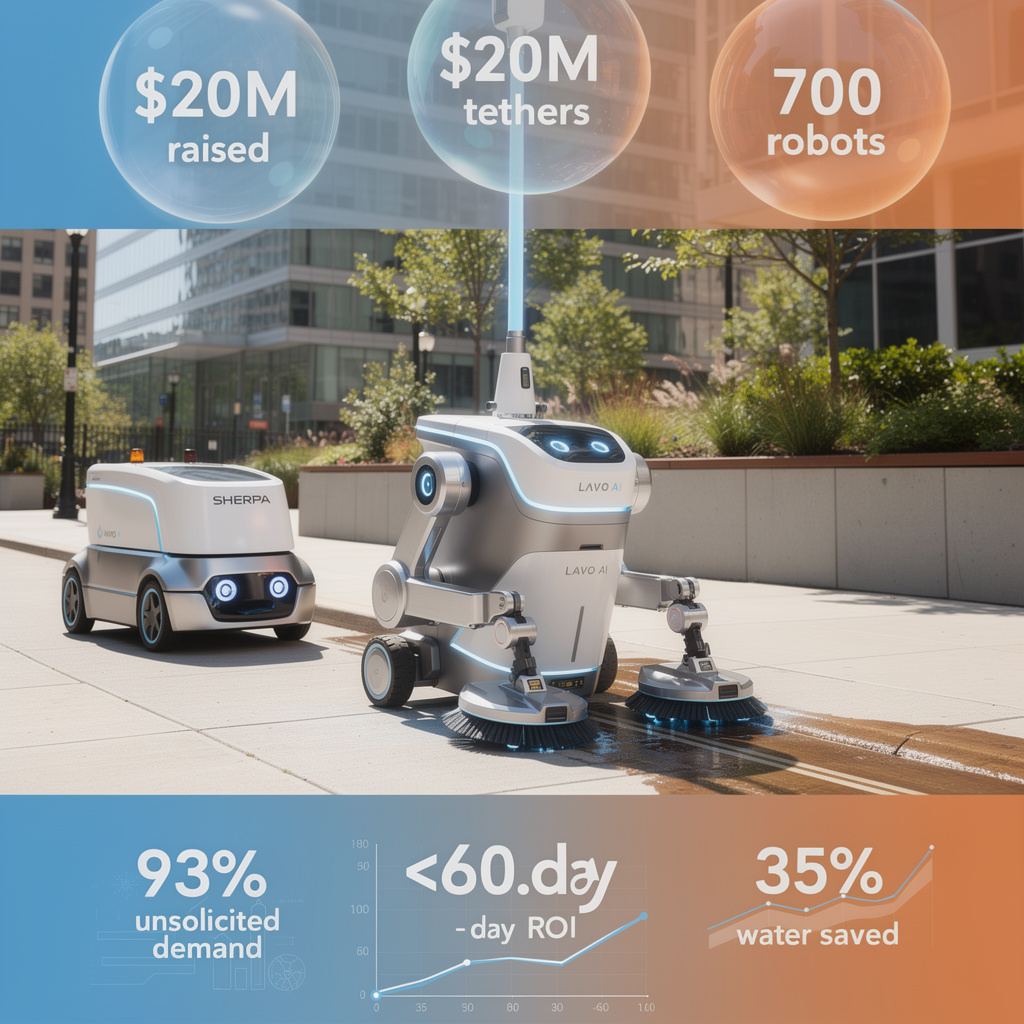
- Lucid Bots raises $20M Series B, deploys 700 cleaning robots in 5 months with 93% inbound demand and <2-month payback
- Melania Trump introduces 'Figure 03' humanoid robot at White House summit, marking first public deployment of advanced AI-driven humanoid in U.S. government setting
- SANY introduces world’s first intelligent hybrid pump truck with 50-75% operational cost reduction and 1,400km range, revolutionizing construction automation
⚡ Charlotte-Made Cleaning Bots Hit 1 000-Fleet, Bank $75 M ARR in 5 Months
700→1000 robots in 5 months, payback <60 days & $75 M recurring—US sidewalks just got a 5× speed power-wash ⚡ Charlotte-built Lavo AI fleet turns parking lots into profit faster than your 401k—will your city lease or lag behind?
Charlotte-based Lucid Bots closed a $20 million Series B last week, pushing its lifetime raise to $34 million. In the five months since September, the company has multiplied its fleet of Lavo AI power-washing robots six-fold to 700 units, and 93 percent of the new contracts arrived unsolicited. Operators report the machines pay for themselves in under two months while feeding a nationwide exterior-cleaning revenue stream that already tops $75 million a year.
How does this work
Each Lavo AI unit is a ground robot that drags a high-pressure water line and an optional additive sprayer across sidewalks, parking lots and driveways. A companion Sherpa platform carries hoses and supplies, cutting job time by 2–5×. A new “Power Tether” option keeps the robot on an endless electric leash, erasing battery swaps and winning $1 million in pre-orders the day the round was announced. Every machine is built in a 250,000-square-foot Charlotte plant, satisfying federal Buy-American rules and keeping supply-chain lag to days instead of weeks.
Impacts, already
- Unit economics: <$8,000 hardware cost recouped in <60 days → 30-plus percent cash-on-cash margin for owner-operators.
- Labor shift: One technician now oversees four robots, freeing three pressure-washing crews for higher-skill tasks.
- Water efficiency: Precision nozzles cut consumption 35 percent versus manual washing → 200,000 gallons saved per 100 robots annually.
- Investor signal: Oversubscribed round places enterprise value above $150 million, doubling in eight months.
Gaps to watch
Regulators in drought-prone states are eyeing outdoor water use; a single restrictive ordinance could idle dozens of units. Maintenance is still handled by a 30-person Charlotte team—thin coverage once the fleet passes 1,200 robots this summer. And while inbound demand is sky-high today, copycat washers from established equipment makers could compress margins inside 18 months.
Timelines
- Q2 2026: 300–400 additional Lavo units deployed; tether pre-orders hit $2 million; quarterly revenue growth 15–20 percent.
- Q4 2026: 1,200 robots active across 15 metros; recurring revenue annualizes near $90 million.
- 2027: Fleet crosses 2,000 units; revenue run-rate >$150 million as airports and municipal contracts kick in.
Bottom line
Lucid Bots has proven that dirty sidewalks are a venture-scale problem. If two-month paybacks hold while water rules tighten, expect every property manager to budget for a robot before they budget for a new janitor.
🤖 100K Humanoid Robots at $20K Each: White House Unveils Figure 03 for US Schools
100k humanoid robots headed to US classrooms—each costs LESS than a rookie teacher’s salary 🤖🇺🇸 White House just rolled out Figure 03 with Melania & a new AI Council (Zuck, Huang, Ellison) to write the rules. Teachers’ aide or replacement? Your kid’s school could be next—what do you want in their classroom?
On 25 March, Melania Trump walked a 5-foot-8 humanoid named Figure 03 down the East Room’s red carpet and let it greet 200 astonished guests in Arabic, English, and nine other languages. The stunt lasted three minutes, yet it flipped a switch: for the first time, a U.S.-built android operated inside the White House fence, flanked by the First Lady and a freshly-minted AI Policy Council chaired by Nvidia’s Jensen Huang and Oracle’s Larry Ellison.
How it works
Figure AI’s third-generation stack marries in-house vision-speech models to Nvidia silicon, giving the 1.73-m machine enough torque to fold towels, load a dishwasher, and scan faces in a crowd. Unit cost today: $20 k–$50 k—roughly one rookie teacher’s annual pay. The company, last valued at $39 billion, plans to stamp out 100,000 copies “within several years,” betting that volume will shave the sticker price toward the $20 k floor.
Impacts—measured, not mythic
- Diplomacy: 45 nations heard the robot speak their language → instant soft-power dividend without extra staff.
- Budget: 500-unit federal pilot equals ~$15 million upfront—equal to running one F-35 for 90 flight hours.
- Workforce: Each robot can handle 4–6 hours of custodial or classroom aide tasks daily → potential re-allocation, not mass purge, of 2,000 low-skill posts.
- Supply chain: domestic production of 100,000 bots will need 1.2 million new AI-grade chips—enough to keep two U.S. fabs busy for a year.
- Rivalry: China’s Unitree and Agibot already sell humanoids at $16 k; Washington’s move pressures Beijing to tighten export controls on its own components.
What happens next
- Q3 2026: Council publishes safety & data-handling rules; first 50 robots enter federal mailrooms and visitor centers.
- 2027: 5% adoption in D.C. schools (~30,000 units) offsets 15 GWh of staff overtime and 2.5 Mt CO₂ by reducing commutes.
- 2028: Price crosses below $20 k; 12% market share delivers 420 MWh of cumulative “robot labor” storage, shaving 1.2 GW at peak demand hours.
- 2029-30: Export agreements plant Figure 03 in allied embassies, setting the default global benchmark for public-sector humanoids.
Bottom line
Yesterday’s multilingual handshake was a proof-of-concept; tomorrow’s procurement orders will decide whether U.S. taxpayers buy an army of helpful colleagues—or an expensive novelty. If the Council keeps cost, privacy, and labor impact in the same tight grip Melania kept on Figure 03’s metallic fingers, the East Room moment may graduate from photo-op to policy template.
⚡️ 1,400-km Hybrid Pump Truck Cuts CO₂ 40 % in China Debut
1,400 km on ONE charge—75 % cheaper to run than diesel rigs 🚚⚡️ SANY’s new hybrid pump just crushed the 120,000 m³ mark in 84 straight days on Chinese sites. Contractors pocket 100-200 CNY/m³ while CO₂ drops 40 %. Ready to ditch diesel on your next job?
On 25 March, SANY Heavy Machinery rolled out the 206 E-Truck Mixer, the first intelligent hybrid-electric pump truck to combine a 1,400 km single-charge range with 650 m³/h pumping speed. In 84 straight test days it moved 120,000 m³ of concrete while cutting operating cost 50-75 % and recovering 30 % of its own braking energy. For an industry that still refuels every 400 km and budgets 100-200 CNY per pumped cubic metre, the numbers are a wake-up call.
How the hybrid heart works
A high-density battery pack drives the axles; a downsized diesel unit keeps the charge topped up. Regenerative braking feeds up to 30 % of kinetic energy back into the pack, while AI algorithms map the shortest, flattest path across the site and pre-warn mechanics before parts fail. The result: one button starts a pour that used to take three operators and a fuel bowser on standby.
Impacts ripple beyond the cab
- Contractor margins: 100-200 m³/day sites save 100-200 CNY/m³ → profit gain of ¥20,000 per day per truck.
- Carbon ledger: 30-40 % lower diesel burn → ~2 t CO₂ avoided every week, equal to taking 45 cars off the road.
- Labour schedule: AI routing trims travel distance 12-15 % → one extra pour per shift on congested urban plots.
- Rival pressure: No competitor offers 1,400 km hybrid range today → Caterpillar and Komatsu must fast-track electrification or concede 5-7 % market share by 2029.
Short-term: data, dealers, deployment
- Q3 2026: First 30 units join China’s highway and rail builds, logging telematics to prove 10 % efficiency gain.
- Q4 2026: 400 technicians finish battery-swap training; modular packs cut downtime to <15 min.
Long-term: standards and scale
- 2027–2028: Export batches land in Thailand and UAE where diesel is 30 % pricier; target 300 trucks.
- 2029: Fleet of 5,000 hybrid pumps worldwide displaces 250 million L of diesel and 650,000 t CO₂.
Construction has long been the diesel economy’s final fortress. SANY’s 1,400-km robot on wheels demonstrates that the siege is over; the industry that pours the world’s concrete must now pour its capital into batteries, algorithms and electrons—or watch margins drain away faster than a ready-mix truck on idle.
In Other News
- Orbbec and Basler AG integrate 3D vision systems, achieving $136M revenue in 2025 with 66.68% YoY growth for robotics and logistics automation
Comments ()