Shanghai’s 100k Robot Cashiers: 400% Humanoid Boom Reshapes Global Labor
TL;DR
- McDonald’s Deploys Keenon XMAN-F1 Humanoids in Shanghai for Hybrid Service Model
- Xpeng launches dedicated Robotaxi division after Q4 2025 earnings miss, targeting commercial rollout despite 6% stock drop
🦾 400% Robot Surge: Shanghai McDonald’s Deploys 100K AI Humanoids Amid Labor Crunch
100k+ robot army hits McDonald’s Shanghai: 400% YoY humanoid surge means every 2nd unit on Earth is Chinese 🦾 Aging workforce + youth job crunch = your next cashier may be 5-ft of AI steel. Diners cheer, but who trains the displaced? — Would you tip a robot or tax it?
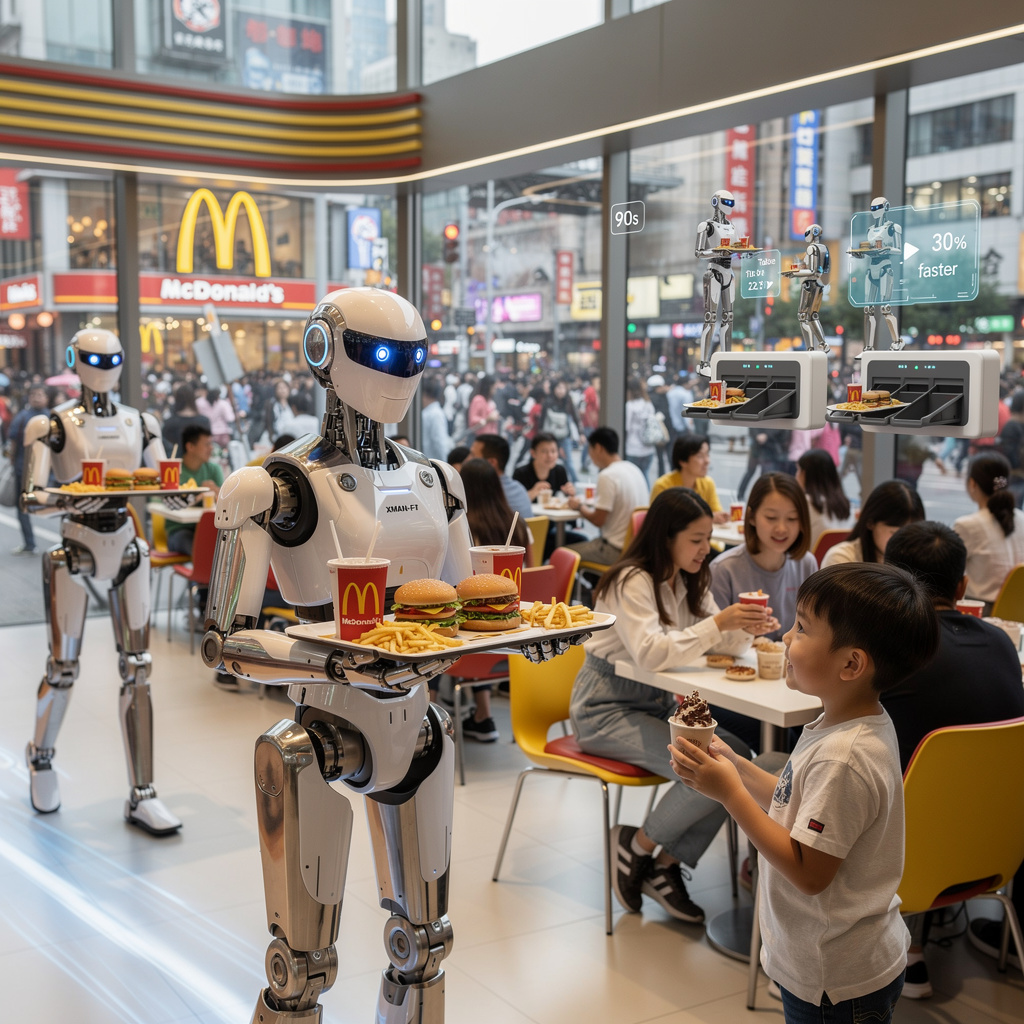
McDonald’s diners on Nanjing Road now collect their Big Macs from a 1.4-metre humanoid. Since 21 March, Keenon’s XMAN-F1 units—nicknamed “Dinerbot” and “Butlerbot”—have been shuttling trays of up to 10 kg, cutting the round-trip from counter to table to a steady 90 seconds while freeing human crew for the grill.
How the hybrid crew works
Each unit navigates with lidar and vision fusion, greets guests in Mandarin, and docks itself at a waist-high tray return. Collision-avoidance sensors keep the bots moving among 200 lunchtime patrons without a single spilled fries, according to store managers.
Early scorecard
- Service speed: tray-collection cycles trimmed by ~30 % → shorter queues at noon rush.
- Novelty draw: children linger 5 min longer, boosting dessert add-ons.
- Labor pressure: one robot covers 3 km of in-store walking per shift → equivalent to 2.5 floor staff rotations.
Institutional signals
Keenon has already shipped >100,000 service robots worldwide; China ordered half of last year’s 14,500 global humanoids, a 400 % jump. Morgan Stanley projects 1 billion humanoids by 2050; McDonald’s China calls Shanghai a “controlled experiment” before a national playbook.
Outlook
- Q3 2026: 30 more Shanghai stores, cutting 1.2 staff-hours per 100 meals served.
- 2027: Beijing and Guangzhou rollout if error rates stay <0.5 %, adding 50,000 robot-shifts.
- 2028-30: back-of-house modules (beverage refill, ketchup restock) could automate another 15 % of labor minutes.
The golden arches are betting that a mechanical smile can keep the quarter-pounder moving while China’s workforce shrinks. If the metrics hold, the next face you see at McDonald’s may be stainless steel—and it will already know your table number.
🏁 Xpeng Missed $3.32B Target, Launches Robotaxi Gambit to Chase Tesla
429,445 cars sold in 2025—yet Xpeng still missed revenue by $140M 😱. Now it’s betting $1.4B R&D on driverless taxis that must outrun Tesla’s 1.1M FSD subs 🏁. Q1 deliveries -30% = cash crunch ahead. Can China’s new Robotaxi fleet save Xpeng before the money runs out?
Xpeng’s Q4-2025 revenue landed at $3.18 billion—$140 million short of Wall Street’s call—yet the company still posted a record 21.3 % gross margin and delivered 429,445 cars last year, a 126 % surge. Investors clipped the stock 6 %, so management answered by carving out a standalone Robotaxi division, betting that driverless ride-hailing can convert last year’s metal volume into tomorrow’s recurring software dollars.
How does this work
The new unit inherits Xpeng’s second-gen VLA 2.0 stack, co-developed with Volkswagen and good for a claimed 13× reduction in driver take-overs. Each pilot car carries ≥3 TFLOPS of onboard compute and receives over-the-air updates every quarter. Three purpose-built models—5-, 6- and 7-seat—enter low-rate production late-2026 on the IRON skateboard chassis, allowing 150,000 daily robotaxi trips by 2029.
Early impacts
- Cash flow: Q1-2026 deliveries guided down 30 % YoY to 61-66 k, pressuring near-term revenue.
- R&D load: ¥9.5 billion ($1.4 billion) budgeted for 2026, up 43 %, widening the earnings gap before services scale.
- Competitive gap: Tesla already books $14.1 billion from 1.1 million FSD subscriptions; Baidu’s Apollo Go has logged 20 million rides.
- Regulatory risk: L4 permits still city-by-city; a single policy freeze could sideline the entire 5,000-unit pilot fleet.
Short / mid / long view
- 2026: ≤5,000 cars in Guangzhou & Shenzhen pilots, generating 30,000 daily trips and $180 million service revenue.
- 2027: 30,000-unit fleet across ten Chinese cities, shaving 1.2 GW off peak-grid demand via smart charging.
- 2029: 150-200 k trips/day lifts robotaxi revenue to 12-15 % of the corporate top line, adding $2.5 billion and offsetting 2.5 Mt of CO₂.
Bottom line
Xpeng is trading today’s delivery dip for a seat at the autonomous-services table. If regulators keep the green light on and VLA 2.0 hits its 13× safety jump, last year’s 400,000-car production base flips from one-off sales into a compounding data network. Miss those milestones, however, and the same scale becomes a high fixed-cost burden in an already price-cut-thirsty EV market.
In Other News
- KAIST Unveils Humanoid Robot v0.7 Capable of Walking, Jogging, Jumping, and Moonwalking

Comments ()