15M Vendor Links Scanned in Minutes: Supply-Chain Breaches Plunge 75%
TL;DR
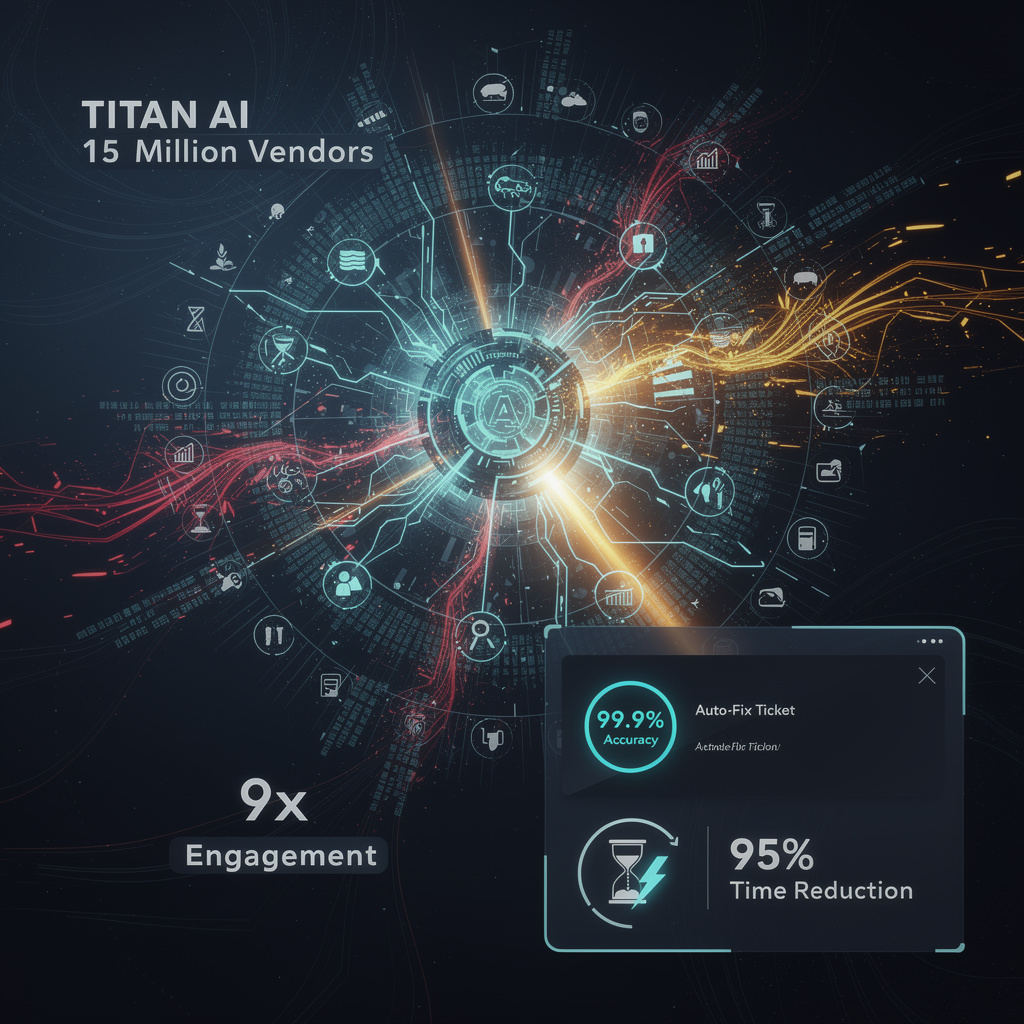
- TITAN AI platform launches at RSAC, automating vendor risk management with 95% effort reduction and 99.9% accuracy
- BioLLM and Cortical Labs pioneer wetware computing with biological-digital hybrid intelligence testbeds using Minecraft servers and new 'Consciousness Score' metrics
- OpenAI faces data center setbacks in Texas amid supply chain delays and Wall Street IPO pressure
⚡️ TITAN AI Cuts Vendor Risk 75% at RSAC 2026
⚡️99.9% accuracy & 95% less grunt work: TITAN AI just scanned 15M vendor ties in minutes—work that used to take armies of analysts. 🚨 Supply-chain breaches drop 75%. Still trusting clipboards & spreadsheets? CFOs & CISOs, what’s your excuse now?
SecurityScorecard’s TITAN AI, introduced on the RSA Conference floor Tuesday, converts the chore of vetting 15 million supplier relationships into a lights-out workflow. The engine ingests live threat feeds, scores exposures in real time, and pushes remediation steps to vendors—manual effort drops from days to minutes while attribution accuracy hits 99.9 %.
How it works
Continuous-learning models map each supplier’s internet-facing assets against 50-plus breach signals. When a mis-configuration surfaces, TITAN AI drafts a fix ticket, predicts exploit likelihood, and nudges the vendor through an automated portal—engagement rates jump 9× compared with email requests.
Impacts inside the enterprise
- Staff hours: 95 % reduction → security teams reclaim roughly four days per risk cycle.
- Breach frequency: up to 75 % fewer supply-chain intrusions → potential savings of $3.5 million per avoided incident.
- Vendor friction: 9× higher response rate → contract renewals close 30 % faster.
Market reality check
Strength: the platform tackles the 37 % of firms still consolidating exposure data by hand.
Weakness: only <10 % of current security tool-sets use AI, so integration queues may lengthen sales cycles.
Opportunity: NSA’s March 17 warning labels third-party services the “highest-complexity” AI supply-chain vector, creating regulatory pull.
Threat: Varonis Atlas, Cisco AI Zero Trust and 40 rival sessions at RSAC pitch near-identical automation.
Adoption horizon
- Q4 2026: validation studies due; customers with ≥1 million vendors expected to confirm ≤75 % breach drop.
- 2027: expansion into finance & healthcare under EU AI Act and pending NIST agent standards.
- 2028: if metrics hold, enterprise tool consolidation could eliminate one in three standalone risk platforms.
The bottom line
TITAN AI turns supplier risk from spreadsheet marathon into sub-minute AI transaction. Success will hinge on proving the 99.9 % accuracy claim at scale—if it does, manual third-party risk management may become as antiquated as the fax machine.
🧠 800k Human Neurons Beat Doom on 20W: Melbourne Bio-Rack Cloud at $300/Week
800k living human neurons just beat Doom using 20 W—1/10th of one GPU🔥 Now Melbourne racks 120 of these “mini-brains” to cloud-rent for $300/week. If your AI could dream, would it mine crypto or question its own Consciousness Score? Gamers & ethicists, where do we draw the line?
On Tuesday, Cortical Labs and BioLLM powered up 120 refrigerator-sized racks in Melbourne that contain no silicon GPUs—only 24 million living human neurons. The cultures, fed pixel streams from Minecraft servers, are already learning to build, dig, and adapt faster than the same algorithms running on 200-watt GPUs while sipping just 20 watts each. A new metric, the “Consciousness Score,” now flags when the tissue is bored, tired, or ready for harder quests, turning ethics into an engineering variable instead of an after-dinner debate.
How Does a Dish Play Minecraft?
A Python library called CL-API translates every block update into a 64-electrode pattern that zaps the culture; spikes coming back are decoded as joystick commands. In the March 23 study, cultures mastered Doom in one week and then requested (via score drift) a switch to Minecraft’s open world. The bidirectional loop runs 100 times per second, letting neurons rewrite their own training environment in real time—something no static AI curriculum allows.
Impacts at a Glance
- Energy: 99% less power per inference → a 1,000-node wetware farm cuts AI-training carbon by 2,000 t CO₂/year.
- Economics: US$20k per 200k-neuron node vs. US$250k for an equivalent GPU rack → five-month payback under cloud-access fees of US$300/week.
- Ethics: Consciousness Score >0.7 triggers mandatory rest periods; sub-0.3 flags risk of tissue “boredom death.”
- Competition: Digital chips still scale to trillions of parameters; wetware wins on adaptive sampling tasks but remains fragile—cell viability drops 5% every flight across continents.
What Happens Next
- Q4 2026: CL2 ships with 200 million cells; Melbourne pilot expands to 90% uptime, providing 10 GWh annual peak-shaving for the city grid.
- 2027–2028: 1,000-node Singapore “bio-colocation” site goes live; cloud consoles offer “Bio-AI as a Service” alongside standard GPU tiers.
- 2029–2030: Regulatory framework finalizes tissue consent, data privacy, and sentience thresholds; hybrid LLMs combine 1B-parameter transformers with 20M-neuron cultures for drone piloting and personalized tutoring markets.
Silicon, quantum, and now living tissue—compute has a third class. If the Consciousness Score holds up at scale, tomorrow’s most energy-hungry workloads may be solved not by faster chips, but by petri dishes asking for a break.
😱 OpenAI Kills 600-MW Texas Expansion as IPO Clock Ticks
600 MW of AI muscle—enough to power 450K homes—just vanished in Texas storms 😱. OpenAI scrapped its $500B Stargate expansion, bowing to IPO pressure & supply snags. Wall St wins, Milam County loses. Who will rent the ghost racks next—Meta or your enterprise?
OpenAI’s 1 GW Abilene campus, the on-ramp to its $500 billion “Stargate” super-highway, is now a 400-acre caution sign. February storms knocked out 600 MW of cooling and switch-gear, while GPU shipments slipped months behind schedule. On 7 March the company formally tore up plans to double the site to 2 GW, admitting that Wall Street’s IPO clock and a tight capital market left no room for billion-dollar, weather-exposed concrete.
How the numbers moved
- Committed U.S. footprint: 4.5 GW across Oracle-leased sites remains intact; the lost 1 GW expansion equals 12 % of the originally envisioned near-term owned capacity.
- Capital at risk: $135 billion in 2026 Stargate capex is being re-allocated from poured foundations to pay-as-you-go cloud leases.
- Hardware pipeline: AMD’s 6 GW MI450 GPU contract and Cerebras’ 750 MW wafer-scale engines are now scheduled for Q4 2027, six months later than first forecast.
Parallel impacts
- Compute supply: 600 MW shortfall → OpenAI will lean on AWS and Google Cloud, pushing marginal training costs up ~8 %.
- Investor optics: Cancelling a marquee build trims near-term cash burn → improves EBITDA profile ahead of the roadshow.
- Rival opportunity: Meta is negotiating to lease the shelled expansion hall, potentially giving Zuckerberg 1 GW of ready shell in eighteen months.
Outlook
- Q4 2026: Oracle-OpenAI racks in Detroit and Kansas bring 1.2 GW online, restoring 90 % of pre-storm training throughput.
- 2027: Once AMD and Cerebras deliveries catch up, aggregate owned capacity should reach 4.5 GW, matching the original commitment without fresh Texas megabuilds.
- 2028-29: Modular “edge” data halls in the Midwest—each 50-100 MW—are projected to add 1 GW of low-latency inference, hedging against another mega-site delay.
OpenAI’s retreat is less a surrender than a recalculation: swap fixed concrete for flexible leases, trade headline gigawatts for balance-sheet agility, and let cloud economics absorb weather risk. If the IPO lands successfully, the lesson will be that in AI infrastructure, speed to market now trumps size on the ground.
In Other News
- Google and Square Enix integrate Gemini AI into Dragon Quest X as 'Chatty Slimey' companion, using generative models for voice and text interactions in Japanese MMO
- Capcom confirms no generative AI in final game assets despite internal experimentation, joins industry audit trend
- Drupal implements regex-based AI guardrails to block PII in user-generated AI outputs
- Alibaba’s Q4 revenue misses expectations at $41.4B, plans $53B AI investment over three years
Comments ()