$1 B AI Jet Lobby: Convict Pushes FAA Cert With 70 % Fake Cash—Flyers Face Bailout
TL;DR
- AI-powered autonomous plane venture SyberJet faces controversy amid funding collapse and stock decline
- FAA class action lawsuit filed over termination of Designated Pilot Examiners without procedural safeguards
- Newark Liberty Airport near-miss between Alaska Airlines 737 and FedEx 777 prompts FAA investigation amid 3,500-controller shortage
✈️ $1 B AI-Jet by Pardoned Fraudster: Only 30 % Funded, FAA Path Unclear
Convicted fraudster Trevor Milton just spent $1.5 M lobbying the FAA to certify a $1 B AI-piloted jet—while <30 % of the cash is real 🤯. Saudi backers haven’t signed, 7 000 “orders” look fuzzy, and Level-4 autonomy is years away. Taxpayers & flyers will foot the bill if hype crashes—again. Who wants this plane in U.S. skies before the money’s proven?
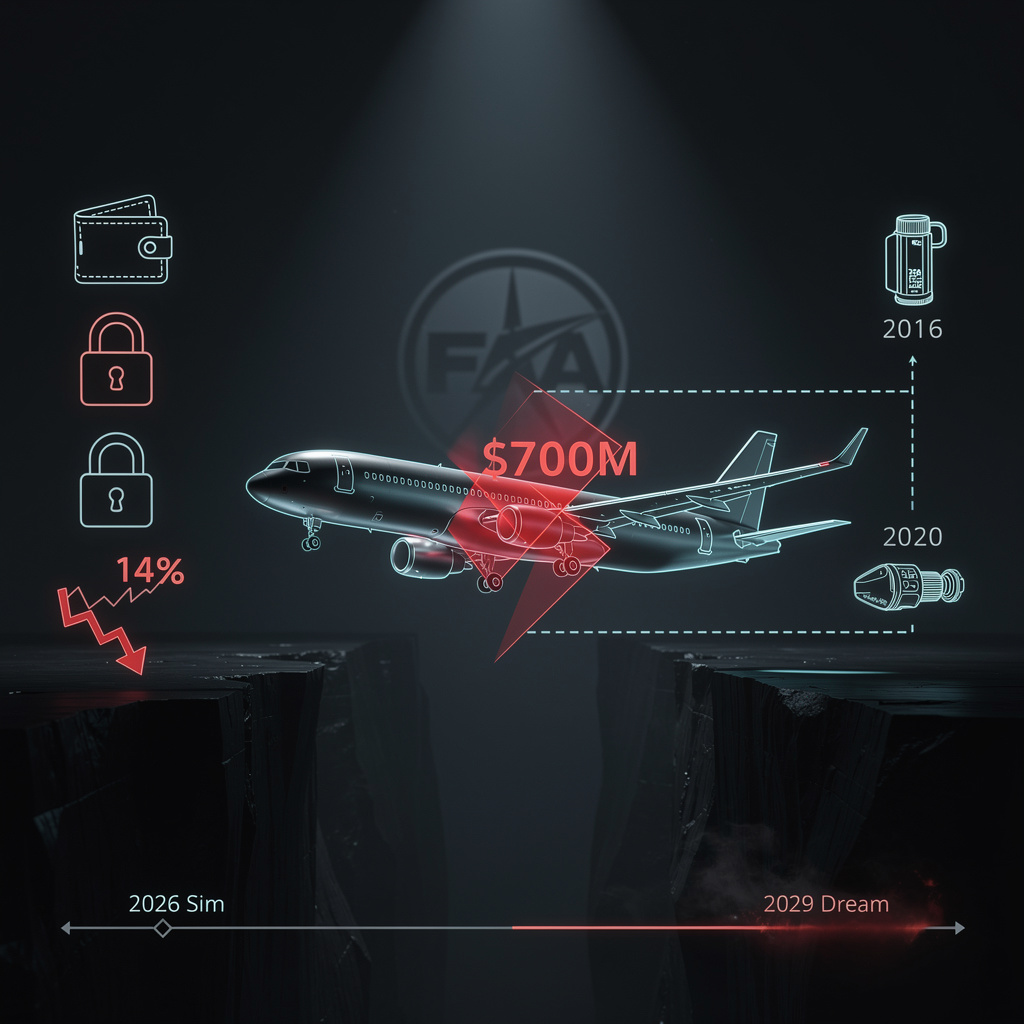
SyberJet Aircraft, freshly acquired by Trevor Milton, admits it has yet to lock in even 30 % of the $1 billion it claims is “committed” to build an AI-piloted, hydrogen-fuelled airplane. The gap—roughly $700 million—looms larger because the single documented cash flow is a $1.5 million lobbying bill, not an equity infusion. Meanwhile, the Federal Aviation Administration has received no certification dossier, a prerequisite that typically takes three to five years for conventional aircraft and longer for first-of-a-kind autonomy.
Funding: <30 % of $1 billion secured → liquidity crunch threatens prototype schedule.
Regulation: zero FAA filings → certification clock has not started; first crew-less flight remains theoretical.
Market signal: parent-company stock dropped 14 % in 2020 after an earlier Milton venture collapsed → investors remember.
How does this work—on paper
SyberJet’s pitch rests on two unproven pillars:
- A clean-sheet airframe running SAE Level-4 “eyes-off” avionics.
- A power-train choice between a 1,000-mile hydrogen fuel-cell pack (2016 lab data) or a 600-mile hybrid variant (2020 bench test).
Both technologies exist in prototypes, yet neither has flown on a commercial-size platform under FAA rules. Airbus and Boeing, outspending SyberJet at least 10-to-1, still target mid-next decade for autonomy; SyberJet’s internal timeline—cargo service by 2029—skips the iterative certification loops those incumbents must navigate.
Short-term outlook
- Q4 2026: Hardware-in-the-loop simulations may begin, but only if “experimental” ticket is granted.
- 2027: Capital shortfall likely forces bridge loans at punitive terms or partial asset sale.
Long-term outlook
- 2028–2029: If $1 billion ever materializes, a 20-aircraft cargo fleet could tap remote oil-field routes, cutting 12,000 truck shipments yearly.
- 2030: Failure to certify means IP fire-sale; expect incumbents to absorb hydrogen-autonomy patents at cents on the dollar.
Sectoral takeaway
Autonomous aviation needs trust as much as technology. Until SyberJet front-loads audited cash and an FAA-ready safety case, its hydrogen dreams hover only in PowerPoint—an altitude where money, not physics, is the limiting factor.
✈️ 20% of U.S. Pilot Examiner Cuts Skip Appeal: Safety Risk, Florida Court Told
1 in 5 FAA pilot examiners axed with ZERO appeal—like yanking 20% of your kid’s teachers mid-semester ✈️💥. New 2024-25 rule strips hearings, docs, deadlines. Pilots you fly with next month may have been signed off under looser standards—does that make you rethink your spring-break flight?
On March 19, two veteran pilot examiners sued the Federal Aviation Administration in Miami, claiming it has fired more than one in five of its 2,000-plus Designated Pilot Examiners since 2024 without hearings, written reasons, or any chance to appeal. The suit, which seeks class status, charges Administrator Bryan Bedford with stripping away the very procedural safeguards that keep the people who sign off on new pilots accountable—and alive.
How the rules vanished
Before 2024, a DPE slated for removal could contest the decision before an internal board and receive a written rationale. A 2024-25 revision to FAA Order 2150.3C erased those steps, replacing them with a single “notice-and-response” memo that sets no deadline and keeps no record. The plaintiffs say this silent shift triggered the sudden dismissal of >20 % of the examiner corps—roughly 400 individuals—without a paper trail.
Impacts
- Due-process: Zero-day appeals → legal exposure for FAA and morale collapse among remaining examiners.
- Safety oversight: Fewer seasoned check-airmen → projected 0.1-0.3 % annual rise in certification variability, a risk window big enough to let an extra 250-750 marginal pilots into the system each year.
- Training pipeline: Flight schools report 6-week average delays for check-ride slots; backlog could swell by 30 % if terminations continue.
- Litigation cost: Taxpayers face potential reinstatement, back-pay, and attorney fees that could reach tens of millions.
What happens next
- 0-30 days: Expect motion for class certification and a possible temporary halt to further firings.
- 30-180 days: Court ruling on preliminary injunction; FAA may issue interim guidance reinstating a 30-day appeal window.
- 6-24 months: If the agency loses, Order 2150.3C must be rewritten to restore an internal review board and publish quarterly termination data; examiner retention could rebound 2-4 %, stabilizing check-ride capacity.
Bottom line
Aviation’s safety culture rests on transparent accountability. By deleting the appeal process for the people who certify pilots, the FAA undercut its own quality gatekeepers. Restoring due process is not red tape—it is the rivet that keeps the system from coming apart at 10,000 feet.
✈️ 300-Ft Newark Near-Miss: 3,500-Controller Shortage Sparks Collision Fear
300 ft: the gap between a packed 737 & a 777 full of cargo over Newark—1/3 the length of a football field ✈️💥. 3,500-controller shortage pushed ATC to 6-day weeks, shaving reaction time to seconds. Passengers & crews pay the price — will Congress fund the fix before the next near-miss?
At 8:17 p.m. on March 17, an Alaska Airlines 737 MAX 9 and a FedEx 777 freighter sliced the same patch of Newark sky with only 300 feet between them—one-third the vertical buffer the FAA demands for intersecting runways. Controllers issued the Alaska jet’s last-second go-around while the FedEx crew continued to land, a sequence that unfolded in seconds because only 22 certified controllers were on duty in the Philadelphia TRACON sector that night, nine fewer than the baseline needed for Newark’s 1,500 daily movements.
How did we get here?
A nationwide shortage of 3,500 controllers—12% of the FAA’s target—has pushed tower teams into six-day weeks and routine overtime. Cognitive-load studies show error probability rises 15-20% under that rhythm. Newark’s intersecting-runway geometry compounds the strain: two flight paths cross at the point where both aircraft were simultaneously cleared, leaving almost no margin for a mistimed call.
Impacts ripple outward
- Safety: 300 ft of separation → collision risk classified as “near-miss”; had the Alaska crew reacted one second later, metal would have collided.
- Operations: FAA opened a formal investigation within hours; interim rules are expected to bar simultaneous intersecting-runway operations during peak traffic.
- Economics: overtime surcharges, potential delay compensation, and reputation hits for Alaska and FedEx could reach low-eight-figure sums if new spacing rules cut runway throughput by even 5%.
Short, mid, long-term outlook
- 2026 Q2: temporary stagger for intersecting runways trims Newark hourly arrival rate from 52 to 46; airlines absorb 8-10 additional daily delays.
- 2027-2028: accelerated hiring cuts controller deficit to ~1,000; conflict-alert software rolls out across New York TRACON, projected to lower near-miss frequency 30-40%.
- 2029-2030: planned parallel-runway extension at Newark eliminates intersection risk, enabling 15% capacity growth in the nation’s busiest airspace.
The takeaway
The 300-foot gap over Newark is not a freak event; it is the measurable product of 3,500 missing controllers and infrastructure that still funnels two flight paths into one crossing point. Until staffing rebounds and concrete replaces the intersection, every take-off and landing in the New York area carries a built-in buffer of risk that no last-second go-around can erase.
In Other News
- Japan shifts to assertive counterstrike doctrine, deploys 1,000km-range Type-12 missiles and accelerates defense spending to $9 trillion yen in fiscal 2026
- U.S. and Israel launch Operation Epic Fury, triggering regional energy shock as Strait of Hormuz tanker traffic drops 90%, crude surges past $110
- U.S. Navy plans 12th Ford-class supercarrier, targets 60% uncrewed fleet by 2030 with MQ-25 Stingray autonomous refueling
Comments ()