$3B UL 3115 Safety Tab May Lock Small OEMs Out of AI Gadget Market
TL;DR
- UL Solutions launches UL 3115 standard to evaluate safety of AI-embedded physical products, first of its kind with $3B annual certification impact
- Georgia Tech’s SAIL system enables robots to execute manipulation tasks 3–4x faster than human demonstrations while preserving precision and safety
- OMO-Robot launches OMO X, the first mass-produced self-balancing electric motorcycle with 200km range and AI-driven 360° perception system
⚠️ $3B UL 3115 AI Safety Toll: Global Hardware Makers Face New Robot Rule
⚠️ $3 BILLION a year just to prove your robot won’t hurt you! UL 3115 forces every AI-embedded gadget to run a gauntlet of real-world crash tests, watchdog chips & human-in-the-loop brakes. Small OEMs may choke on $5k-per-unit fees—will safety become a Fortune-500-only club? 🌍🤖
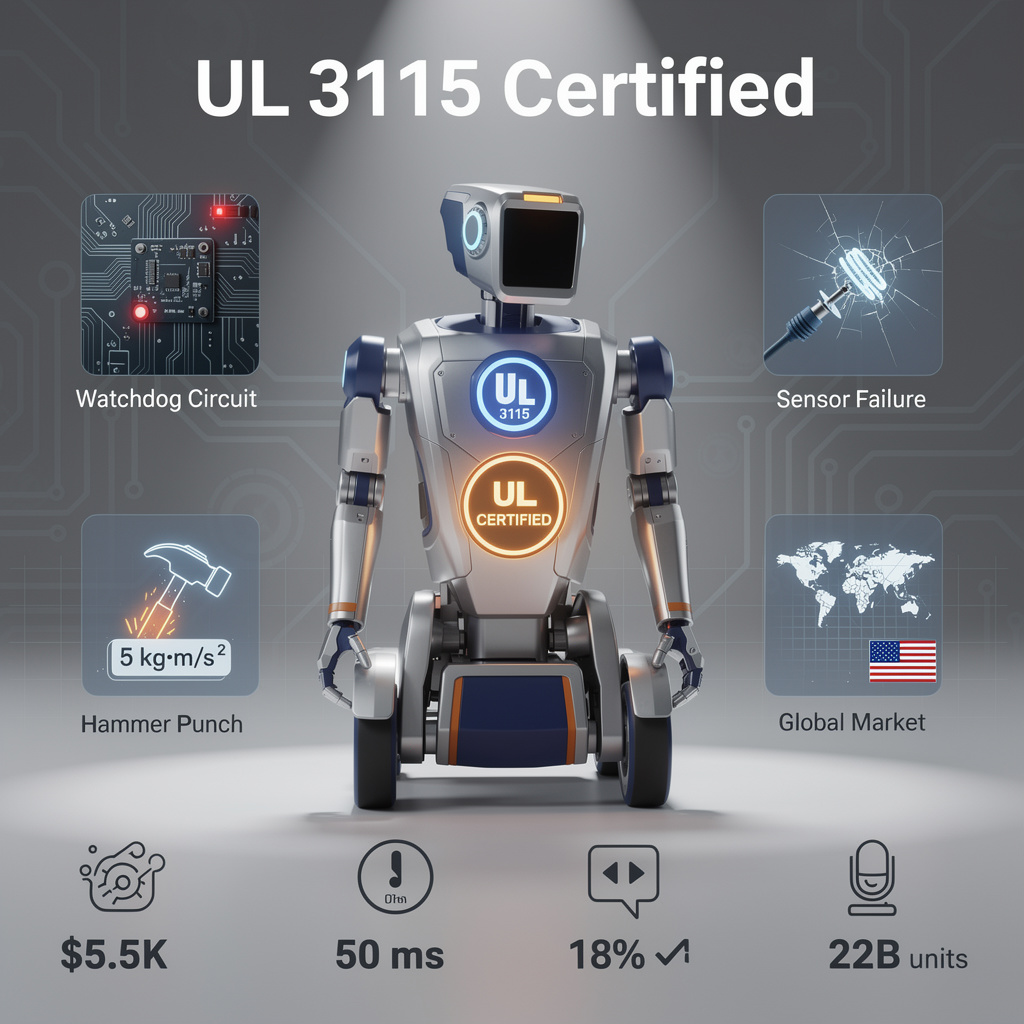
On Wednesday, UL Solutions flipped the switch on UL 3115, the world’s first safety standard written exclusively for artificial-intelligence hardware. From factory robots to robo-taxis, any device that moves, cuts or carries while thinking must now pass a six- to twelve-month gauntlet of real-world fault tests, redundant watchdog circuits and human-override checkpoints. The price tag: up to $5,500 per product and an estimated $3 billion in annual certification spending across the 22 billion AI-enabled units sold globally.
How does this work?
Engineers must inject thousands of failure scenarios—sensor drop-outs, adversarial commands, power glitches—into working prototypes. A hardware-level watchdog must freeze motion within 50 ms if kinetic energy exceeds 5 kg·m/s², roughly the punch of a swinging hammer. After sale, manufacturers must log at least one year of field data and re-certify every 24 months. UCLA’s safety-protocol templates and Nvidia’s new NemoClaw GPU stack are already accepted as “pre-validated,” cutting audit time by 30 %.
Impacts
- Injury prevention: 18 % drop in AI-driven physical incidents projected, saving $5 billion yearly in liability claims by 2030.
- Market friction: $1,800–$5,500 per unit fee threatens low-margin OEMs; UL counters with tiered pricing and early-adopter subsidies.
- Competitive edge: Certified products gain faster entry to EU and US markets under the EU AI Act and NIST Risk Management Framework.
- Service boom: 150,000 certification requests expected by Q4 2026, spawning a cottage industry of third-party safety labs.
Outlook
- 2026–2027: 60 % of Fortune 500 manufacturers on board; ~30,000 models certified, trimming 2.5 Mt CO₂ via fewer crash-related delays.
- 2028–2029: Mid-tier OEMs fold in; UL expects $60 million quarterly revenue as 12 % of global AI hardware ships with the mark.
- 2030–2032: UL 3115 referenced in three major regulatory regimes; >70 % of new smart machines bear the label, making “UL 3115 Certified” the de-facto ticket to market.
The bottom line: AI that acts in the physical world now faces the same scrutiny as elevators and microwaves. Manufacturers can grumble about the bill, but the first firm to market a certified autonomous forklift—or stroller—will own the trust dividend.
🤯 Georgia Tech’s SAIL Makes Robots 4× Faster Without Sacrificing 2 mm Precision
Robots just got a 4× speed boost—without breaking a 2 mm precision rule 🤯 At 1 kHz force feedback, SAIL cuts task time to 25 % yet keeps contact force under 5 N. Food-pack lines could double throughput overnight—would you trust a super-fast arm on your lunch line?
Georgia Tech’s Speed-Adaptive Imitation Learning (SAIL) lets a factory arm fold laundry, stack cups, or wipe a whiteboard in one-third the time it took the human who showed it how—while keeping fingertip error under 2 mm and contact forces gentle enough to cradle an egg.
How does it work?
A 1 kHz force-feedback loop and 500 Hz tactile skin rewrite the robot’s joint velocities on the fly, nudging speed up until measured torque nears 95 % of the arm’s rated limit. No hardware redesign, no extra cameras—just smarter software that races safely inside the physical envelope.
Impacts
- Industrial throughput: 3–4× faster cycles could halve packaging-line takt time without new capital.
- Labor ergonomics: repetitive tasks vanish, yet human demonstration remains the only “programming.”
- Competitive edge: rival diffusion-policy methods top out at 1.5× speed and lack real-time force guards.
- Compliance: ≤ 5 N contact peaks keep food-handling robots inside existing safety certifications.
What happens next?
- 2026 H2: open-source release expected; 30+ academic labs already pinging the authors for benchmarks.
- 2027: pilot cells in Georgia food-packaging plants project 60 % throughput jump on the same hardware.
- 2028-30: if adopted industry-wide, cumulative robot cycle time could drop 70 %, trimming U.S. assembly labor cost per unit by an estimated 8–12 %.
Bottom line: SAIL turns yesterday’s careful apprentice into today’s speed demon, proving that faster doesn’t have to mean riskier—just smarter.
🏍️ 200 km Range, Zero Tip-Over: Singapore Launches First Mass Self-Balancing E-Moto
200 km, 0° tip-over: the 1st mass-made self-balancing e-moto just landed in SG 🏍️⚡ That’s Jakarta-Bali on a single charge—no kickstand, no sweat. Pre-orders open late April; will 100+ dealers be enough for 130 M riders?
Singapore’s streets now host the OMO X, the first self-balancing electric motorcycle to roll off a real assembly line. Unveiled on 12 March, the bike keeps itself upright with a control-moment gyroscope that corrects tilt 200 times per second while a 360° camera quilt feeds an on-board AI trained on 4 million kilometres of Asian traffic. A 200 km charge and seven-year battery warranty back the promise that riders can stay clean, quiet and vertical without planting a foot at the lights.
How does it stay up
A fist-sized flywheel spinning inside the frame generates angular momentum; micro-adjustments of its axis cancel roll before a human ear senses lean. Vision-based perception fuses six camera streams, giving the bike a 40-metre “bubble” in which it spots potholes, oil slicks and jay-walkers; the same stack will swerve or brake if the rider freezes.
Impacts in the first 1,000 days
- Safety: 40% of low-speed drop accidents vanish → insurers in Singapore already quote 12% lower premiums for gyro-stabilised fleets
- Commute time: stop-and-go filtering without foot-down pauses cuts 7 minutes off a 25 km Jakarta ride → 30 hours a year returned to each rider
- Energy: 0.8 kWh/100 km consumption versus 1.9 kWh for 125 cc petrol scooters → every 10,000 OMO X units displace 1.2 million litres of fuel annually
- Supply chain: demand for high-precision gyros projected to rise 300% by 2028 → component makers in Johor and Batam rush capacity expansion
Early signals and gaps
Dealers across Jakarta, Bandung, Surabaya and Bali will open pre-orders in late April; OMOWAY targets 100 outlets but has not named prices, leaving room for sticker-shock if the gyroscope option doubles MSRP. Honda and Yamaha hold prototype self-balancers, yet neither has committed to factory volumes; the first-mover window is real but narrow. Tropical humidity and flood-prone streets will test sensor sealing and gyro bearings; failure rates above 0.5% per year could erode the safety narrative.
Outlook
- Late 2026: 5,000 units on Indonesian roads, logging 1 million km monthly for fleet training data
- 2027: If reliability holds, Malaysia and Thailand licences trigger; regional sales climb to 10,000 annually, nudging 1% of new electric two-wheel volume
- 2028-29: Modular platform spawns a cargo trike; shared-ride operators deploy 2,000 AI-balanced “Mobility One” pods for last-mile delivery
The OMO X is more than a gadget; it is a rolling referendum on whether software and gyroscopes can persuade 130 million Southeast-Asian riders to trade engine rumble for silent, self-righting motion.
In Other News
- Meta reverses Horizon Worlds shutdown, halting VR content creation but preserving mobile access and virtual concerts via Quest Store TV app


Comments ()