Meta 30-PFLOP AI Chip in 1.7 kW Outruns GPUs, Cuts Latency 40 %
TL;DR
- Meta's 1700W MTIA 450/500 superchip delivers 30 PFLOPs and 512GB HBM for AI inference at scale
- Xanadu and TELUS partner to build Canada’s first sovereign hybrid quantum-classical computing infrastructure
- Sandia National Labs Releases First Blind Comparison of Seven Commercial PV Modeling Tools
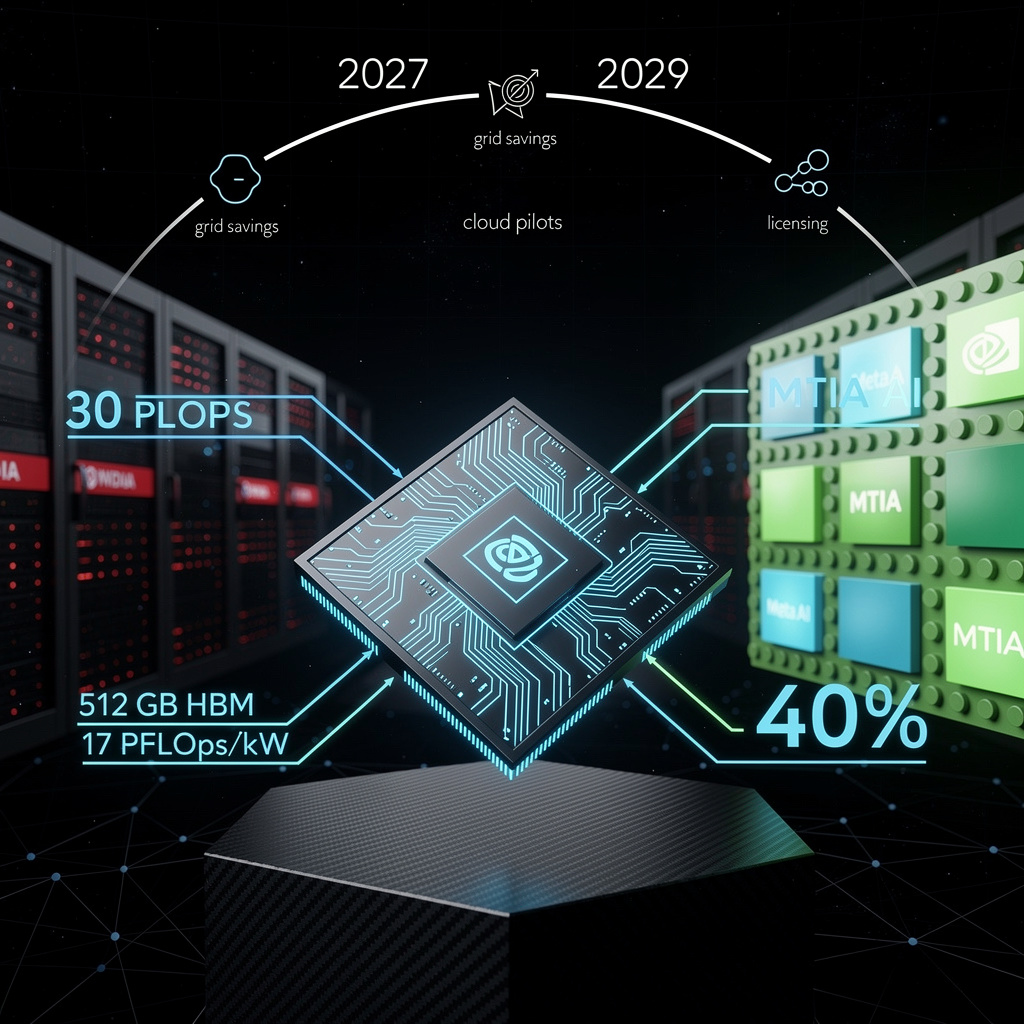
🚀 Meta MTIA 500 Delivers 30 PFLOPs at 1.7 kW, Slashes Inference Latency 40 %
30 PFLOPs in 1.7 kW—Meta’s new MTIA 500 crams 25× more AI muscle into one chip than its 2024 ancestor, sipping 17 PFLOPs/kW to outrun today’s best GPUs 🚀 That’s a 40 % latency cut for every scroll & ad you see. Your feed’s about to feel psychic—ready for an Nvidia-free internet?
Meta slipped a new engine into its data centers last month: a 1,700-watt ASIC the size of a paperback that can execute 30 quadrillion FP8 operations every second while holding 512 GB of data inside the package. The MTIA 450/500 family is not a research toy; it is already chewing through the ranking and generative-AI jobs that decide which post, ad or reel reaches 3.9 billion people.
How the numbers stack up
- Compute: 30 PFLOPs FP8 at 1.7 kW → 17 PFLOPs per kilowatt, roughly double the efficiency of today’s best inference GPUs.
- Memory: 512 GB HBM feeds the cores at 27.6 TB/s, enough to keep a 175-billion-parameter model resident on a single chip.
- Cadence: A fresh generation every six months—four times the traditional 18-24 month GPU cycle—thanks to a reusable chiplet Lego set.
What it changes, in plain sight
- Latency: 30-40 % shorter wait for an ad or translation, translating into more completed purchases and longer session times.
- Power bill: ~40 % less energy per inference; at Meta’s scale that is tens of megawatts freed for new workloads without new substations.
- Supplier risk: Nvidia’s share of Meta’s inference load slides from >90 % today to <30 % by 2029, tilting negotiation power back to the buyer.
Timeline worth circling
- Early 2027: MTIA 450 in production, cutting grid draw by an estimated 180 GWh/year across the fleet.
- Late 2027: MTIA 500 widens memory to 512 GB while holding the 30-PFLOP line; external cloud pilots begin.
- 2029: MTIA 600 targets 40 PFLOPs at <1.5 kW, and Meta starts licensing the chiplet blueprint—think ARM for AI silicon.
Bottom line
Meta just turned a warehouse of general-purpose GPUs into a line of bespoke, six-month refresh engines that answer only to its own code. If the modular cadence holds, the company that already writes the social graph will also write the silicon graph the rest of the industry must follow.
⚡️ $390M Quantum Vault: Canada Locks 500 Logical Qubits Inside TELUS Fiber Fortress
$390M just bought Canada its own quantum fortress: 500 logical qubits locked inside TELUS fiber vaults, slashing AI runtimes 25% 🇨🇦⚡️ First chips roll off Ontario line 2027—will your data stay sovereign or still live in foreign clouds?
On 16 March, Xanadu Quantum Technologies and TELUS signed a memorandum that turns Canada’s quantum aspirations into silicon and glass. Backed by CAD 390 million in federal-provincial money and a US $500 million SPAC war-chest, the pair will bolt Xanadu’s photonic quantum racks onto TELUS’s PureFibre backbone, creating the country’s first sovereign hybrid quantum-classical data-centre. The pilot node—two to three refrigerator-sized cabinets humming with 20-qubit chips—will sit inside an existing TELUS secure facility, keeping classified AI workloads on Canadian soil.
How the hybrid engine works
Each Aurora processor fires laser pulses through low-loss silicon-nitride waveguides, executing up to 35 million quantum gates before handing the reduced problem to AMD GPU clusters. PennyLane and the Catalyst compiler knit the two domains into one workflow; early tests already cut runtime 25 % compared with classical HPC alone. A dedicated “qubit factory” under construction in Ontario will print 5,000 photonic chips this year, scaling to 500 logical qubits per rack by 2029.
Impacts in parallel
- Security: Data never leaves Canadian jurisdiction → eliminates foreign-cloud exposure for defence and health analytics.
- Economy: 200 high-tech jobs by 2028 → CAD 15 million in federal pilot revenue already inked for 2027.
- Innovation: Modular racks lower entry cost for start-ups → projected 5–10 new quantum companies within five years.
- Climate: 20 % faster materials simulations → accelerates battery and catalyst R&D without extra energy burn.
Short, mid, long view
- 2026–2027: Pilot node live; 5,000 photonic chips delivered; first secure AI inference contracts worth CAD 15 M.
- 2028–2029: Ontario factory ramps to 25,000 chips/year; national network grows to 10 nodes; >100 fault-tolerant logical qubits demonstrated.
- 2030–2035: 500-logical-qubit sovereign data-centre captures >5 % of Canada’s HPC market; exportable quantum-secure architecture licensed to allies.
The payoff is bigger than bragging rights. If timelines hold, Canada will own a plug-and-play template for data-sovereign quantum computing, turning today’s science experiment into tomorrow’s strategic utility.
⚡️ 14 % Solar Forecast Error on Complex Terrain: Sandia Blind Test Flags Risk for US-German Projects
14.65 % error in PV yield forecasts on hilly sites—enough to erase a whole year of solar profit 😱. Sandia’s blind test of 7 top tools shows terrain & shading chaos blow models apart. Utility devs: are you still using flat-field software for rugged land? —Which site feature trips YOUR models most?
On March 19 Sandia National Laboratories dropped a quiet bombshell: the first blind shoot-out of seven commercial PV modeling packages. At a 15 kW Albuquerque roof and a 14.5 MW desert plant, median plane-of-array irradiance guesses missed reality by 6–14 %. On hilly, shade-strewn sites the spread doubled, showing that “industry-standard” tools are only standard for flat parking-lot arrays.
How the test worked
Sandia fed each vendor a year of anonymized weather and performance data, then locked them out of the actual meter readings. Models had to predict hourly output without knowing whether they faced a backyard array or a utility behemoth. Algorithms diverged first on how they sliced terrain shadows—some used 1 m LiDAR, others a single “horizon line”—and second on inverter clipping rules, where static curves added up to 3 % extra error.
Impacts
- Investor returns: a 14 % yield overestimate can flip a 1 GW project from 8 % to 5 % IRR—enough to kill financing.
- Grid planners: 30 GWh/year of missing output in a 200 MW cluster forces 6 % extra spinning reserve.
- Software market: vendors with 3-D shading engines now hold a 6–9 % accuracy edge—an advertised differentiator overnight.
Institutional response
Developers are already inserting “Sandia clause” in engineering contracts: if terrain complexity exceeds a threshold, two independent models must cross-check. Meanwhile, standards bodies have queued the study for the 2027 IEC 61724 revision, hinting at future compliance margins.
Timelines
- 2026: expect 25 % of utility RFQs to demand dual-tool validation; early patches from three vendors target clipping fixes.
- 2027–2028: industry adopts “complexity tiers”; LiDAR DEMs become default shading input.
- 2029–2030: interconnection rules could cap allowable modeling error at 8 % for non-flat sites; AI ensembles blending live sensor data enter commercial licenses.
Close
Sandia’s numbers shred the myth that any black box can size a solar plant. Accuracy is now terrain-specific, and the penalty for ignoring that is measured in million-dollar megawatt-hours. Pick your model like you pick your inverter—match it to the landscape, or the landscape will correct you at commissioning.
In Other News
- Google signs 20-year deal with DTE Energy for 2.7GW clean energy, allocating 1GW–1.7GW to Michigan communities
- Intel and CEA-Leti Demonstrate Channel-Last Integration of MoS2 Transistors on Silicon for Next-Gen Chips
- Fervo Energy secures $421M federal loan to scale geothermal power to 500MW in Utah by 2027
- Samsung enforces NCNR DRAM/NAND contracts, locking buyers into 3–5-year fixed pricing amid AI-driven demand surge

Comments ()