75 Senators Order AI Apps to Self-Police or Face Suits: Startups Face $300K Audit Bill
TL;DR
- U.S. Government Proposes National AI Bill with Duty of Care, Transparency Mandates, and Quarterly Job Impact Reports to DOL
- Mistral AI launches Forge platform for enterprise LLM fine-tuning on proprietary data, adopted by ASML, Ericsson, and European Space Agency
- AI-powered AI chatbot breach exposes 3.7M records: ExpressVPN uncovers unencrypted databases with 415GB audio, 3.9TB transcripts from Sears Home Services' retail chatbots
⚖️ 75-Senator AI Bill Orders Suicide-Filter Mandate, Threatens Section 230 Shield
75 senators just backed a bill forcing every AI app to police itself—or get sued. That’s 3-in-4 lawmakers telling your kid’s feed to stop self-harm posts or else. Start-ups face a $300 k audit toll while giants laugh. Who pays when code becomes cop? — TN families, your teen’s scroll is on the line.
Sen. Marsha Blackburn’s 18-page “AI Bill,” released Wednesday, would make every U.S. developer legally liable for protecting children, creators and conservatives, force every AI image, video or song to carry a tamper-proof label, and require quarterly spreadsheets to the Department of Labor showing exactly how many jobs their code has erased. With 75 co-sponsors already aboard—roughly three-quarters of the Senate—the draft is no press-release stunt; it is the closest Washington has come to a national rulebook for artificial intelligence.
How would it work?
Before a model goes live, an independent auditor must certify that its guardrails block content linked to eating disorders, self-harm or sexual exploitation for users under 17 with a false-positive ceiling of 2 percent. Platforms must embed digital watermarks that travel with any AI-generated file; failure to do so strips Section 230 immunity, exposing firms to the same lawsuits that traditional publishers face. Every 90 days, companies with more than 10,000 U.S. users must file a DOL report listing positions automated, workers re-skilled and net head-count change.
Who feels the sting?
- Start-ups: one pre-launch audit costs $150-300 k, a price few seed-stage firms can float.
- Big Tech: OpenAI, Google and Microsoft can amortize that fee across millions of users, widening an already yawning market-share gap.
- Workers: DOL projections show 0.4 % of U.S. jobs displaced annually, but a 0.6 % gain in AI-augmented roles—net positive only if the $12 billion retraining fund survives appropriations.
What happens next?
- Q2 2026: Senate Commerce Committee markup; Section 230 repeal likely narrowed to platforms that profit directly from unlabeled AI content.
- Q4 2026: DOL issues standardized job-impact template; pilot reports from Adobe and Amazon.
- 2027: NIST rolls out audit certification; FAIO (Federal AI Oversight Office) opens inside Commerce.
- 2028: First annual compliance sweep; platforms hosting >1 m unlabeled AI files face fines up to 4 % of U.S. revenue.
Bottom line
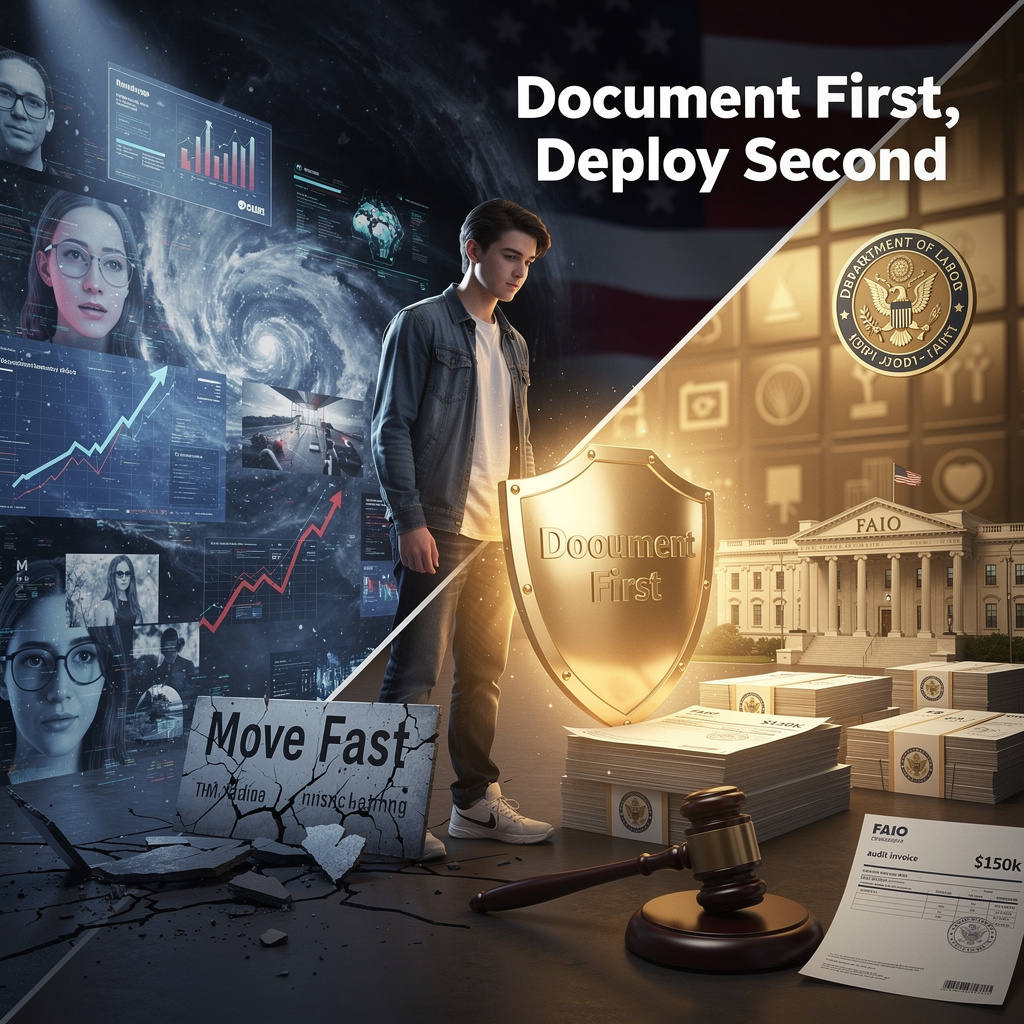
If the draft becomes law by early 2027, “move fast and break things” will be replaced by “document first, deploy second.” The reward is a safer web for 50 million teens and a data-rich map of AI’s labor shocks. The price is steeper legal exposure and a six-figure entry ticket to the U.S. AI market—barriers that could freeze out the next OpenAI before it ever ships.
🚀 Mistral Forge Targets $1 bn ARR Letting Giants Train LLMs On-Prem
€11.7 bn-valued Mistral just handed Europe the keys to its own AI: pre-train LLMs on secret docs, keep every byte on-prem, beat RAG by 15 %. 20 more giants queued—will your firm own its model or rent OpenAI’s? 🚀
On Monday Mistral AI opened the Forge platform, letting ASML, Ericsson, and the European Space Agency turn their own documents, code, and sensor logs into private large-language models. The move vaults the Paris start-up—valued at €11.7 billion only four months ago—into the fight for the €30-40 billion enterprise-AI market that hyperscalers have dominated through rented, black-box APIs.
How does it work?
Forge ingests text, structured tables, and operational records inside the customer’s firewall or on Mistral-managed clusters. Engineers pick a base model—Leanstral (6 B parameters, 3× faster queries) or Mistral Small 4 (119 B)—then run pre-training, supervised fine-tuning, and reinforcement-learning loops. The finished weights stay on the client’s disks; Apache 2.0 licensing keeps audit trails transparent and GDPR-compliant.
Why corporates are signing up
- Sovereignty: IP never leaves EU or Singapore jurisdiction, slashing cross-border transfer risk.
- Accuracy: Custom models beat generic RAG baselines by 10-20% on internal Q&A tasks.
- Lock-in: Companies own the model, dodging future API price hikes or policy shifts.
Competitive scorecard
- OpenAI/Anthropic: broader general knowledge, but data leaves the premises.
- AWS Bedrock: cheaper per-token pricing, yet offers no on-prem training path.
- Forge: higher upfront cost (≈ €10-15 m per enterprise) but full IP control and compliance-ready provenance.
What happens next
- 2026: 20 additional large customers push annual recurring revenue toward the projected $1 billion.
- Q1 2027: “Forge-Lite” SaaS tier gives mid-size firms capped compute and one-click licensing.
- 2028: Vertical bundles (legal, healthcare) and edge packages could lift Mistral’s share of enterprise LLM spend to 5%, adding $2-3 billion in ARR.
The takeaway
By hard-wiring data sovereignty into the training stack, Mistral is turning Europe’s strict privacy rules into a competitive moat. If the $1 billion revenue forecast holds, owning your algorithm may soon matter as much as owning your factory.
📢 3.7M Voice Files Exposed: Sears AI Chatbot Breach Opens Door to $40B Deep-Fake Fraud Wave
3.7M Sears customers’ voices left wide-open on the web—enough audio to fill 4 straight YEARS of talk-time 📢🔓 No password, no encryption, just click & download. Perfect fuel for deep-fake scams already pegged at $40B by 2027. If your home warranty ever spoke, it may now speak for scammers — did you get a heads-up?
A mis-click in the cloud has handed strangers the keys to 3.7 million Sears Home Services voice files—enough audio to fill 37 years of non-stop playback.
How did 415 GB of our voices end up on the open web?
Jeremiah Fowler found three storage folders that behaved like public web pages: no password, no encryption, no TLS. Browsers could stream .wav files directly, each holding up to four hours of background household chatter. Alongside sat 3.9 TB of chat transcripts—54,359 full sessions in one CSV alone—plus Excel logs and biometric voiceprints. The setup violated every basic rule for AI data pipelines.
Impacts
- Voice-cloning fraud: raw speech feeds deep-fake tools; industry losses projected at $40 B by 2027.
- Phishing & social engineering: names, addresses, service details exposed → higher success rate for targeted scams.
- Regulatory exposure: potential FTC and state-breach fines; no “reasonable safeguards” visible.
- Consumer trust: shoppers who once shared appliance woes now hear their own voices replayed on hacker forums.
What Sears did—and still must do
Within hours of Fowler’s alert, Transformco yanked public permissions, wrapped the data in AES-256, and added TLS 1.3 plus API-key gates. That stops today’s casual snoopers, but not determined intruders who already copied the files. A full forensic sweep, zero-trust architecture, and automated drift detection are the minimum ante before regulators and class-action lawyers finish shuffling their papers.
Timelines
- Next 3 months: expect FTC inquiry, state AG letters, first lawsuits; rival retailers quietly audit their own AI buckets.
- 2026–2027: new “AI-Consumer Privacy Act” drafts mandate encryption and audit trails for voice data.
- 2028: market for AI-security platforms protecting conversational datasets grows 30 % annually; voice-spoof detection becomes standard in call centers.
The takeaway
If we expect algorithms to listen like humans, we must secure the recordings like state secrets. Until then, every smart speaker is a potential witness—and every leaky database a future impersonator.
In Other News
- U.S. Army signs $20B contract with Anduril to consolidate 120+ defense tech contracts into single AI-driven battlefield platform
- FICO launches Credit Insights Lab to expand financial inclusion using alternative data and AI-driven scoring models
- Tempo Launches Mainnet with Machine Payments Protocol, Enabling AI Agents to Coordinate Programmable Payments Across Stripe, Visa, and Coinbase
- DeepSeek's stealth Hunter Alpha model surfaces on OpenRouter with 1T parameters and 1M token context, hinting at April V4 launch



Comments ()