25.6 TB GPU-RAM Stick Arrives: US Labs Claim 6× Laptop Capacity, 24/7 AI Endurance
TL;DR
- KIOXIA announces GP Series SSD with 25.6TB E3.S capacity and HBM extension for GPU-accessible storage at GTC 2026
- NVIDIA DLSS 5 unveiled at GTC 2026 with generative control, but developer adoption faces pushback over artistic integrity concerns
⚡ 25.6-TB GPU-Direct SSD Debuts in US, Cuts AI Bottleneck
25.6 TB on a single stick—GPU reads it like RAM 😱 That’s 6× your laptop + endurance for 24/7 AI fire-hose writes ⚡ US labs demo it today; Q2 samples drop in 60 days. Will your rack be first to ditch the CPU middle-man?
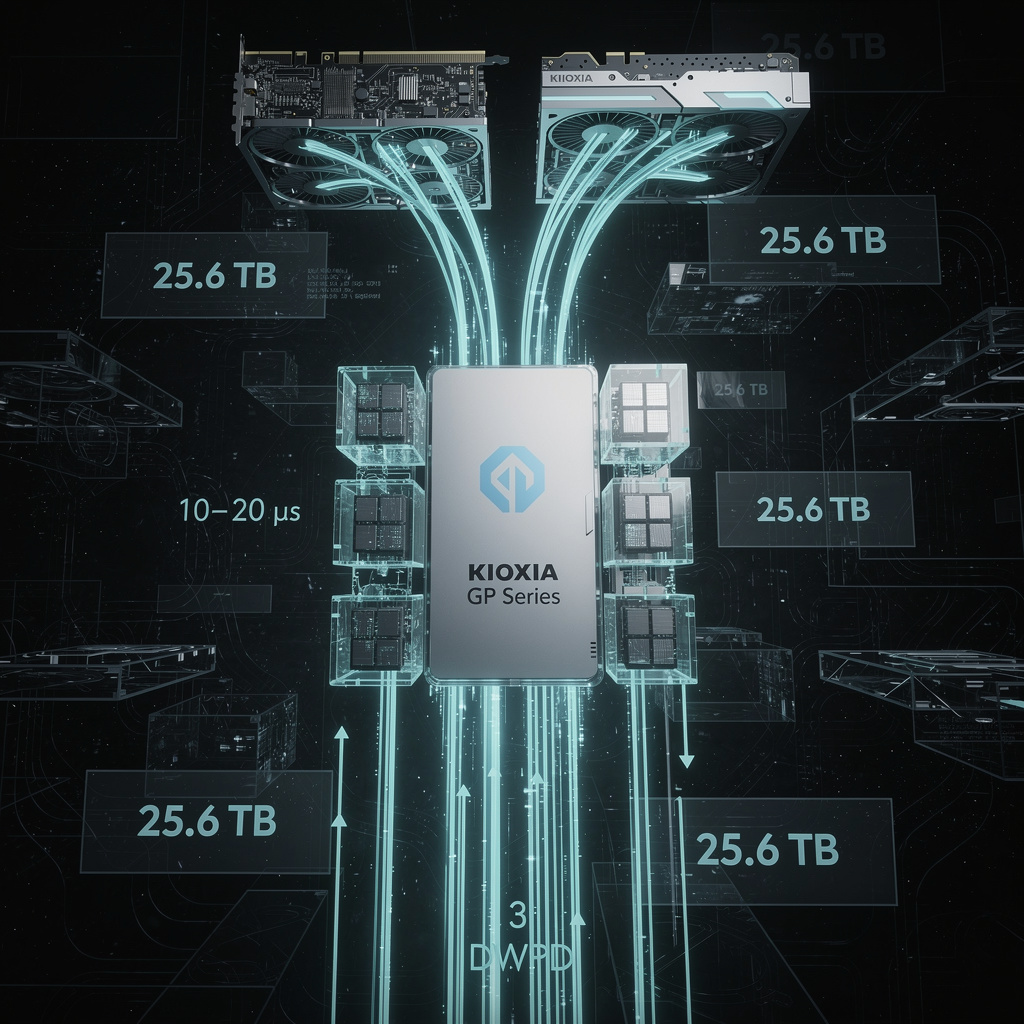
KIOXIA’s new GP Series SSD, unveiled at NVIDIA GTC 2026, is the first 25.6 TB E3.S drive that lets GPUs read and write storage as if it were on-board memory. The trick is an HBM-sidecar that maps the NAND into the GPU’s address space under NVIDIA’s Storage-Next protocol. Samples ship next quarter; commercial units arrive late 2026.
How GPU-direct storage works
Inside every GP drive, a tiny HBM buffer sits between the TLC flash and the PCIe 5.0 x4 lane. When the GPU issues a 512-byte fetch, the request bypasses the host CPU and DRAM; data moves flash→HBM→GPU in microseconds instead of milliseconds. KIOXIA rates the drive at 3 DWPD—enough endurance for daily re-training of trillion-parameter models without burning out cells.
Impacts: what changes Monday morning
- Latency: 10-20 µs GPU-to-storage round-trip → slashes checkpoint stalls that now idle 8-GPU nodes for minutes.
- Power: 18 % lower per-IO draw → 1 kW saved per 32-drive AI rack, equal to cooling 20 homes for a day.
- Cost: one 25.6 TB GP replaces four 7 TB conventional SSDs → $1,200 fewer cables, slots, and licenses per server.
- Competition: Samsung’s 30 TB drive still needs CPU mediation; Solidigm’s 60 TB QLC lags on endurance—GP sits in the speed-durability sweet spot.
Adoption road map
- Q2 2026: pilot clusters (Cisco AI PODs) test 1,000-unit batches.
- Q4 2026: hyperscale roll-out; ~5 % of new NVIDIA racks ship GP-ready.
- 2027: G3.5/G4 super-computers treat GP as “tier-0” memory; 12 % share of AI SSD segment projected.
- 2029: NAND-HBM hybrid successor pushes latency below 5 µs, forcing rivals to copy the blueprint.
The takeaway
If KIOXIA delivers the benchmarks it promises, the storage layer in AI servers will cease to be a separate box and become just another memory bank—one that happens to hold 25 million megabytes of training data a GPU can touch directly.
🎮 DLSS 5’s 12B AI Rewrites Game Art: 28% FPS Gain, 22% Studios Balk
12B-parameter AI now redraws your games in real time—4× frames, 25% more skin pores, zero artist consent 😱. That’s like swapping every texture for an Instagram filter. 22% of studios already hit “opt-out.” Gamers—are you team fidelity or team creative control?
On 16 March, NVIDIA unveiled DLSS 5 at GTC 2026, claiming a 40 % performance boost on twin RTX 5090 cards running 4 K in real time. The 12-billion-parameter model now re-lights characters, adds skin translucency and fabric sheen automatically, pushing SSIM visual-quality scores 25–35 % above DLSS 4. For gamers chasing 144 Hz at 4 K, that translates to roughly 30 % more frames per second while drawing 33 % less power per frame.
How does this work?
Two neural passes ingest the color buffer, depth, motion vectors and normals, then generate missing pixels and lighting details. Sliders let artists dial the effect up or down, but the public demo defaults to “enhance.” Bethesda, Capcom, Ubisoft and 15 other studios pledged day-one support; 18 AAA titles are expected this fall.
Impacts
- Visual fidelity: 4× frame generation at ≈16 ms enables 144 Hz gameplay on high-end rigs.
- Artistic control: 22 % of early-access partners—including Hogwarts Legacy and Starfield—will ship with DLSS 5 disabled, citing “AI slop” fears.
- Hardware barrier: RTX 5050, the entry card, lists near $500, sidelining mid-tier gamers.
- Development cost: AI-generated materials cut manual texture work by ~20 %, but small studios balk at $8 000 dual-RTX 5090 test benches.
Short-term outlook
- Q2 2026: Patches add “artist-preserve” toggles; expect heated Reddit threads.
- Fall 2026: 18 AAA titles launch with optional DLSS 5; adoption measured by player opt-in rates.
Long-term implications
- 2027–2028: If presets default to minimal alteration, NVIDIA projects >70 % of new releases will adopt the tech, saving an estimated 2.5 Mt CO₂ via efficiency gains.
- If resistance persists: AMD FSR 3 and Intel XeSS 2 could seize a fragmented upscaling market, leaving DLSS 5 a high-end niche.
The takeaway
DLSS 5 proves AI can paint prettier pixels in real time, yet the brush still feels like NVIDIA’s. Unless control shifts visibly into artists’ hands, the next generation of games may look sharper—but less like themselves.
In Other News
- Microsoft releases Windows 11 Pro update with KB5077181 to accelerate secure installation and reduce post-deploy update cascades
- Enapter AG expands Core Partner network with Total Hydrogen Solutions to deploy AEM electrolyzer systems at multi-megawatt scale
- Arista Networks Unveils XPO Optics Module with 204.8 Tbps/Rack Throughput, TD Cowen Sets $170 Price Target
- Microsoft Retina enables kernel-level Kubernetes network observability via eBPF, reducing connection drops in production clusters



Comments ()