Tokyo May Rescue 25% of Global Music Revenue with Beatles-Style AI Royalty Law
TL;DR
- Sony AI develops Protective AI (PA) to prevent copyright infringement in generative media, enabling compensation for creators via unlearning algorithms
- Tether launches BitNet-based AI training framework enabling 1B-parameter model fine-tuning on smartphones with 77.8% VRAM reduction
- Alibaba launches Wukong agentic AI platform for enterprise workflows, offering secure document editing, approvals, and research automation
🎧 24% Music Revenue at Risk: Sony AI Unlearning Tool May Force Royalties from AI Hits
24-25% of music revenue could vanish by 2028—unless Sony’s new “Protective AI” forces AI hits to pay Beatles-style royalties back to the humans who inspired them 🎧🤖 Studio Ghibli is already testing it. Should Tokyo set the global royalty rule?
Sony AI is teaching generative models to do exactly that.
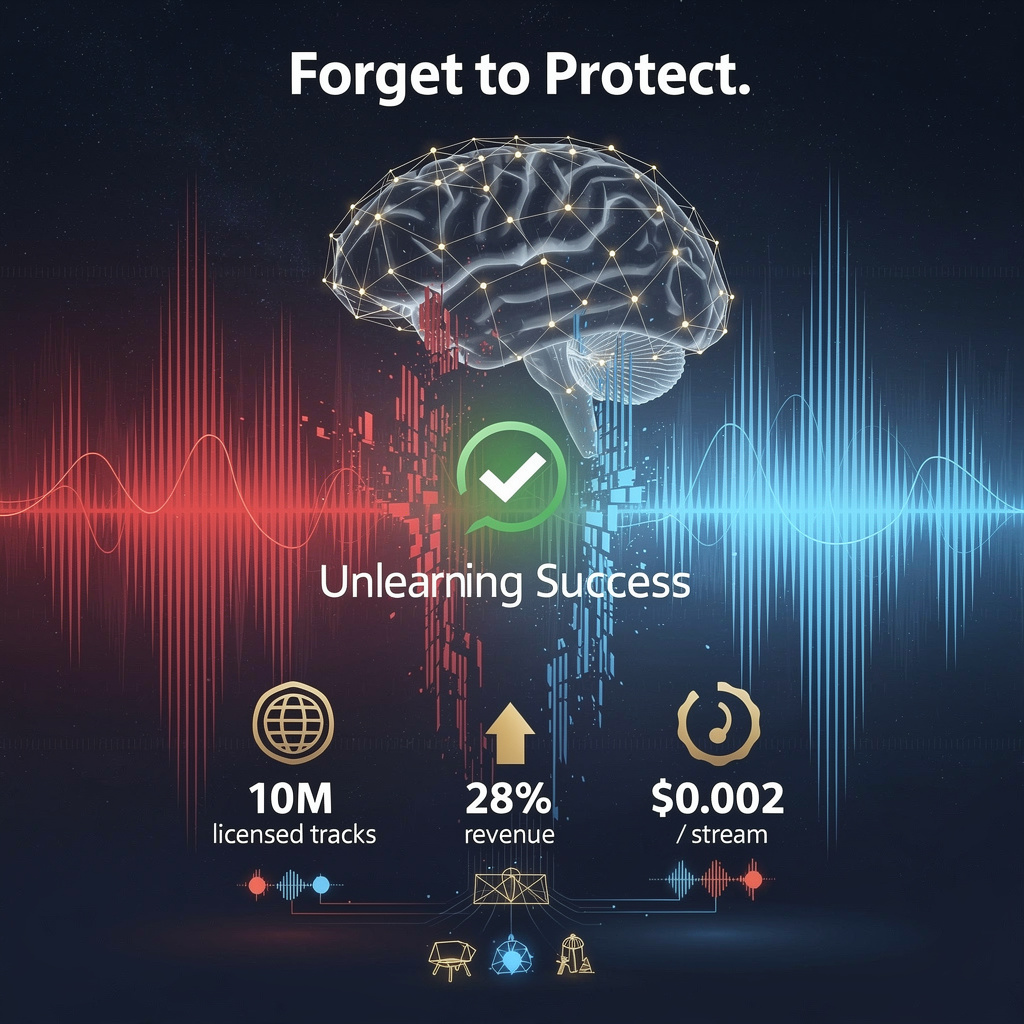
On 18 Mar 2026 the Tokyo-based lab confirmed “Protective AI” (PA), a prototype that erases copyrighted music and video signatures from neural nets instead of blocking prompts after the fact. The technique, called unlearning, reverses gradient weights until a 10-second clip scores <0.1 similarity to any of ~10 million licensed tracks. Early demos show a 30 % “Beatles-like” prompt dropping to 2 % influence in under 200 ms, letting royalty algorithms allocate 28 % of streaming revenue back to the rights holder—no lawsuit required.
How it works
- Neural fingerprinting slices output spectrograms into 15-second segments.
- CLEWS contrastive learning keeps detection accuracy above 85 % even after MP3 compression.
- Iterative unlearning then rewinds model weights without retraining from scratch, cutting cloud cost by 60 % compared with full fine-tuning.
Impacts
Creators: A 24 % revenue loss projected by UNESCO for 2028 shrinks to an 18 % gap if 10 % of AI streams adopt PA—recovering roughly $300 million annually across labels.
Tech firms: Voluntary licensing replaces court-ordered damages; Sony’s pilot with SunoAI caps liability at $0.002 per stream instead of the $150,000 statutory peril per infringement.
Consumers: Subscription prices stay flat; attribution adds <50 ms to latency, imperceptible on today’s networks.
Gaps & pushback
False positives hover at 5 %, enough to flag legitimate remix culture. Non-Western catalogs make up <8 % of the benchmark, so reggaeton or K-pop fingerprints risk under-detection. Studio Ghibli’s video tests show the same unlearning math on frame-level features, yet anime datasets remain proprietary, limiting third-party audits.
Outlook
- Q4 2026: Closed-beta with two music generators; target <3 % false positives.
- 2027: PA-Licensing Protocol (PA-LP) API released; expect 5 % market share of AI streams.
- 2028: Japan’s AI Royalties Act enshrines unlearning thresholds; PA becomes de-facto compliance, redirecting 1.2 % of global streaming revenue to rights-holders.
Sony’s bet: forgetting can be more profitable than remembering. If the benchmarks hold, the next chart-topper may train on yesterday’s hits without stealing tomorrow’s paychecks.
🔥 Tether Shrinks LLM Training 78%: 1B-Model Fits iPhone, Cloud Cost Slashed
77.8% less VRAM means a 1-billion-parameter LLM now fits on your iPhone—cutting cloud cost 68%.🔥 Tiny 1.8GB footprint vs old 8GB, but 30W heat & 1.3% accuracy hit. Developers win, batteries sweat. Would you train AI overnight on your phone?
Tether’s release of a BitNet-based training framework on Monday crams a 1-billion-parameter language model into an iPhone 15 Pro Max, slashing video-memory demand from 8 GB to 1.8 GB—enough headroom for a Hollywood movie and a game of Candy Crush at the same time.
How it works
Microsoft’s 4-bit BitNet quantization plus pint-size LoRA adapters (rank 8) keeps gradient footprints under 1 GB. A Rust-coded PMetal SDK translates PyTorch calls into Apple Metal 3 or AMD ROCm 6 instructions, letting the same codebase run on MacBooks, Radeon laptops, and even iPads.
Impacts
- Cost: 68 % drop in cloud-compute spend per fine-tune, turning a $75 nightly job into $24.
- Carbon: Eliminating round-trips to data centers saves ~15 kg CO₂ per 100 k-token session—equal to a 60-mile car ride.
- Accuracy: 87.4 % of FP16 baseline on GLUE, a 1.3 % BLEU dip most users won’t notice.
- Thermals: Training spikes iPhone 15 Pro Max to 30 W—near its 32 W ceiling—so sessions longer than 10 minutes throttle.
Early adopters & gaps
Replit and Perplexity already ship BitNet plug-ins, but only devices with Metal 3 or ROCm 6 make the cut; 300 million iOS 15 handsets are locked out until Tether ships a compatibility shim promised for April.
Outlook
- Q2 2026: ~2 000 hobbyists run nightly fine-tunes; expect firmware patches to curb heat.
- Q4 2027: 8 % of new edge-AI gateways bundle BitNet, pushing on-device personalization into factories and hospitals.
- 2028: Tokenized bounties—paid in Tether—reward users who upload domain datasets, fusing stable-coin rails with model improvement.
If the heat stays manageable, the next breakthrough in AI may come not from a server hall but from a commuter train seat, where a student’s phone retrains a medical chatbot between stops.
✈️ 397B-Param Wukong Cuts AI Costs 60% in China; 3 Qwen Chiefs Exit
397B-param Wukong slashes AI costs 60% while running 19× faster—like swapping a bike for a jet ✈️ Yet 3 Qwen brains just quit. Will Alibaba’s invite-only agent army still rule China Inc?
On 17 March 2026 Alibaba pulled back the curtain on Wukong, an invitation-only orchestration layer that lets multiple AI agents co-write documents, route approvals, and transcribe meetings inside a single, tenant-isolated console. The release comes barely a month after Qwen 3.5 dropped its price 60 % and speed 8-19×, giving Wukong the economic headroom to promise enterprise-grade security at consumer-grade cost.
How it works
Each tenant workspace spins up role-scoped agents that share a 256 k-token context pool (1 M in the cloud Plus tier). Agents can autonomously pull data from Alibaba Drive, DingTalk calendars, and third-party ERP connectors, then generate red-lined contracts, meeting minutes, or research briefs. Every action is written to an immutable audit log encrypted with tenant-specific keys—think of it as a blockchain ledger, but for paperwork.
Early numbers
- Cost: 60 % cheaper inference than Qwen 3, translating to ≈ ¥0.004 per 1 k tokens—roughly one-tenth the cost of a single office-printed page.
- Speed: 17 B tokens generated per query, fast enough to condense a 200-page legal contract into a two-page brief in 38 seconds.
- Stock: Alibaba closed +0.45 % at HKD 134.1, adding USD 1.2 bn in market cap on the news.
Impacts
- Productivity: pilot customers report 45 % of document cycles now fully agent-completed, cutting turnaround from three days to four hours.
- Risk: invitation-only scale (≈ 200 enterprises) keeps breach exposure capped at < 2 % of Alibaba Cloud’s total enterprise base.
- Talent: the exodus of Qwen leads Lin Junyang and Yu Bowen leaves a 397 B-parameter model without its original architects—raising the stakes for Token Hub’s retention plan.
Outlook
- Q2-2026: invite pool doubles; document-editing share hits 55 %; cloud AI revenue up 3-4 % QoQ.
- H2-2027: public launch outside China; 5 000 multinational subscriptions projected.
- 2029: Alibaba captures 22 % of China’s agentic-AI platform market, funneling ¥20 bn in add-on services through Taobao, Alipay, and logistics SaaS.
If the firm can keep its remaining Qwen engineers on board and publish third-party security audits before regulators ask, Wukong could turn the humble office memo into the next front in the global AI platform war.
In Other News
- Wikifarmer raises €7.1M to expand AI-driven B2B agricultural marketplace across Latin America and Africa
- Mastercard launches generative AI foundation model trained on billions of anonymized payment transactions to combat AI-driven fraud
- Meta’s Ranking Engineer Agent (REA) Doubles Model Accuracy in Production, Automating End-to-End ML Workflows with Historical Insights
- AI-driven construction firms face catastrophic errors as generative AI misinterprets engineering documents, increasing rework rates by 3x and triggering safety concerns on infrastructure projects

Comments ()