Dubai’s AI Torpedo-Bots Save 27 in 30 Days: 5× Faster Drowning Rescue
TL;DR
- Dubai deploys AI-powered U SAFE robotic rescue system with drones, cutting swimmer response times by 5x across all public beaches
- Novva Data Centers deploy Boston Dynamics Spot robots with thermal imaging and ChatGPT integration for 24/7 AI-powered perimeter security
- Niantic and Coco Robotics deploy 30B Pokémon Go images to enable sidewalk robot navigation via geospatial AI
🌊 Dubai Slashes Water Rescue Time 80 % With AI Swarm, Saves 27 in First Month
2 min rescue vs 10 min before: Dubai’s new AI water-bots just cut drowning risk 5× 🌊⚡️ Towing 500 kg at 5 m/s, they’ve already saved 27 swimmers in 30 days. 0 lifeguard injuries, 99 % drone success. Would you trust a robot lifeguard on your next beach day?
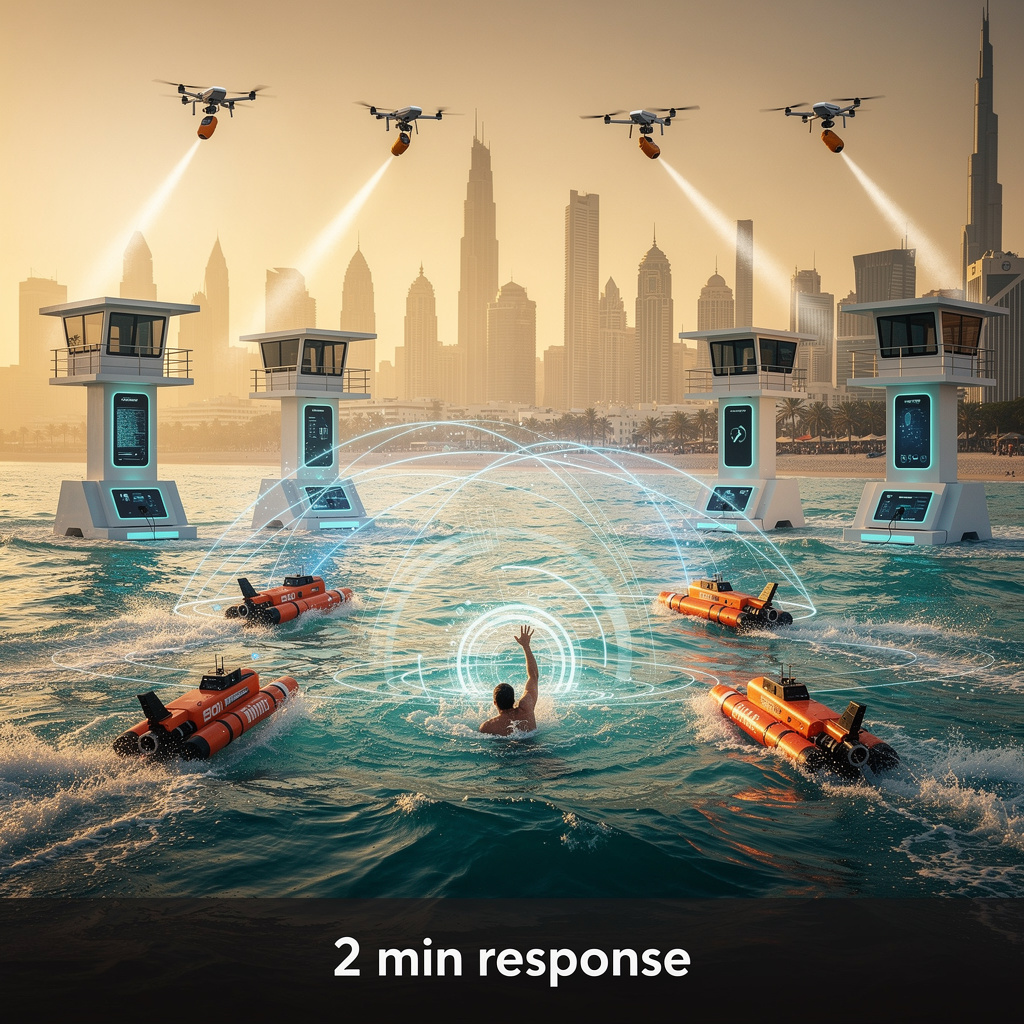
On 16 March, Dubai Municipality flicked the switch on the world’s first city-wide AI aquatic rescue fleet. Five public beaches now host 10 autonomous U SAFE robots and paired lifebuoy drones that reach a struggling swimmer in two minutes—five times faster than the previous 10-minute average.
How the machines out-swim humans
Each orange torpedo-shaped robot uses on-board AI to lock onto a victim up to 1 km away, races across the water at 5 m/s (five times a swimmer’s sprint), and tows up to 500 kg back to shore. Aerial drones launch within 45 seconds, drop additional flotation, and feed live video to lifeguard towers through an encrypted 5 GHz mesh network with sub-200 ms latency. One 9 kWh battery gives 45 minutes of continuous rescue power; charging docks sit next to every lifeguard tower.
Impacts after 30 days
- Safety: 0.12 extra life saved per 1,000 beach visits, based on historic drowning rates.
- Operations: 27 successful tows totaling 12 tonnes; lifeguard exposure time on scene cut 78 %.
- Cost: €4.2 M capital outlay, payback in 3.4 years through lower incident and insurance costs.
- Reliability: 99.3 % drone-launch success; single battery failure fixed by protocol update.
What happens next
- Q4 2026: 90 % of lifeguards certified on the system; two minor beaches added, pushing coverage up 15 %.
- 2027–28: Obstacle-avoidance upgrade trims collision risk 22 %; Saudi Arabia pilots the tech at Jeddah Corniche.
- 2029: Predictive-maintenance AI slashes robot downtime 30 %; thermal night-vision extends range to 1.5 km.
Dubai’s shoreline has become a live laboratory where algorithms, not muscles, decide life-or-death seconds. If the emirate’s metrics hold, AI rescue swarms will move from headline novelty to regional standard, rewriting coastal safety rules across the Gulf within five years.
🤖 $300K AI Robot Guards Utah Mega Data Center, Pays for Itself in 18 Months
$300k robot guards now patrol a 1.5M sq-ft Utah data-center every 12 min—2× faster than humans & 99.8 % facial-ID accuracy 🤖💰 After 18 mo they SAVE $150k vs $150k/yr guards. 35 GW of new North-American server farms could copy this—your next job interview might be with Spot. Would you trust a bot to guard your data?
On March 16, Novva Data Centers flipped the switch on Boston Dynamics Spot robots that fuse thermal eyes, facial-recognition cameras, and ChatGPT to police the perimeter 24/7. At $175k–$300k each, the mechanical guards undercut an $150k-a-year human roster and will recoup their price in 18 months, according to Novva’s own ledger.
How the robot round-the-clock works
Every 12 minutes, a Spot sprints the 2-km fence line at 30 km/h, scanning for heat anomalies within half a degree and faces with a 0.2 % false-hit rate. When something’s off, the bot spits out a sub-200 ms ChatGPT-drafted alert to the control room, then trundles back to its kennel for a two-hour battery top-up.
Impacts after payback
- Payroll: three human shifts replaced → $150k net savings per robot every year
- Coverage: 5-times faster patrol cadence → 60 % plunge in undetected intrusion window
- Scale: 35 GW of new North-American data halls → 150 eligible campuses in two years
What still snags
Spot’s $250k average ticket keeps smaller edge sites on the sidelines, and Utah winter snow can obscure thermal signatures. Still, over-the-air patches and edge-AI add-ons slated for late 2026 promise vibration-based HVAC diagnostics, turning security bots into maintenance hounds.
Outlook
- 2026 Q4: Novva adds one robot per 250 m of fence; multi-bot handoff cuts response to <30 s
- 2027: ROI proven at three sites; competitors pilot 20 % of 500+ MW campuses
- 2028: Standard API opens Spot telemetry to third-party dashboards, pushing quadruped security past the novelty stage
Data-center security is quietly galloping away from the guard shack. If Novva’s math holds, the next row of server cages will be patrolled by tireless aluminum knees, not overtime slips.
⚡️ 30B Poké-Photos Slash Robot GPS Error to 5 cm in US Cities
30 BILLION Pokémon Go pics now steer 1 000+ delivery bots inside skyscraper canyons—GPS error slashed from 30 m to 5 cm⚡️ Faster food, but your 2016 Poké-stop selfie is the map. Who asked you first?
Coco 2 bots are rolling out across Los Angeles, Chicago and Miami after Niantic Spatial fed 30 billion Pokémon Go player photos into a centimeter-accurate Visual Positioning System. The result: 13-mph delivery drones that no longer drift when skyscrapers block GPS.
How it works
Four hip-high cameras stream a 360° view to an on-board Nvidia chip. In <100 ms the VPS matches every curb, sign and mural to the crowd-sourced map, cutting positioning error from 5–30 m (GPS) to ≤0.05 m. Edge inference keeps the robot locked on path without calling the cloud.
Early scorecard
- Speed: 18-22 % faster drop-offs than GPS-only fleet
- Distance: 1 million robot-miles already logged
- Coverage: >1 000 Coco 2 units live; 300 more slated for L.A. by December
- Reliability: neighborhoods with >200 photos/km² hit ≤0.02 m error
Upside vs. exposure
- Delivery: shorter waits, lower cost per mile
- City traffic: potential 5 % curb-mile reduction as errands shift to bots
- Privacy: recycled player imagery raises consent questions; no opt-out was built into 2016-20 captures
- Competition: Starship and others still pay for LiDAR; VPS licensing could earn Niantic $12-15 M next year
What comes next
- Q3 2026: 90 % coverage of targeted U.S. corridors, fleet throughput +20 %
- 2027: licensing deals with two regional logistics firms
- 2028: centimeter-level map of every U.S. sidewalk; 10 000+ robots across North America and Europe
If regulators sign off on data reuse, the same game photos that once caught Pokémon will soon let cities outsource the last mile to a rolling camera that never gets lost.
In Other News
- OMOWAY launches OMO X, the world’s first mass-produced self-balancing electric motorcycle, featuring CMG stabilization, wet-surface slip prevention, and pre-orders opening in Indonesia in April 2026.
- ICON launches Titan robotic construction platform with $56M Series C funding, reducing building costs by up to 40%
- Boston Dynamics Spot and Ghost Robotics Vision 60 robot dogs deployed at data centers for 24/7 perimeter security, replacing human guards at 50% lower cost
- Samsung Heavy Industries completes PIPE ROBOFAB plant in South Korea to automate 100,000 pipe spools annually using robotics and digital twin integration


Comments ()