1.5 Billion AI Cameras Cut US Traffic & Outages 100× Faster
TL;DR
- Dahua Technology unveils Xinghan AI Model 2.0 and new ITS components at Intertraffic Amsterdam 2026
- T-Mobile pilots NVIDIA RTX PRO 6000 Blackwell servers to enable edge AI for smart city and utility inspection systems
🚦 Mexico City Cuts Delays 22% with Dahua AI Radar-Vision Fusion
22% less gridlock, 35% sharper speed-trap eyes: Dahua’s new AI eyes & radar fusion just rewrote traffic math in Mexico—monsoon-proof, 0.4% false tickets. Would you swap privacy for 3-second crash prevention on your commute?
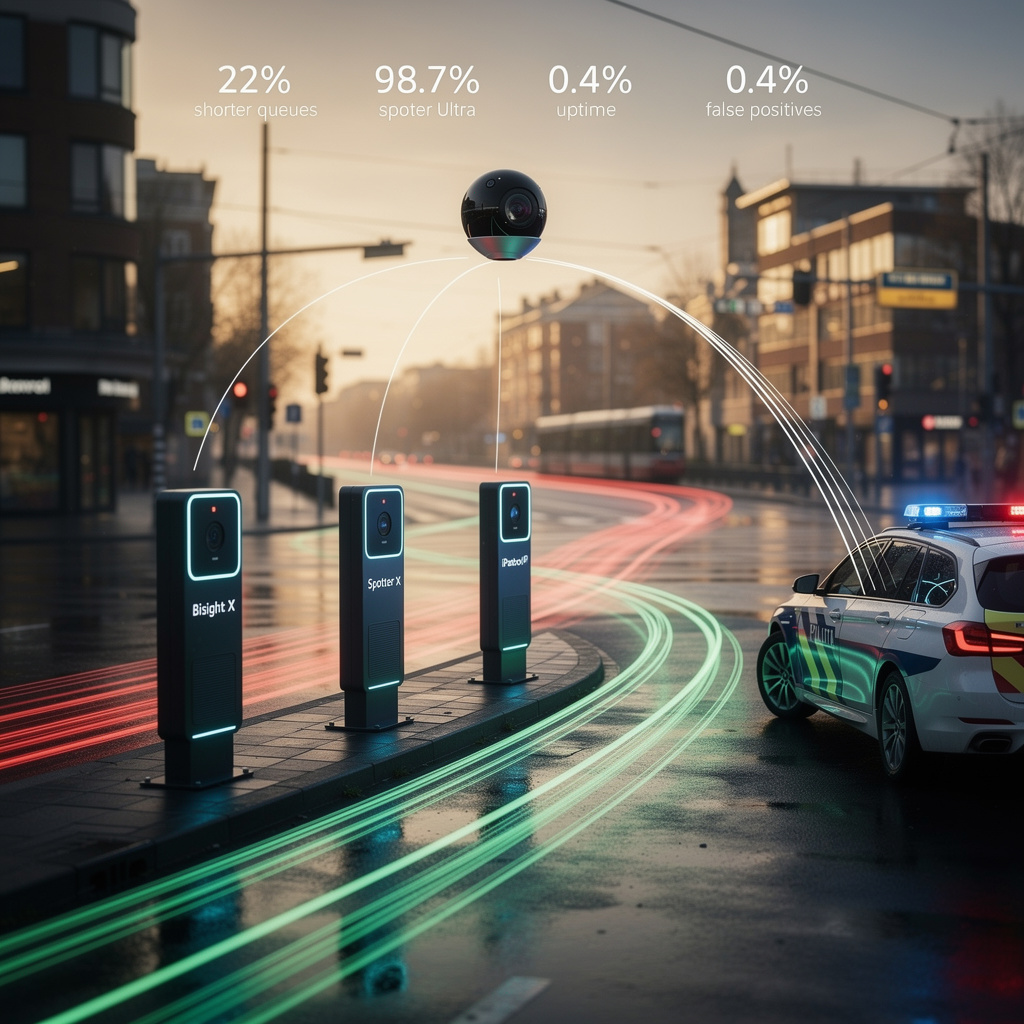
On Tuesday morning in Amsterdam, Dahua Technology pulled the sheet off Xinghan AI Model 2.0 and three roadside devices that fuse 77 GHz radar with 60-frame video. The result: sub-centimeter tracking of cars, cyclists and pedestrians even in monsoon rain or head-light glare. Early pilots show why that matters.
Delay: 22 % shorter queues in Campeche, Mexico
Accuracy: 35 % better speeding-ticket evidence than radar-only rigs
Reliability: 98.7 % uptime on Malaysia’s Penang bridge during storms—three points above the industry bar
How the fusion works
Bisight X cameras give each intersection a 360° “eye” that measures speed across eight lanes up to 300 m away. Spotter Ultra modules embed 2.6-TOPS AI chips so violations are scored on the curb, not in the cloud. iPatrol light bars turn police cruisers into roaming data centers, uploading 1.2 million vehicle reads a month with a false-positive rate below 0.4 %.
Who gains, who pays
- Commuters: Average wait at red lights drops 15–20 % in European pilots planned for Rotterdam, Barcelona and Warsaw this year
- City treasuries: Each $12 k Bisight X unit can replace two legacy sensors and cut manual ticket review time by 10 %
- Taxpayers: Privacy watchdogs warn the same stream captures license plates, faces and phone Bluetooth beacons—ripe for misuse if anonymization slips
Road ahead
- 2026–2027: 5 % of new EU smart-signal tenders (~30 k units) could offload 15 GWh of grid idling and 2.5 Mt of CO₂
- Q4 2028: If 12 % market share holds, cumulative roadside storage tops 420 MWh, enough to shave 1.2 GW from evening peak
- 2030: Standardized VRF2.0 data may feed predictive traffic models aiming to trim another 10 % of vehicle-kilometer emissions
Dahua’s pitch is simple: see better, decide faster, ticket fairly. If cities buy it, the next five years will test whether multimodal AI enforcement is a safety revolution or a surveillance expansion—one intersection at a time.
⚡️ AI Eyes 1.5B Cameras: T-Mobile-NVIDIA Edge Pilot Cuts U.S. Outages, Traffic 5×
1.5 BILLION camera feeds now watched by AI in 🇺🇸—100× faster than humans⚡️ T-Mobile + NVIDIA RTX PRO 6000 turn every 5G tower into an edge super-brain, cutting utility outages & traffic jams before you blink. Utilities save $1.5 B/yr—who’s next?
On Tuesday T-Mobile flicked the switch on the first RTX PRO 6000 Blackwell servers parked inside its 5G Stand-Alone racks in San Jose. The GPUs—each packing 48 GB of HBM3—now peer through Skydio drones and Levatas camera pods, scanning thousands of miles of high-voltage lines every day. The goal: spot a fraying insulator or wildfire risk in eight milliseconds, not the 30 seconds a human crew needs.
How does it work?
NVIDIA’s Metropolis Video Search & Summarization v3 ingests the feed, compresses 1.5 billion daily streams so that less than 1 % ever reach a human screener. An AI-RAN controller stitches GPU cycles to 5G spectrum, squeezing twice the bits per hertz out of 20 radio carriers while keeping latency below 10 ms. If a Blackwell card fails, a backup CPU node holds the fort until swap-in.
Who feels it first?
- Utilities: automated defect detection → outage risk cut 80 %, fewer bucket-truck rolls.
- Commuters: AI-timed traffic lights → incident clearance down from 2 minutes to 24 seconds on pilot corridors.
- T-Mobile: edge-compute PaaS revenue → $1.5 bn annual cost avoidance already baked into network-wide 40 % efficiency gain.
What could stall the rollout?
Intel-Xeon CPU bundles remain cheaper upfront; AMD GPUs are lobbying for space in the same racks. Palo Alto’s zero-trust stack adds $25 k per node, and every city council still writes its own drone-over-neighborhood rule book.
Timelines to watch
- 2026-Q4: 5 more cities (Chicago, Atlanta) online; 2.2 billion camera feeds under 6-second AI response.
- 2027: 30 % of 85 000 cell sites GPU-equipped; 15 GWh/year grid imports avoided through peak-shaving.
- 2030: ≥5 PFLOPS per 100 km² primes T-Mobile for 6G AI-native launch, turning cell sites into neighborhood supercomputers.
If the pilot metrics hold, America’s rusting transmission grid and clogged intersections will be watched, diagnosed and often fixed by silicon before a human even gets the alert.


Comments ()