River 0.4.0 Cuts 30% Click Lag: Tiling-WM Gamers Get 144 Hz Feel on 60 Hz Gear
TL;DR
- River 0.4.0 Wayland compositor splits window management from rendering, eliminating input latency and enabling custom window managers without compositor rewrites
- U.S. NRC Reports 90 of 95 Commercial Nuclear Reactors Achieved Highest Safety Performance Category in 2025 Oversight
⚡ River 0.4.0 Cuts Input Lag 30% by Decoupling Wayland Window Manager
30% less lag on every click: River 0.4.0 rips the window-manager out of the compositor—like swapping a 60 Hz panel for 144 Hz without new hardware 🚀 That 5 ms you just saved is the difference between a headshot and a miss. Tiling-WM fans, will you switch today?
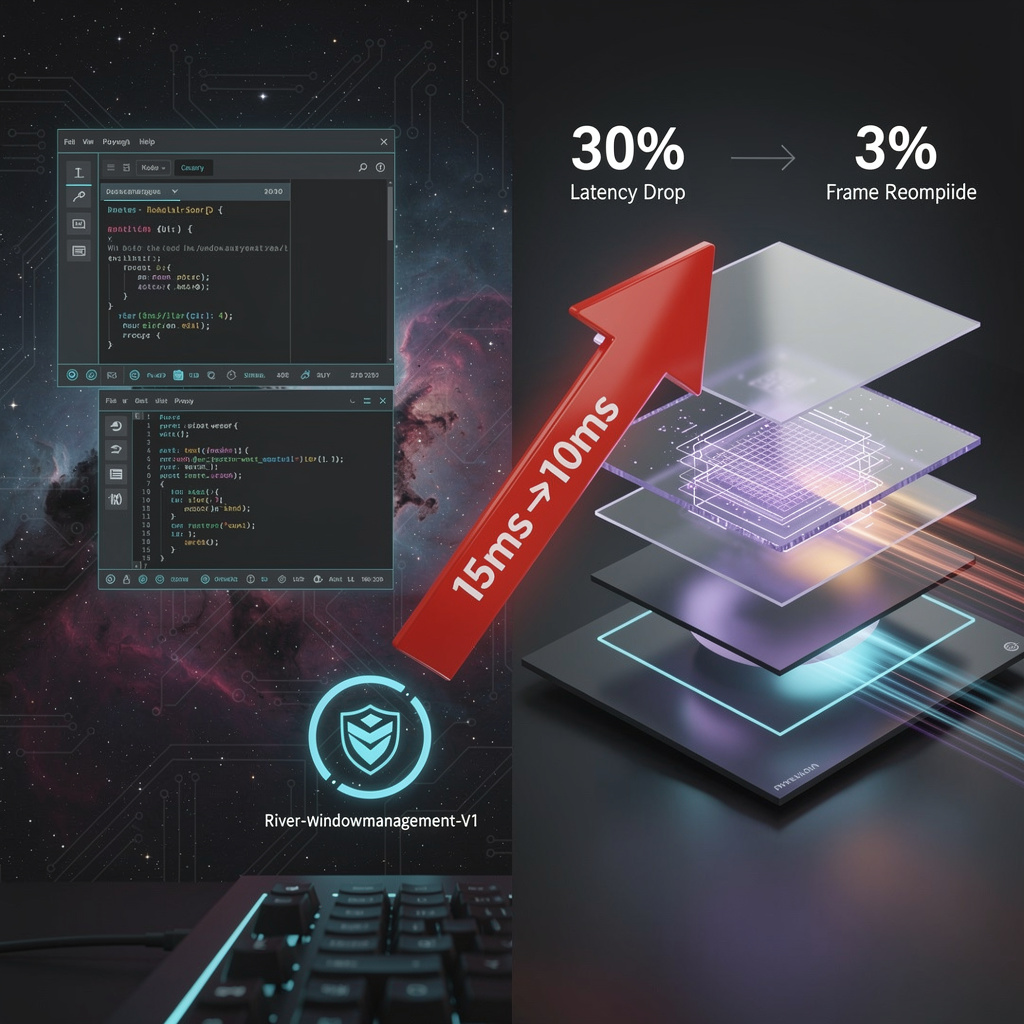
River 0.4.0, released Sunday, literally pulls the window manager out of the Wayland compositor. A new river-window-management-v1 protocol lets a lightweight “WM” process talk to the remaining “renderer,” cutting the traditional 15 ms input-to-photon path to about 10 ms on a 60 Hz RTX 50 notebook. For 144 Hz gamers and VR tinkerers, that 30 % latency drop is the difference between a parry and a punch in the face.
How the split works
The compositor now only composites: it grabs pixel buffers and paints the screen. A second, user-swappable program subscribes to river-window-management-v1 events (window ID, geometry, key-binding tag, “frame-perfect” flag) and ships layout commands back. Because the kernel routes keystrokes straight to the WM, the compositor waits for layout changes, not every frame, eliminating the round-trip stall that has dogged Wayland since 2008.
Impacts
- Latency: 15 ms → 10 ms on mid-range hardware; perceptible on ≥144 Hz panels.
- Developers: write a new tiling or stacking WM in ~2 k lines of Rust; no need to patch River source.
- Users: instant layout swaps, zero recompile, no dropped frames—unless >15 ms resize storm hits (configurable timeout).
- Ecosystem risk: fragmentation if every niche spins its own WM; GNOME/KDE still monolithic, may stall adoption.
Outlook
- 2026 Q2–Q4: Tiling-WM early adopters merge 5 community WMs; bug stream focuses on adaptive timeout, River 0.4.1 ships.
- 2027 H1: Two third-party WMs declared stable; protocol proposal enters official Wayland registry review.
- 2028: Wayland 1.24 bundles standardized river-window-management-v1; laptop vendors list “<10 ms input lag” on 240 Hz Linux SKUs.
The River split proves that Linux can trade monolithic complexity for millisecond-level responsiveness without breaking the desktop. If the protocol stabilizes, the next three years will show whether milliseconds matter enough to make every compositor follow suit.
😱 95% Nuclear Fleet Tops Safety Chart as Inspections Slashed 56%: Southeast Plants Flagged
95% of US reactors ace safety—yet 56% fewer inspection hours loom 😱 That’s like cutting lifeguards at 42-yr-old pools. Hope Creek, Watts Bar & 3 more already leak, miss PMIs, can’t talk in an emergency. Will faster licensing + thinner oversight let the next fault slip? — what’s your plant’s plan?
Ninety of the nation’s 95 commercial reactors landed in the Nuclear Regulatory Commission’s top safety tier for 2025, the best collective showing on record. The five stragglers—Hope Creek (NJ), South Texas-2 (TX), V.C. Summer (AL) and Watts Bar 1 & 2 (TN)—were downgraded only for maintenance lapses, not design-basis failures. Still, the NRC proposes to cut emergency-preparedness inspection hours 56 % and radiation-protection hours 38 % next year, even as it fast-tracks licenses for next-generation reactors.
How the scoring works
The annual “Performance Category” blends inspection findings, corrective-action speed and risk significance. A Tier-1 label means regulators found no issues with “appreciable” safety impact; Tier-2 signals low-significance deficiencies. No U.S. plant has entered Tier-3 or below since 2015.
Where the cracks showed
- Hope Creek: undetected water intrusion in safety electrical boxes → accelerated corrosion risk
- South Texas-2: missing preventive-maintenance instructions → repeat valve-seat and pump-bearing wear
- Watts Bar 1 & 2: inoperable plant-wide loudspeakers → compromised evacuation orders
All five reactors were built 1970-1990, averaging 42 years in service—an age bracket that now makes up 60 % of the fleet.
Regulatory cross-currents
Executive Orders 14300 and 2025-06 order the NRC to delete ~750 pages of licensing paperwork and license three experimental reactors by July 2025. Meanwhile, baseline inspection hours—about 1,900 per plant each year since 2018—are scheduled to fall below 900 for preparedness drills. The same inspectors must master sodium-cooled and 19.75 %-enriched fuel designs headed for Wyoming’s Natrium and TerraPower sites, both aiming for operating licenses late 2026.
Short-term outlook
- Q3 2026: corrective-action orders due for the five Tier-2 plants
- Late 2026: Natrium and TerraPower licenses hinge on new inspection protocols; if hours stay cut, expect longer review cycles
- 2027: without moisture sensors or acoustic valve monitors in place, minor findings could rise 10–15 %, offsetting paperwork savings
Long-term bet
Fleet modernization is the wild card. By 2030, advanced reactors could add 3 GW—equal to three Hoover Dams—while 5–7 vintage plants retire. Maintaining Tier-1 dominance (>85 %) will hinge on swapping clipboard hours for real-time data, not simply trimming them.

Comments ()