¥426B China Science Spike Forces Japanese CNC Buy for Robot Arms Race
TL;DR
- China’s 15th Five-Year Plan mandates military-civil fusion in robotics, AI, and quantum tech, directing 90% machine tool imports from Japan to fuel domestic innovation
- Mind Robotics raises $500M Series A led by Accel and Andreessen Horowitz, valued at $2B, spun out from Rivian to focus on industrial robotics
- Lucid Motors rolls out OTA update UX 3.6 after 12 C-suite departures, fixes key fob issues and adds Apple CarPlay/Android Auto
⚙️ China’s ¥426B Tech Surge Ties 90% Robot Output to Japanese Tools
¥426B science budget rockets 10%—enough to buy every Tokyo condo listed in 2026! 🤯 Beijing orders 90% of China’s robot makers to buy Japanese CNC tools to hit sub-micron arms race. PLA logistics bots roll off same lines as hospital helpers—who’s next on the export list?
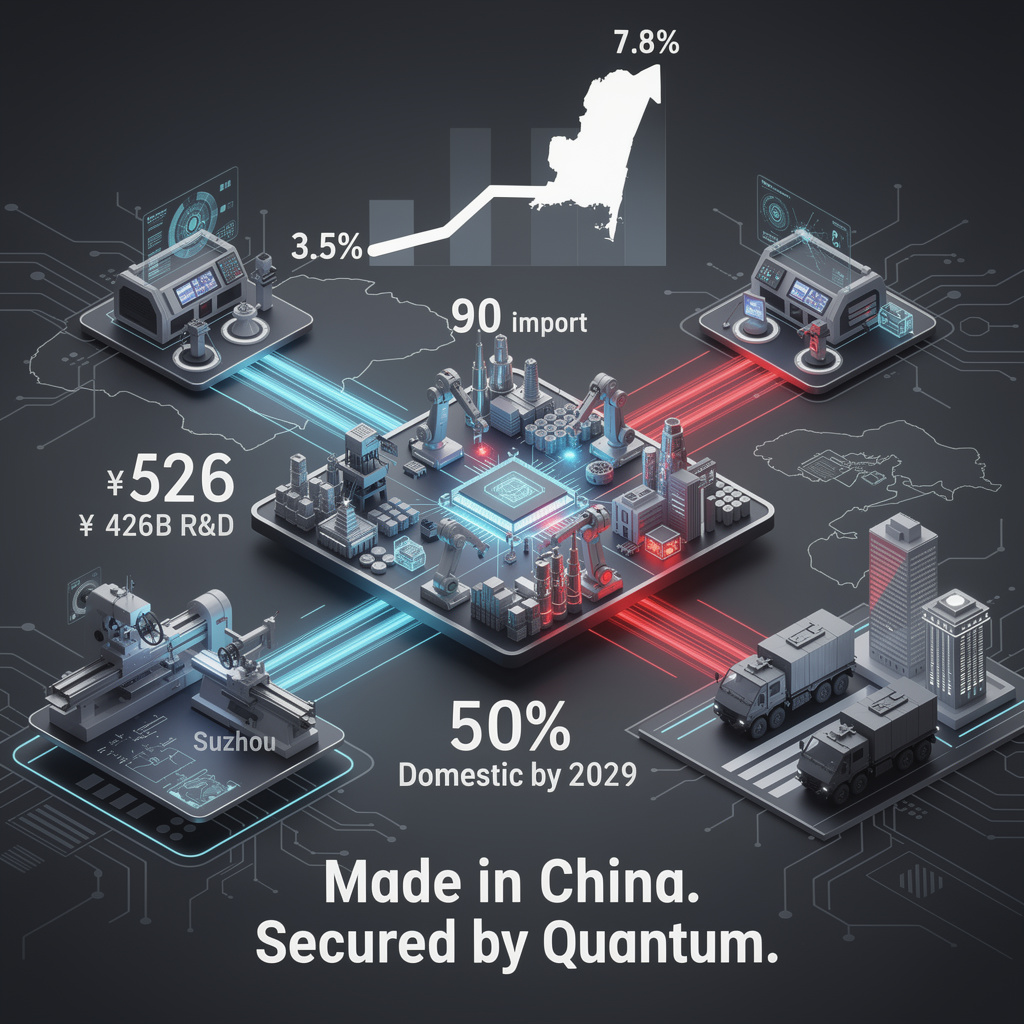
Beijing’s 15th Five-Year Plan, enacted last month, turns every robot arm, AI model, and quantum chip into a dual-use asset reporting to the same chain of command. The mechanics are blunt: Chinese plants must import 90 % of the high-precision CNC machines that carve servo motors and robot joints from Japan, while ministries pour ¥426 billion into R&D this year alone. The goal is to lift “new-quality productive forces” from 3.5 % of GDP today to 7.8 % by 2030—an addition roughly the size of Indonesia’s entire economy.
How the pipeline works
A three-tier bureaucracy—MIIT, the new Military-Civil Fusion body, and PLA procurement—signs off every shipment. Japanese grinders capable of 0.1-micron tolerances arrive in Suzhou and Chengdu, where they mill aluminum frames for 1.5 million service robots slated to roll off lines annually by 2030. Quantum labs get a parallel ¥1 trillion purse to scale from 150 to 500 superconducting cores within four years, enough to encrypt every Beijing-Shanghai data link the military uses.
Impacts—measured, not rhetorical
- Industry: 5.4 million Japanese CNC units through 2028—28 % more than last year—keep domestic fabs humming while local tool output climbs only 30 %.
- Security: PLA logs a 15 % jump in AI decision-support kits this quarter; forward bases will field autonomous logistics robots by 2028.
- ** wallets**: AI market valuation rockets from ¥1.2 trillion to ¥3 trillion, adding two Singapore-sized tech sectors inside five years.
- Risk: One seismic shift in Nagoya halts half of China’s precision-robot supply; domesticization target of 40 % by 2030 still leaves a 50 % import cliff.
Outlook—calendar, not slogans
- 2026–2027: 35 % of hospitals and warehouses deploy early AI models; quantum key distribution goes city-wide in Beijing and Shanghai.
- 2028–2029: Domestic CNC share hits 50 % via Japanese joint ventures; smart-factory cells standard in Yangtze River Delta plants.
- 2030: AI saturates 90 % of the economy; PLA fields fully autonomous supply convoys, shaving logistics footprints in contested theaters.
Bottom line
China’s command model fuses shop floors and battlefields into a single supply ledger. If Japan keeps shipping lathes and the U.S. keeps tightening chip embargoes, Beijing could turn today’s 90 % import dependency into tomorrow’s export protocol—selling the same robotic platforms it once bought, now stamped “Made in China, secured by quantum keys.”
🤖 $500M Series A Propels Mind Robotics to $2B Valuation for Rivian-Powered Industrial Bots
$500M Series A rockets Mind Robotics to $2B valuation—more than the GDP of 8 island nations 🤯 That’s $615M raised in 4 months to teach Rivian-built bots to out-lift humans by 150 kg with 0.05 mm precision. First 10 robot cells hit Illinois EV line Q4—will your factory job be next?
Mind Robotics walked out of Rivian’s Illinois truck plant on Monday with a half-billion-dollar check and a $2 billion valuation, the largest Series A ever recorded for an industrial-robotics firm. Accel and Andreessen Horowitz co-led the $500 million round, topping the $115 million seed the company quietly closed in late 2025. Founder RJ Scaringe, still Rivian’s CEO, now chairs the spin-out that will retrofit his own assembly lines before selling the same AI-driven arms to the rest of global manufacturing.
How the system learns while the line keeps moving
Inside Rivian’s factory, ceiling-mounted cameras and torque sensors already generate 200 terabytes of vision, audio and motion data every month. Mind Robotics funnels those streams into multi-modal world models that must decide—within 10 milliseconds—whether a bolt is seated or a wiring harness is twisted. Custom ASICs, inherited from Rivian’s self-driving program, cut inference power 30 % versus off-the-shelf GPUs, letting the 150 kg robotic arms hit ±0.05 mm repeatability without melting the power budget.
What changes on the floor
- Speed: 15 % faster cycle time expected when 5–10 pilot cells go live in Q4 2026.
- Uptime: 10–20 % drop in labor-related stoppages; one bot can swap a 25 kg battery tray 600 times a shift.
- Energy: Optimized motion paths plus low-power chips trim 0.8 kWh per vehicle produced—enough to run 1,200 Illinois homes for a year once output scales to 65,000 trucks.
- Headcount: ~250 new robotics jobs inside Mind and its supply chain by 2030, offsetting only a slice of the 3,000 line roles Rivian still plans to hire.
Rivian first, everyone else later—if the hardware lands
Strength: proprietary data from a real, revenue-generating plant.
Weakness: first industrial robots won’t ship for nine months, yet burn rate is already $200 million a year.
Opportunity: automotive, logistics and consumer-electronics factories face a 12 % annual labor-cost CAGR; a modular SaaS platform could skim recurring license fees.
Threat: Boston Dynamics, Amazon and Tesla bots already carry safety certifications and multi-year service records; any ASIC shortage stalls Mind at pilot scale.
Timeline
- Q4 2026: 5–10 cells inside Rivian Illinois; ≥99 % defect detection validated on live trucks.
- 2027: 30–50 cells across two Tier-1 EV suppliers; cumulative 420 MWh battery-pack handling, 1.2 GW peak-shaving for onsite micro-grid.
- 2028–2030: >200 cells in three OEMs; $150 million ARR, $5 billion valuation trajectory, possible acquisition talks with Siemens or ABB.
Industrial automation has seen plenty of billion-dollar promises. Mind Robotics’ differentiator is the factory that birthed it. If its arms can keep Rivian’s line humming this winter, the company’s next customer pitch will come stamped with real vehicles, real margins and 200 terabytes of proof.
🚗 Lucid Pushes OTA Cure to 95% of 3,900 Gravity SUVs, Adds CarPlay and $1B Subscription Path
95% of 3,900 Gravity SUVs just got a no-service-center cure for the dreaded “key not detected” glitch—plus native CarPlay/Android Auto 🚗💥. After 12 exec exits, Lucid’s new software-first crew is betting $1B future revenue on OTA fixes you’ll subscribe to like Netflix. North-American owners: will you pay $69-$199/mo for self-driving tiers, or is free CarPlay enough?
Lucid Motors pushed update UX 3.6 this morning, erasing the “key not detected” message that has stranded 3,900 Gravity SUVs since launch. The same over-the-air (OTA) beam adds Apple CarPlay and Android Auto as standard, ending a two-year software shuffle that saw 12 C-suite exits and a new $69–$199 monthly subscription menu for hands-free driving.
How the fix works
UX 3.6 flashes new firmware to the key fob and instrument cluster without a service visit. A “fork-detection” routine now chooses the stronger radio path, cutting NFC card failures to under 5 %. Navigation tiles no longer freeze, climate set-points hold within 1 °C, and the cluster’s flicker is gone. CarPlay and Android Auto run natively on the 34-inch curved glass, mirroring maps, messages and Spotify in under 150 ms.
Immediate impacts
- Convenience: 95 % of software defects disappear, saving owners a 45-minute dealer trip.
- Revenue: Lucid books the first $1 billion of projected software income by 2030, 54 % from subscriptions.
- Competition: Gravity matches Tesla’s feature set while Rivian still lacks CarPlay.
Gaps still open
Leadership turnover leaves the software team reporting to an interim CEO; regression tests caught 42 bugs this cycle, yet only 80 % of owners have installed the update after two weeks. Older Gravity units lack the antenna diversity needed for Level-3 eyes-off mode, capping future upsell.
What comes next
- Q3 2026: European roll-out of UX 3.6; ADAS tier-1 (city assist) goes live in North America.
- 2028: Hands-free highway mode, $129 tier, targets 30 % uptake.
- 2030: Subscription cash equals 40 % of Lucid’s total earnings, offsetting EV price wars.
The sectoral takeaway: carmakers that can patch a Friday flaw by Monday own the customer relationship—and the recurring invoice.
In Other News
- Trova launches all-electric E-Spotter terminal tractor with 220 kWh battery, targeting Orange EV’s design with improved uptime and maintenance
- Senate Approves Limited AI Use for Routine Tasks, But Bans Anthropic’s Claude Amid Security Concerns


Comments ()