€1.7 B Paris AI Blitz: Fjord-Cooled Supercomputers to Run Europe’s ChatGPT
TL;DR
- Nscale raises €1.7B Series C at $14.6B valuation, largest European AI funding round to date
- Gilead Sciences acquires Arcellx for $7.8B, advances pipeline with IgAN trial success and Yetzugo launch
- Uber invests $100M to deploy 1,000 EV charging stations across U.S. and Europe with minimum time guarantees for drivers
⚡️ €1.7B Nscale Mega-Round Fuels 1.5 GW Green AI Empire Across Europe
€1.7 BILLION in one day = the price of 3 Eiffel Towers ⚡️ That’s what Paris-based Nscale just raised to blanket Europe in AI super-computers running on 80 % green juice. Your next ChatGPT prompt could be cooled by Norwegian fjords—wild, right? 🇫🇷💻 Are you cool with AI that’s powered by waterfalls & baguettes, or still ?
Paris woke up Monday as host of the continent’s largest-ever AI funding round. Nscale, barely three years old, pocketed €1.7 billion in fresh cash and now carries a sticker price of $14.6 billion—more than double last September’s valuation. Translation: investors just bet the equivalent of Iceland’s annual GDP that Europe can grow its own GPU orchard instead of renting American cloud.
How do you spend two billion bucks on air?
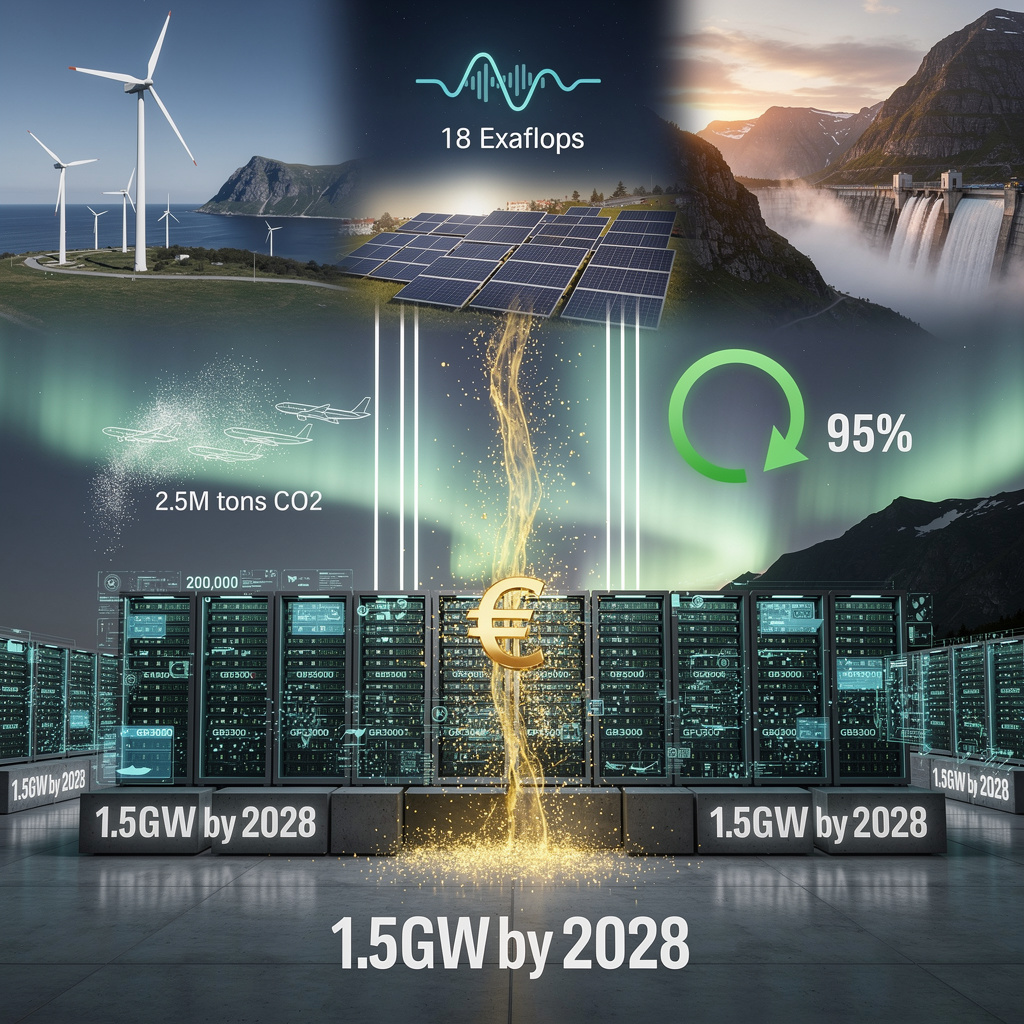
First, pour concrete. By 2028 Nscale will bolt down at least 1.5 GW of AI-optimized data centers—think 300 wind turbines running flat-out, except every watt feeds nothing but silicon brains. Second, hoard GPUs: 200,000 of Nvidia’s newest GB300 chips are already on order, enough to churn through 18 Exaflops of calculations, or the entire Netflix catalog rendered in 8K every 30 seconds. Third, stay green: 80 % of the juice will come from hydro in Norway, solar in Germany, and Texas wind paired with closed-loop liquid cooling that recycles 95 % of server heat.
Impacts—who feels the shockwave?
- Hyperscalers: instant relief valve—230 MW Stargate site alone frees them from 2 million household-equivalents of grid demand.
- European taxpayers: every GPU-hour booked locally keeps an estimated €0.04 per kWh inside the EU instead of flowing to U.S. cloud giants—small change that scales to €400 million annually once 600 MW is live.
- Competitors: CoreWeave and regional telcos must match Nscale’s 15-month build cadence or lose an forecast 15 % slice of the €22.6 billion European AI-infrastructure pie next year.
- Climate ledger: 2.5 million tons of CO₂ avoided yearly once Norwegian hydro displaces coal-heavy grids—equal to grounding 550 trans-Atlantic flights daily.
Short / mid / long-term scorecard
- Q3 2026: France 200 MW site breaks ground, locking in 50 k GPUs and 1,200 local tech jobs.
- Early 2027: Norway Stargate goes live, cutting peak EU grid imports by 1 GW during winter nights.
- 2028 IPO window: if revenue tops $2 billion ARR, a $20–25 billion Euronext listing is already prepped; miss the milestone and the $1.4 billion term loan starts asking awkward questions.
- 2030 vision: 3 GW total footprint could push European AI-compute share past 15 %, turning Nscale into the reference architecture for EU AI-Act compliance.
Bottom line: Europe didn’t just buy a company—it bought a shortcut to digital sovereignty. If the concrete cures on schedule, the next ChatGPT moment might be served from a barn-sized hall outside Oslo rather a Pacific Northwest server rack.
💸 Gilead’s $7.8B Arcellx Buy Fuels 78% Stock Blast, $70B Pipeline Bet
Gilead just dropped $7.8 B—79 % premium!—to nab Arcellx, then watched its own stock rocket 78 % in a day 🤯 That’s like paying Rolls-Royce prices for a Ferrari… and waking up to find your garage gold-plated. Now they’re promising a $70 B jackpot by 2030—if the FDA plays nice. Patients with blood cancer & rare kidney disease could win big, but will your wallet feel the love or the sting?
Gilead Sciences swiped its AmEx for $7.8 billion last week, stuffed Arcellx into the cart, and watched its own stock jump 78 % to $114 before the ink dried. The 79 % premium—$115 a share—was the steepest biotech markup since Gilead itself paid $21 B for Immunomedics in 2020. Wall Street loved it: Jefferies instantly lifted the price target to $180, basically daring traders to keep up.
How does this work
Arcellx brings CAR-T and T-cell engagers that chew up multiple myeloma; Gilead’s labs think they can shave 12–18 months off two pipeline timelines by plugging the new tech into existing oncology lines. Meanwhile, the home-grown RAINIER trial in IgA nephropathy posted a 51.9 % placebo-adjusted response—15 percentage points better than today’s standard—clearing the way for an FDA filing in Q4. Add Yetzugo, the new once-a-day PrEP pill that hit pharmacies Sunday, and Gilead has fresh revenue engines in three body systems before lunch.
Impacts
- Investor wallets: 150 million shares traded in two days → market cap up $45 B, enough to fund the deal twice over.
- Patients: 150,000 Yetzugo courses projected by end-2027 → ~25,000 new HIV infections averted if uptake mirrors older PrEP cousins.
- Competitors: AstraZeneca’s Enhertu and Vertex’s $116 M Casgevy now stare at a Gilead combo that can pair blood-cancer cell therapy with kidney-protection antibodies in the same sales call.
Short-term, long-term
- 2026–2027: IgAN therapy approval would add $2–3 B annual U.S. sales; Arcellx programs release first pivotal data, keeping shares in the $150–$180 corridor.
- 2028–2029: Two launched oncology products rack up $5–8 B cumulative revenue; Yetzugo tops $1 B globally as generics finally nibble older PrEP pills.
- 2030–2032: Nephrology plus oncology slice out ≥$10 B yearly, about 15 % of Gilead’s self-projected $70 B empire that now also spans (yes) Fluffy’s chemo.
Gilead’s shopping spree shows big pharma can still write eye-watering checks and make the math work—provided regulators play along and the integration crew doesn’t trip over its own lab coats.
⚡ Uber Sparks $100M EV-Charging Blitz: 1,000 Fast Stations to Cut Driver Fuel Costs 15%
$100M buys 1,000 Uber chargers that juice your ride to 80% in the time it takes to inhale a burrito ⚡️ That’s 400,000 kWh/day—enough to power 13k homes—while trimming driver gas bills 15%. Cities from LA to London get first dibs; the rest of us wait. Are you on the map?
Uber just wired $100 million into 1,000 new fast-chargers that promise an 80 % top-up in the time it takes to order a latte. The plug-fest starts this summer in Los Angeles, London, and Paris, then fans out to ten more metro areas before the 2027 ball drops.
How the 30-minute guarantee works
Each stall pushes ≥150 kW DC—roughly 200 miles of range while you stretch your legs. A driver opens the Uber app, reserves a cord, and the station’s IoT sensors log every kilowatt. That anonymized feed goes straight to Tesla, Lucid, and Waymo so they can fine-tune battery software and site planning.
Impacts in one breath
- Driver wallet: 10–15 % cheaper per mile than gasoline, saving the average full-timer about $1,200 a year—equal to a month of San Francisco rent.
- Sky: 400,000 metric tons of CO₂ avoided annually, the same as taking 87,000 combustion cars off the road.
- Grid: 400 kWh daily per station; during evening peaks, that’s a 1.2 GW collective sponge soaking up surplus wind and solar.
- Data market: Sharing usage patterns could shave 5–7 % off operational costs and open a future revenue pipe worth ~$10 M a year by 2035.
Short, mid, long—mark your calendar
- Q3 2026: 150 stations live; drivers save 8 % versus fuel.
- Q4 2027: 1,000-strong network humming at 65 % peak utilization.
- 2030: 1,200 sites, 0.5 Mt yearly CO₂ cut, and idle time 12 % below industry average.
- 2035: 30 % of stalls run vehicle-to-grid, letting parked Ubers sell juice back to utilities after midnight.
The fine print
Permit delays, charger-part shortages, and local utility upgrades could still stall electrons. Uber’s hedge: multi-vendor contracts and a 10 % contingency fund—about the price of 40 Super Bowl ads, but with zero celebrity tantrums.
Bottom line: by betting on its own pumps, Uber turns every charging minute into a competitive moat, nudges drivers toward cleaner rides, and positions itself as the gas station of the robot-taxi age.
In Other News
- StageOne Ventures closes $165M Fund V to back pre-idea founders globally
- Hershey partners with TogetherCocoa to improve cocoa supply chain sustainability, backed by Nestlé, Mars, and Mondelēz in a $195M price target upgrade
- Google acquires Wiz for $32.5B, largest ever venture-backed startup buy, to integrate AI-powered cloud security into its enterprise stack
- Snowflake reports $1.23B product revenue, 30% YoY growth, adds 740 net new customers in Q4

Comments ()