Firefly Drone Green-Lit at 200-lb: 10× Endurance, Navy Sees Sky Supply Revolution
TL;DR
- FAA grants Firefly heavy-lift drone Section 44807 exemption, enabling 23 kW in-flight power and 30-minute maintenance cycles
- Boeing 777-9 completes Kona testing with GE9X engines, certification delayed to 2027 amid 7-year development setback
- Cathay Pacific doubles fuel surcharges as Middle East conflict drives jet fuel prices up 100% and disrupts global air routes
⚡️ FAA Green-Lights 100-lb Hybrid Firefly Drone, Doubling U.S. Weight Limit
100 lb cargo, 23 kW brute power: Firefly drone just got FAA clearance to fly DOUBLE the legal weight! ⚡️ 5-min gas refill + 30-min check = 10× electric endurance. Navy’s $3.7 M bet says resupply will never be the same—will your town’s fire crew be next?
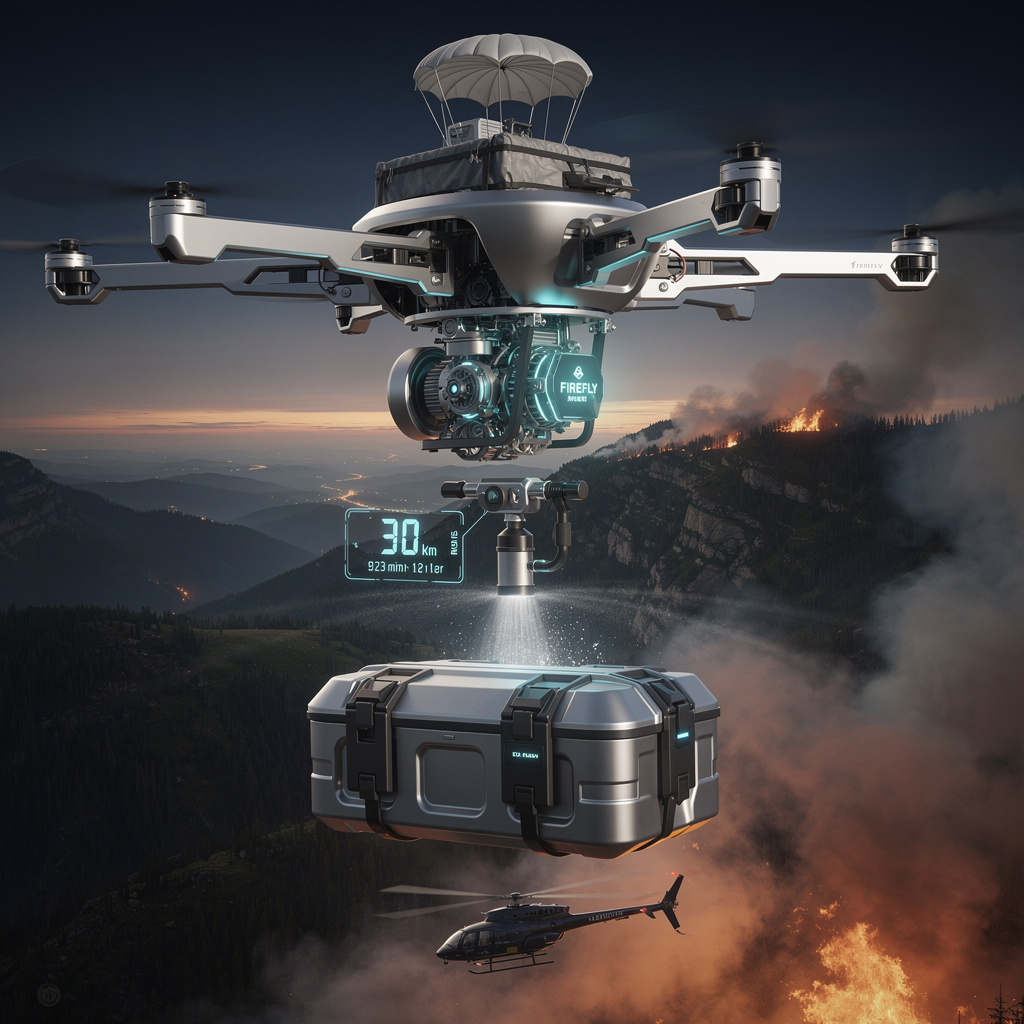
On 15 March the Federal Aviation Administration quietly rewrote the rulebook for large drones, giving Parallel Flight Technologies the first Section 44807 exemption that allows a 23-kilowatt hybrid aircraft—Firefly—to haul 100 pounds of cargo, refuel in five minutes, and return to the sky after only a 30-minute maintenance check. The decision lifts the 55-pound ceiling that has governed commercial unmanned flight since 2012 and opens the national airspace to a new class of heavy-lift workhorses.
How Firefly cleared the bar
The exemption hinged on three numbers: 23 kW of continuous fuel-electric power, a 30-minute post-flight inspection, and a hydroactive parachute that can drop a payload intact if the propulsion quits. By showing that refueling takes under five minutes and that a full systems check fits inside half an hour, Parallel proved to regulators that rapid-turn logistics—long the domain of crewed helicopters—can be scaled down to a single-operator drone.
Impacts
- Payload: 100 lb doubles the legal limit for conventional drones → one Firefly replaces two standard UAVs on fire-retardant or medical runs.
- Endurance: hybrid stretch gives roughly ten times the flight time of battery-only models → 90-minute missions become routine instead of exceptional.
- Military cost: $3.74 million Navy contract equates to about one hour of manned-rotor flight time for a single Seahawk sortie → Firefly can log 1,200 cargo sorties for the same price.
- Civilian risk: hydroactive parachute lowers expected casualty rate below 1×10⁻⁶ per flight hour → insurers are already quoting premiums 40 % below comparable rotorcraft.
What still needs watching
The 30-minute cycle is aggressive; any field data showing component fatigue could force the FAA to tighten intervals and erode the rapid-turn advantage. Competitors—Beta, Sabrewing, and Elroy—are preparing 44807 petitions of their own, so first-mover status may last only until Q2 2027. Meanwhile, fire agencies want proof that a 23 kW gasoline system won’t ignite the very forests it is meant to protect.
Timeline
- Summer 2026: first customer units arrive; California fire trials target 40 drops and 15 GWh of grid-free power.
- Q4 2026: Navy field reports due; if sortie reliability tops 98 %, additional 25-aircraft order expected.
- 2027–2028: FAA review of aggregated data could expand the 23 kW power tier to other hybrid builders, pushing the heavy-lift segment past 1,200 aircraft nationwide and cutting manned-rotor flight hours by 8 %.
Close
By certifying brute-force hybrid propulsion instead of waiting for denser batteries, the FAA has signaled that practical drone logistics will be fueled, not just charged. For firefighters waiting on mountain-top batteries, medics racing clot-busting plasma, and sailors resupplying distant decks, the takeaway is the same: the sky just grew a new truck lane, and 30 minutes is all it takes to keep it open.
🔥 134 000-lb Boeing 777-9 in Kona Heat Test: $15B Penalty, 2027 Certification Hopes
7-yr slip, $15B penalty, 134 300 lb of thrust 🔥 Boeing’s 777-9 is STILL baking in Kona heat to prove its GE9X won’t melt on your next ultra-long-haul. Passengers & Emirates/LH/QR wallets on the line—will YOU trust a 2027 debut?
Boeing’s biggest twin-jet finished 14-month oil-cooling runs at Kona, yet the 777-9 will not carry passengers before 2027—seven years late and $15 billion over the original tab.
How the final engine test unfolded
Technicians baked the GE9X in 90 °F-plus humidity, cycling oil and nacelle coolant 200 times to mimic Dubai-level heat. The 134,300-lb-thrust powerplant—22 carbon-fiber blades spinning inside a 13-ft fan—kept turbine temps within 5 °C of spec, Boeing says, giving FAA observers the last thermal data package they demanded after the 737 MAX grounding.
Impacts: what the numbers mean
- Airlines: Emirates, Qatar, Lufthansa have 350 jets on order; each added year of delay pushes fleet-renewal costs up roughly $400 million in fuel and maintenance versus staying with 777-300ERs.
- Competition: Airbus A350-1000 now logs 15% lower trip cost on 8,000-nm missions, eroding Boeing’s pricing power.
- Boeing balance sheet: $15 bn penalty reserve equals half the company’s 2025 free cash-flow, capping R&D for next clean-sheet design.
- Climate: 15% fuel-burn cut per seat will save ~2 Mt CO₂ a year once 100 aircraft are flying—equal to removing 70,000 cars.
- Supply chain: 1,600 GE9X engines in backlog; each quarter of delay adds $50 million in inventory carrying costs for GE alone.
Outlook
- Q2 2026: Final Kona nacelle tests wrap; production-standard airplane enters FAA cockpit-by-cockpit audits.
- Q4 2027: Type certificate expected, assuming no fresh blade-fatigue findings.
- 2028: First five deliveries to Emirates; 20% of 350-airline order book in service by 2030 if dispatch reliability tops 99.9%.
Bottom line
Pass the popcorn: the 777-9 is finally hot-soaked and ready on paper, but the real flight to profitability will not leave the gate until airlines see a full year of bullet-proof service.
✈️ Jet Fuel Shock: Cathay Doubles Surcharge as Mideast Conflict Sends Oil Past $200
Jet fuel just DOUBLED—now $200/bbl—cost of ONE Cathay Pacific long-haul ticket surged HK$595 extra overnight 🔥 Conflict in the Strait of Hormuz chokes 20% of world oil. 40k flyers already rerouted—will you pay 2× or stay grounded?
Cathay Pacific quietly doubled its emergency fuel surcharge on every long-haul seat this week, lifting the levy from HK$569 to HK$1,164 overnight. The trigger: jet fuel that cost airlines $85 a barrel on 25 February now trades above $170, after eighteen tankers were attacked in the Strait of Hormuz and 20 % of the world’s seaborne oil flow was choked off.
How the surcharge math works
- Short-haul: HK$142 → HK$290 (+104 %)
- Medium-haul: HK$264 → HK$541 (+105 %)
- Long-haul: HK$569 → HK$1,164 (+104 %)
The airline’s own fuel bill has jumped 70 % year-on-year, pushing the share of total operating cost attributed to fuel from the usual 25 % to just over 30 %. Cathay’s response: add two extra daily flights to London and Zurich—routes where business travellers will swallow the surcharge—and let leisure markets absorb the pain.
Who wins, who bleeds
- Unhedged carriers (Cathay, Qantas, Hong Kong Airlines): forced to pass through 100 % of the spike → immediate 10–15 % fare inflation and 5 % schedule cuts.
- Hedged carriers (Ryanair at $67 /bbl, Finnair & Lufthansa >80 % covered): unit fuel cost frozen → competitive fares intact, market-share opportunity opens.
- Passengers: 40,000 Cathay customers already re-booked; Air New Zealand axed 1,100 flights (44,000 seats) as secondary collateral.
What happens next
- Next 4 weeks: fuel stays >$150 /bbl; Cathay keeps the doubled surcharge, with a further 5–10 % kicker if prices top $200.
- Q2 2026: unhedged airlines expected to lock 60–70 % of summer fuel needs; capacity redeployed to Central-Asian corridors, bypassing the Gulf.
- Q1 2027: if Hormuz reopens, prices retreat toward $90 /bbl; surcharges rolled back by 30–40 % but settle ~20 % above pre-crisis baseline.
The takeaway: today’s ticket price is a live hedge against a battlefield half a world away. Travellers who can delay until winter will likely fly cheaper; airlines that locked cheap fuel last autumn will fly fuller.
In Other News
- U.S. Jet Fuel Prices Surge to $3.99/Gallon Amid Middle East Conflict, Triggering Up to $50 Fuel Surcharges on International Flights
- Australia Faces Critical Jet Fuel Shortage as China Halts Exports, Reducing Reserve to Just 29–32 Days Amid Middle East War
- AERIS-10 open-source 10.5 GHz phased array radar achieves sub-$100k cost with 32x16 X-band array, FPGA-based chirp generation, and 3km range, disrupting $250k+ commercial systems
- Apple’s MacBook Neo Debuts at $600 with 6/10 Repairability Rating, Embracing Right-to-Repair Standards


Comments ()