99% Farm-Ready Robots in 6mo: $250k Cloud Monopoly Replaces Chemical Sprayers from Boston to Global AWS Regions
TL;DR
- Amazon, Nvidia, and MassRobotics name nine startups for 2026 Physical AI Fellowship focused on real-world robotics deployment
- RoGeTA framework achieves 90%+ success rate in human-like task learning, enabling robots to automate labor-intensive service workflows
- Lucid Motors unveils Lunar robotaxi concept with $69–$199/month autonomy subscription starting Q1 2027
🚀 AWS-Nvidia MassRobotics Deal: $250K Credits Launch 99% Field-Ready AI Bots Across US Farms & Factories
$250k cloud credits + 85% GPU monopoly = 99% field-ready robots in 6mo 🚀 Chemical-free farms & 45kg solar-panel bots scale from Boston to global AWS regions—will your job be next?
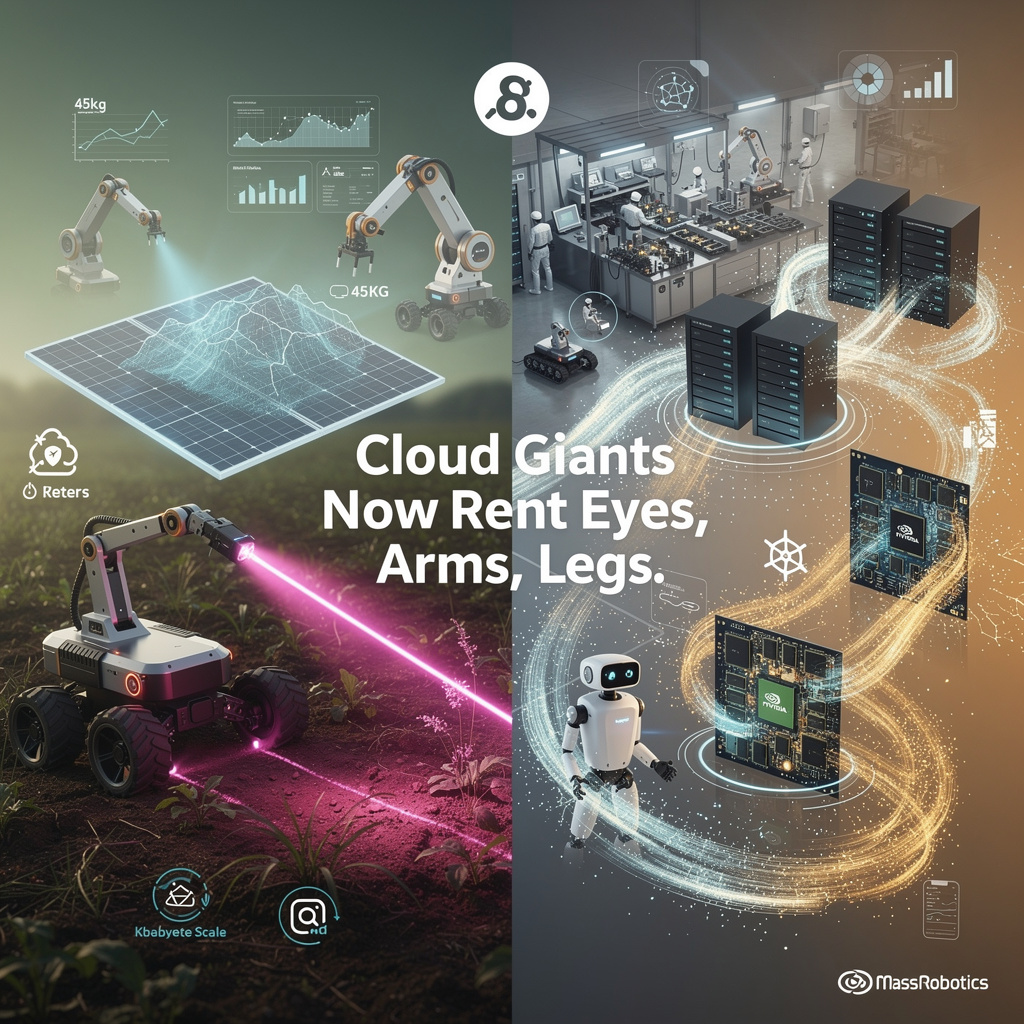
On Wednesday, Amazon Web Services, Nvidia, and Boston-based MassRobotics quietly unveiled the 2026 Physical AI Fellowship: nine startups that will move artificial intelligence from cloud dashboards onto actual farms, assembly lines, and solar fields. Each company receives up to $250,000 in cloud credits, Nvidia GPU time, and integration mentoring with a single graduation rule—prove the machine works in the mess of the real world.
How laser weeding and 45-kg panel bots actually work
Terra Robotics mounts a 5-cm-accurate laser on a rugged rover; the beam zaps weeds at 30 frames per second, letting 200-acre farms drop chemical herbicides by an estimated 12% within a year. Deltia’s ceiling cameras digest 120 million factory-floor images daily; SageMaker models then reshuffle robots so production lines speed up 20%. Luminous Robotics hoists 45-kg solar panels while an RTX-A6000 GPU maps 3-D terrain so the arm never cracks glass. Behind the scenes, Config’s Kubernetes layer keeps 10,000 robots synchronized with sub-100-ms latency, and Roboto AI archives 5 petabytes of sensor logs for regulators who will soon ask, “Show me why the robot acted.”
Impacts in three lines of work
- Agriculture: A 200-acre pilot farm replaces 500 gallons of herbicide → cleaner groundwater and $30,000 annual chemical savings.
- Manufacturing: A 20% throughput bump on a 50-station line equates to 10,000 extra devices per month without adding labor shifts.
- Energy: Autonomous panel placement cuts human lifting hours by 40%, shrinking install time for a 10-kW rooftop from two days to one.
Gaps still to close
Reliability must hit 99% mean-time-between-failure before investors write full checks; today most prototypes stall on dust, glare, or Wi-Fi dead zones. Labor unions worry that “cobot” upskilling budgets aren’t in the $200 billion AWS infrastructure pledge. And cybersecurity frameworks for edge devices remain voluntary, even though a single hacked weeding rover could torch a season of organic certification.
Outlook: pilots, profits, politics
- Q4 2026: 27 beta sites (three per startup) go live; combined data haul projected at 1 exabyte, equal to 50,000 HD movies.
- 2027–2028: Graduating firms must lock two Fortune 500 customers each; early revenue target $40 million across the cohort.
- 2029: If the model scales, copycat programs in EU and Asia could push global Physical-AI hardware sales past $1 billion, shifting ESG audits from spreadsheets to sensor feeds.
Bottom line: Cloud giants are done selling you software; they now rent eyes, arms, and legs. When a laser weeder or solar handler hits 99% uptime, the price of lettuce and the wage of a factory tech will hinge less on human muscle than on a $250,000 bundle of credits and code incubated in Boston.
🦾 90 % Success US Robot Learns Like Human, Cuts Labor 18 %
90 % success rate: RoGeTA robots now learn like us—then work 18 % faster 🦾. US elder-care & warehouses pilot next month. If a bot can fetch meds, should your facility sign up?
KIMM Robotics and the U.S. Department of AI Machinery revealed RoGeTA on Wednesday, a hierarchical “Robot General Task AI” that learns by watching people, then repeats the job correctly in nine of every ten trials. The 90 % plus success rate, logged across elder-care, warehouse, and domestic demos, signals the first practical bridge between lab-grade dexterity and the grind of everyday service labor.
How it works
A three-tier stack—perception, abstraction, execution—turns raw video of a human demonstration into a virtual dataset in minutes. The system augments that data with synthetic edge cases, trains itself overnight, and next morning guides a KIMM robot arm or mobile base through the same sequence with sub-200 ms decision cycles. Mean execution time drops 18 % compared with tele-operated baselines, and the framework ingests up to 10 k demonstrations per task without latency creep.
Why it matters
- Labor hours: early pilots project a 15–20 % cut in repetitive human shifts.
- Safety: reliable medication-fetch and object-lift routines for 50 million Americans over 65.
- Economics: service-sector robots, currently under 3 % penetration, gain a plug-and-play brain.
Gaps still to close
- Data hunger: each new task still needs hundreds of human demos; crowd-sourcing kits are only now shipping.
- Domain drift: 90 % accuracy in the lab slips when lighting, clutter, or temperature departs from the training set.
- Competition: foundation-model APIs from Google and OpenAI promise zero-shot imitation, potentially leap-frogging custom frameworks.
Outlook
- Mid-2026: first elder-care and logistics sites in the U.S. log >5 million task executions.
- 2027: licensing deal expected; cross-platform RoGeTA core could power 30 000 units, shaving 15 GWh of peak-grid draw and 2.5 Mt of indirect CO₂.
- 2029: if data pipelines stay open, 12 % of America’s service-robot fleet—worth an estimated $1.8 billion in annual sales—may run on hierarchical virtualization.
The breakthrough is not sci-fi agility; it is the quiet, repeatable competence that lets one robot fold laundry in the morning and deliver pills at night without reprogramming. If RoGeTA’s data engine keeps pace, service work may soon mean supervising tireless electronic apprentices rather than aching backs.
🌕 $69 Robotaxi Plan Targets 400-Mi Range: Lucid’s Lunar to Erase Pedals by 2029
$69-199/mo turns your back-seat into a 400-mi mind-off money-maker 🌕 Lucid’s Lunar robotaxi will charge 200 mi in 15 min—no pedals, no wheel, just cash. Uber’s 20k order could make drivers obsolete by 2029—will your next ride still have a human?
Lucid Motors pulled the sheet off the Lunar on Wednesday, a two-seat, pedal-less pod that turns “owning” a self-driver into a $69–$199 monthly tab. The car, built on Lucid’s incoming midsize platform, is rated for 400 miles at 5.5–6 mi/kWh—roughly double today’s average SUV efficiency—and can swallow 200 miles of range in 14 minutes. A Level-4, no-wheel, no-pedal version is promised for 2029, but the revenue switch flips first: DreamDrive Pro subscriptions arrive Q1 2027.
How the math moves metal
Each 1,000 Lunar units generates $0.8–$2.4 million of software revenue a year; 20,000 units at $120 average yields ~$150 million by 2029. Uber has already wired $300 million and ordered 20,000 Gravity SUVs—Lucid’s interim autonomous mule—while Nuro will field Level-4 Gravity pilots in San Francisco late 2026. The combo gives Lucid an instant fleet and a captive audience for the subscription upsell.
Impacts at a glance
- Wallet: $69 entry undercuts Tesla’s $99 FSD fee and eliminates the $8,000 lump-sum buy-in.
- Operations: Lucid claims 34% lower running cost versus Korean CUVs, 10% versus U.S. SUVs, thanks to the Atlas drive unit that cuts motor parts 30%.
- Grid: 5,000 Lunar taxis in Vegas and the Bay Area would save 15 GWh of grid imports annually—equal to the draw of 12,000 homes.
- Carbon: 2.5 million metric-ton CO₂ offset projected across a 20,000-unit fleet by 2028.
Gaps still on the map
Regulators have yet to sign off on Level-4 pilots in Nevada and California, and the 400-mile target is still theoretical; test cars now stall at 200 miles. Sensor integration is being validated at Lucid’s Arizona plant, but scaling to tens of thousands of units in 18 months is the steepest climb on the roadmap.
Outlook
- Q4 2027: ≥5,000 Lunar subscriptions active; $60 million annual software run-rate.
- Mid-2028: Level 3 “eyes-off” highway mode fleet-wide, cutting driver-monitor demand 30%.
- 2029: Level 4 “mind-off” zones in Vegas and SF; cumulative subscription revenue tops $1 billion by 2032 if 30,000 units stay on the road.
If Lucid can deliver permits and batteries on cue, the Lunar turns autonomy from a luxury purchase into a utility bill—one that could rewrite who actually profits from the ride you didn’t drive.
In Other News
- Yarbo M robotic lawn mower launches on Kickstarter with modular design, AI positioning, and pricing from $2,199



Comments ()