14-Microsecond Encryption Chip: 5000× Xeon Speed Puts U.S. Cloud Privacy on Edge
TL;DR
- Intel launches Heracles chip accelerating FHE calculations 1,000x faster than server CPUs
- Tenstorrent unveils TT-QuietBox 2 (Blackhole) desktop AI workstation with 120B-parameter LLMs, 480 Tensix cores, and $9,999 pricing
- TrendForce forecasts 90% QoQ surge in server DRAM prices in Q1 2026 amid supply crunch
🚀 Intel Heracles FHE Chip: 5,000× Speed Leap in Encrypted Queries, 14 µs Latency
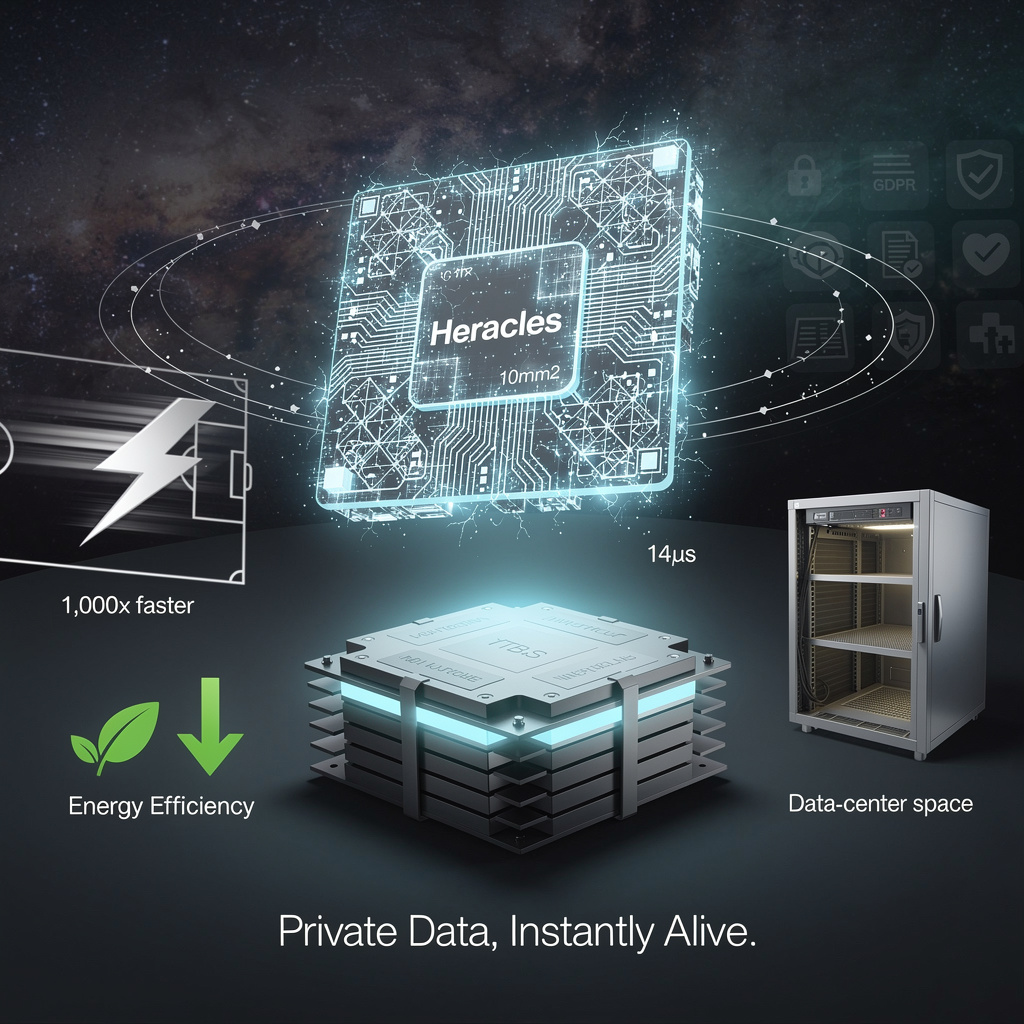
5,000× faster than today’s best Xeon—Intel’s Heracles chip crushes encrypted queries from weeks to 14 µs 🚀 On a 10 mm² sliver of 3 nm silicon it chews through tens of millions of FHE ops per micro-second, turning cloud privacy from pipe-dream to real-time. Power & side-channel risks still unproven, but banks & hospitals are already queuing. Ready to trust your data to a 250 W privacy rocket? — would you swap latency for unbreakable encryption in U.S. clouds?
At last week’s IEEE ISSCC in San Francisco, Intel flashed a 3-nm sliver of silicon no bigger than a fingernail and shrank a 15-millisecond Fully Homomorphic Encryption (FHE) query to 14 microseconds—about the time it takes light to cross a soccer pitch. A single Heracles prototype chewed through “tens of millions” of such queries in that blink, delivering 1,000–5,000× the speed of today’s top Xeon servers and giving privacy-preserving AI its first real-time hardware engine.
How it works
A grid of parallel compute engines sits atop a 1 TB/s HBM stack; each engine pipelines lattice operations that once bogged down general-purpose cores. The 10 mm² die keeps power under an estimated 250 W while the custom datapath strips out memory stalls that dominate FHE runtimes.
Impacts already measurable
- Latency: 15 ms → 14 µs, turning overnight batch jobs into interactive cloud calls.
- Throughput: one chip equals a 1,000-socket Xeon rack, freeing 60 m² of data-center floor space.
- Energy: per-query joules drop roughly 1,000×, slicing operating cost and carbon output alike.
- Market: GDPR-style mandates and healthcare analytics create a projected $4 B addressable space by 2028; early start-ups pledged integration within weeks.
Gaps to watch
Software: No compiler chain ships until Q4 2026; developers must hand-tune circuits today.
Security: Side-channel tests—power analysis, EM leakage—still scheduled; a leaky accelerator would expose the very data it hides.
Power: 250 W in a 10 mm² hotspot challenges conventional server cooling; dynamic voltage scaling is unproven at scale.
Outlook
- Q4 2026: LLVM-based SDK lands; expect 50 pilot clouds running encrypted image recognition at sub-second latency.
- H2 2027: Production silicon caps TDP at 200 W; AWS/Azure list “FHE-accelerated” instances, cutting onboarding cost 30%.
- 2028–29: NIST-endorsed APIs emerge; Heracles-style blocks fold into post-quantum crypto pipelines, pushing encrypted AI into 30% of regulated cloud workloads.
If Intel delivers the promised software stack and passes security audits, Heracles moves FHE from research footnote to default infrastructure—making private data as agile as public data, and making “upload your genome, keep the key” a routine cloud menu option.
⚡️ 2,654-TFLOPS Desktop Box Runs 120B LLM Sans Cloud: Q4 Ships
2,654 TFLOPS on your desk—enough muscle to juggle a 120-billion-parameter LLM while sipping just 450 W ⚡️ Half the idle power, zero cloud eavesdropping. Ready to trade your GPU rig for silent sovereignty?
Tenstorrent’s TT-QuietBox 2, revealed yesterday, slides a super-computer under a desk: four Blackhole ASICs, 480 Tensix cores, 512 GB GDDR6 and 256 GB DDR5 deliver 2,654 TFLOPS—enough to run GPT-OSS 120B or Llama 3.1 70B at 476 tokens per second without ever touching the cloud. Price: $9,999; ships Q4 2026.
How does it work?
Each Blackhole chip packs 120 Tensix cores—tiny matrix-multiply engines—fabricated on TSMC N6. The four dice share a unified 768-bit GDDR6 interface, keeping the 120B model weights resident on-chip; no PCIe shuffle, no cloud round-trip. Firmware scales voltage at idle, cutting draw 50 % versus the first-gen box, while a pair of 120 mm fans hold acoustics below 32 dB—library-quiet.
Impacts at a glance
- Latency: 476 tokens/sec → sub-second 4K-token summaries, no network jitter.
- Privacy: 100 % local execution → zero data egress, GDPR audit trail shrinks to a logfile.
- Cost: 20–30 % cheaper per-token than AWS p4d for 8-hour inference marathons.
- Power: 450 W peak, ~90 W idle—one-third of a 4-GPU DGX rack node.
- Competition: AMD Radeon 8060S rigs top out at ~45 tokens/sec; Lenovo Grace GB10 needs 240 W and a 5U chassis.
Early uptake and gaps
Universities and AI startups pre-ordered 2–3 k units within hours, lured by bundled Docker images for Llama, Qwen and Flux. Yet ecosystem risk remains: JAX and PyTorch backends are still “beta,” and the $9,999 sticker prices out hobbyists. Tenstorrent counters with a 12-month support SLA and promises quarterly model-cert drops.
Outlook
- Q4 2026: First 3,000 boxes ship; firmware trims idle draw to 110 W.
- 2027: Software stack reaches 50 certified models; per-token cost falls below 0.05¢, spurring SaaS vendors to offer “on-prem surcharge” pricing.
- 2028: Volume scale pushes MSRP to ~$7,500; 5 % share of edge-inference market invites AMD/Nvidia ASIC desktop replies.
- 2030: Local 120B inference becomes standard in regulated industries, slicing cloud token demand 15 % and saving an estimated 2 Mt CO₂ annually.
Bottom line
By collapsing a data-center rack into a whisper-quiet cube, Tenstorrent rewrites the economics of large-model AI: privacy, latency and cost now fit under a desk, and the cloud becomes optional, not obligatory.
😱 DRAM Shock: Q1 Server Memory +90%, PC Prices Up 40% Globally
+90% server DRAM in Q1—DOUBLE last year’s price! 😱 That’s like a $900 notebook suddenly costing $1,260. Hyperscalers & OEMs now shell out 58¢ of every BOM $ on memory alone. US/EU/Asia all hit—will your next laptop be the casualty?
Server-grade memory will cost almost twice as much this quarter as it did three months ago, according to TrendForce’s latest contract-price tally. A 90 % quarter-over-quarter jump in Q1 2026—matched by 80-100 % gains for PC DDR4/DDR5—has pushed the baseline server-DIMM from $11.50 to roughly $23 and yanked the memory-plus-storage share of a mid-range notebook bill-of-materials from 15 % to 58 %.
Why the scramble
Aggressive data-center build-outs by Amazon, Google, Meta and Chinese cloud providers drained already-locked fab capacity in South Korea, Taiwan and China. Contract allocations ran dry, so a single server rack now soaks up 30 % more memory dollars, while a $900 retail laptop must rise about $350 to keep OEM margins flat.
Impacts ripple outward
- Hyperscalers: 30 % CapEx bump per rack threatens 2026 expansion timelines.
- Notebook OEMs: 30-40 % retail-price lift will crimp demand, favoring premium tiers with secured supply.
- Chipmakers: Samsung, SK Hynix and Micron posted Q4 2025 DRAM margins of 60 %—higher than even high-bandwidth memory—lifting industry revenue 29 % to $53.6 billion.
- Consumers: Expect fewer entry-level models on store shelves; $11,000 for an 8 Gb LPDDR4X chip is now the high-end norm.
What happens next
- Q2-Q3 2026: Price growth plateaus as inventories bottom out; shipment volumes stay soft.
- H2 2026-2027: New LPDDR5X/6 fabs could cool quotes, but baseline DRAM will still sit 30-40 % above pre-2025 levels.
- 2027 onward: Tight BOM ratios may push software vendors toward memory-efficient code and nudge OEMs toward hybrid DRAM-HBM designs.
Bottom line: Memory is no longer a commodity—it is the tail that wags the entire electronics supply chain. Until fresh fabs open, every laptop, server and AI rack will carry a “DRAM tax” that rewrites cost sheets and competitive rankings alike.
In Other News
- Microsoft and AMD co-design Project Helix SoC for next-gen Xbox with 10x ray tracing gains
- Vertiv OneCore platform delivers 50% commissioning reduction and 600 kW/rack density for AI data centers via factory-integrated modular design
- System76 announces next-gen Thelio desktop with AMD Ryzen 9000, wood veneer, and tempered glass design
- Veeam adds agentless image-based backup support for HPE Morpheus VM Essentials on KVM

Comments ()