$700M B-21 Guzzles 1,200-Gal-a-Minute Over Mojave: Deterrence or Deficit Bomb?
TL;DR
- FAA fines 18 drone operators and suspends 8 pilot licenses for TFR violations in 2023–2025
- Deepwave delivers LRIP units of CADS to U.S. Air National Guard, enabling real-time cognitive sensing on F-16 platforms via Raytheon partnership
- B-21 Raider completes first mid-air refueling with KC-135 Stratotanker, validating stealth bomber operational readiness
💸 $36K Drone Fine: FAA Slams 18 TFR Violators From Super Bowl to Mar-a-Lago
$36,770 fine for 1 drone over Mar-a-Lago—enough to buy a Tesla! 🚁💥 18 pilots busted, 8 licenses shredded. Your beach selfie could cost you next. Florida flyers, ready to lose your wings?
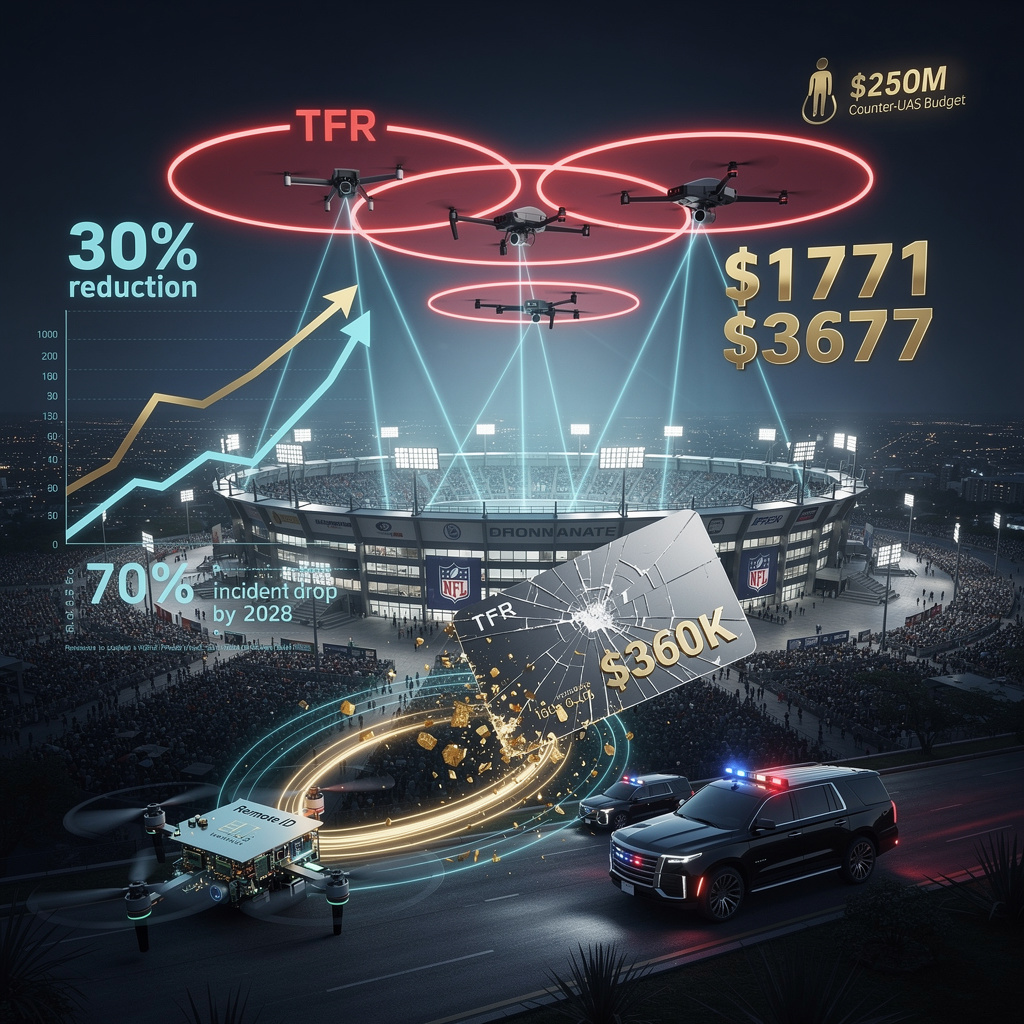
Between the 2023 Super Bowl and last month’s Mar-a-Lago motorcade, 18 remote pilots flew their cameras into tightly guarded sky. The Federal Aviation Administration has now closed the ledger: $360,000 in fines and eight stripped licenses, an unmistakable signal that a Temporary Flight Restriction (TFR) is no longer a suggestion scribbled on a sectional chart.
How the dragnet worked
Every DJI propeller that lifted inside the no-fly rings around State Farm Stadium, Sunfest or Lake Eola automatically pinged Remote-ID beacons. Sixty-four government listening posts logged the 96-percent-DJI fleet, then matched each 15-minute sortie to a named Part-107 certificate. Once the post-flight paperwork landed, fines ranged from $1,771 for a first-time crowd overflight to the statutory $36,770 ceiling for buzzing a VIP TFR. License suspensions followed within days, lasting 150–300 days—long enough to ground repeat hobbyists through two NFL seasons.
Impacts on the ground and in the ledger
- Safety: No one was hit, but a January paraglider entanglement shows the margin was inches, not miles.
- Enforcement: Eight violators—44 percent of the known pool—lost the legal right to fly, shrinking tomorrow’s offender list at a stroke.
- Budget: $20,000-per-incident revenue finances the next round of counter-UAS radars slated for FIFA 2026 host cities.
- Market: DJI’s 96 percent share of detected flights cements its dominance, yet also exposes the brand to every future penalty headline.
Gaps that still let drones through
Real-time detection remains partial; most cases were flagged only after the memory card landed on an investigator’s desk. Cheap $50 toys lack Remote-ID chips, and the fine schedule still wobbles from $1,771 to a possible $75,000, creating a lottery-like deterrent.
Timeline: where the sky is heading
- Q3 2026: FAA sets a $10,000 minimum TFR fine, erasing the low-end outliers.
- 2027: Mandatory Remote-ID for all sub-250 g models takes effect, scrubbing an estimated 30 percent of rogue flights.
- Super Bowl 2028: Counter-UAS budget hits $250 million; incident rate projected to fall 70 percent below 2023 baseline.
Closing thought
The 2023-25 enforcement wave shows the agency can punish; the next wave must prevent. If Congress funds real-time Remote-ID integration and standardizes penalties, the buzzing over football stadiums and wildfire crews can shrink from chronic nuisance to rare anomaly—keeping both the airspace and the FAA’s credibility aloft.
⚡️ AI-Powered F-16s Track 20 Targets in <1 s: Philadelphia Guard Unit Leads
20 targets tracked in real time—now AI decides who lives in under 1 s ⚡️ F-16 “Viper” gets a brain transplant that stretches its life to 2040. But LRIP = only a handful; will the Guard share the sky or hoard the edge?
On 11 March, Deepwave handed the U.S. Air National Guard the first low-rate Containerized Algorithm Deployment System (CADS) units, a shoebox-sized edge-AI stack that turns 1970s airframes into real-time threat hunters. Built around Raytheon’s AIR2302 processor and Deepwave’s AirStack software, the module plugs straight into the F-16’s existing wiring, fusing radar, infrared and Link-16 datalink feeds in under a second—no wrench-heavy rewiring required.
How it works
CADS swallows raw sensor data from the jet’s new AESA radar (able to track 20 targets at once) and the electronic-warfare suite, runs it through on-board neural nets, and pushes a single, ranked threat picture back to the pilot and every Link-16 node in the formation. Because processing happens on the aircraft, the system keeps working even when radio links are jammed.
Impacts on the flight line
- Situational awareness: sub-second cueing cuts reaction time to incoming missiles or drones.
- Fleet economics: the same box extends the F-16’s service life to the 2040s, saving the cost of buying 300 new jets.
- Network effect: one CADS-equipped F-16 shares its threat picture with Navy and Marine fighters, multiplying the value of every sortie.
Short-term outlook
- Q4 2026: 24 more LRIP units finish outfitting the Philadelphia-based squadron.
- Mid-2027: operational certification wraps, allowing CADS to fly in Sentry South and other major exercises.
Long-term horizon
- 2028: full-rate production of 50 units per year scales the system to F-15s and, with a software patch, to F-35s.
- 2030: next-gen modules add autonomous spectrum management, letting the AI jam enemy radars while it searches for targets.
Bottom line
By slipping a pocket-sized brain into a 50-year-old fighter, Deepwave and Raytheon have turned legacy metal into a node of tomorrow’s cognitive air force—proof that smart software can outrun the pace of new airframes.
💨 B-21 Raider Guzzles 1,200-Gal-Min Mid-Air, Extending Global Strike Reach
B-21 Raider just sipped 1,200 gal/min—enough to fill a backyard pool in 60 sec—while stealth-flying over Mojave 🛩️💨. 5h 33m tanker dance proves it can strike anywhere on Earth without landing. Your tax dollars: $700M per jet—deterrence or deficit? —Midwest families feel the bill first. What would YOU buy with that cash?
On 10 March, the B-21 Raider locked its nose-mounted boom to a KC-135 Stratotanker at 23,000 ft and drank 1,200 gallons of jet fuel per minute for 20 minutes, extending a 5 h 33 min test sortie that circled Edwards AFB, California. The choreography—filmed by an F-16 chase plane—proves the $700 million bomber can top off from the same 1957-vintage tankers that still haul 80 percent of Air Force fuel, eliminating the need to wait for a stealth tanker before global missions begin.
How does this work
- Boom receptacle: sits just ahead of the windscreen, shielded by radar-absorbent edges to keep the bomber’s cross-section low.
- Fuel load: 110–120 k lb internal; a single KC-135 shot pushes mission radius past 10,000 nautical miles—roughly Los Angeles to Beijing and back without ground basing.
- Tanker compatibility: certified on KC-135 this year; KC-46 Pegasus and a future low-observable tanker follow in 2027-28.
Impacts
- Reach: one refuel turns a 9,000-mile unrefueled sprint into a 15,000-mile patrol, outdistancing any legacy bomber.
- Risk: legacy tanker radar signature can telegraph the strike package; planners will schedule top-offs in radio-silent corridors or hand off to stealth tankers once available.
- Cost: $4.5 billion FY-25 injection accelerates production 25 percent yearly, targeting 100 airframes by 2032; each Raider equals the price of 2.5 F-35As yet replaces 40-year-old B-1s that demand four times the maintenance hours.
Outlook
- 2026–2027: envelope expansion—night, cold-weather, contested-electromagnetic tests; first operational Raider arrives at Ellsworth AFB, South Dakota.
- 2028–2030: 150-aircraft fleet, 60 percent of long-range nuclear alert shifts from B-52 to Raider, cutting fleet fuel burn 18 percent per sortie.
- 2031–2035: pairing with LRSO cruise missiles and B61-12 nuclear bombs, the bomber becomes the backbone of U.S. strategic deterrence, keeping 200 targets inside any adversary’s anti-access bubble within 24-hour reach.
The March link-up is more than a photo opportunity; it is the moment the Air Force’s future strike arm learned to refuel from its past, guaranteeing that when the first Raider squadron stands alert next year, the planet’s most defended airspace will lie within a single tanker hop.
In Other News
- U.S. and Israel strike Iranian elementary school, killing 175 civilians; Pentagon investigation cites outdated AI targeting data
- U.S. military suffers 140+ casualties in Iran conflict; Pentagon confirms 8 service members killed in Kuwait drone attack
- British Airways suspends London-Abu Dhabi flights until end of 2026 amid Middle East airspace instability and security threats
- Artemis 2 moon mission faces delay as NASA completes Pad 39B repairs after helium flow interruption



Comments ()