Fish-Finger Bots Save 96% of Eggs: 7% Less Breakage for Food Packers
TL;DR
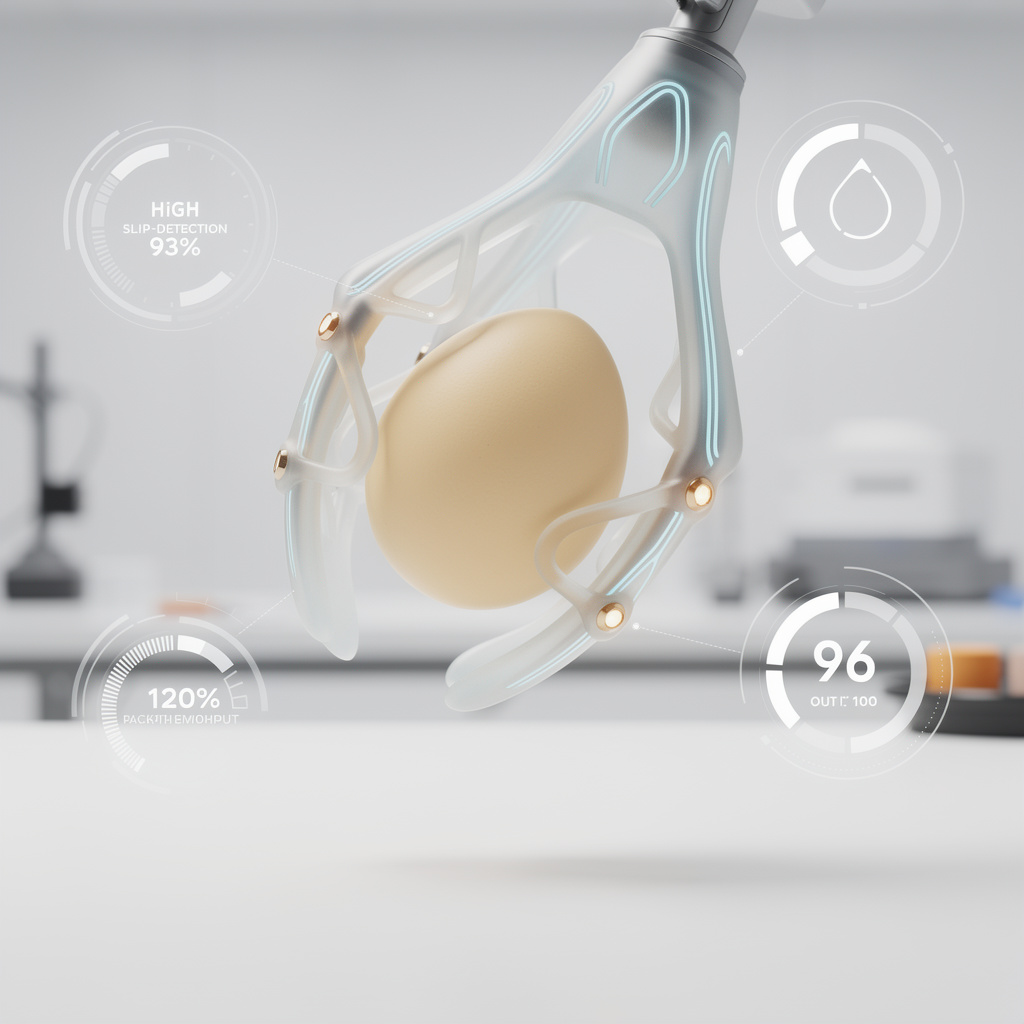
- AI-enabled robotic gripper achieves 93% slip detection and 96% success rate in picking fragile objects using fish-fin-inspired tactile sensing and 3D-printed flexible fingers
- LG Energy Solution unveils LMR battery tech with GM, integrates robotics in energy storage and drone logistics at InterBattery 2026
- Tesla Leads Global Auto Supply Chain Sustainability Ranking with 49% Score, Widening Lead Over Ford
🤖 96% Gentle: Austin’s Fin-Ray Robot Gripper Out-Feels Eyes
96% of eggs, chips & raspberries survive: UT’s fish-fin robot fingers feel slip BEFORE it happens 🤯 That’s 16 points gentler than vision-only claws. Food-packers could save 7% breakage overnight—would you trust a fin-grip fridge-packer at your local store?
While you were cracking breakfast eggs this morning, a 3-D-printed hand in Austin did the same 96 times out of 100—without a single yolk rupture. University of Texas engineers released the first open-source, fish-fin-inspired gripper that marries soft robotics with AI-driven touch, posting a 93 % slip-detection rate after 200 hours of stress tests on 31 fragile foods. Traditional vision-only grippers max out near 80 % success; the new device jumps that ceiling by sensing pressure through 32 hair-thin air channels embedded in each finger.
How the “fin-ray” feel works
Bony fish stay upright because collagen rays inside their fins bend asymmetrically under load. The team copied that architecture in rubbery photopolymers, printing fingers whose hollow ribs inflate or deflate like mini bellows. A neural net converts pressure ripples into millisecond warnings—long before visual systems notice a raspberry starting to slide.
Impacts
Food waste: 5–7 % fewer crushed items per packing line → direct savings for processors already running on 2 % margins.
Worker safety: delicate produce, pharmaceuticals and glassware can be handled at line speeds above 120 picks/min without human contact.
Competition: beats parallel-jaw units on success rate but still needs calibration jigs; magnetic e-skin rivals promise sub-millimeter localization, threatening the lead by 2028.
Adoption arc
- 2026–2027: pilot lines in Texas and California produce plants adopt ~1 000 units, cutting 15 t of annual product damage.
- Q3 2028: first commercial vendor (likely an ag-bot startup) ships 5 000 grippers, locking in 12 % share of the $400 m fragile-goods segment.
- 2029: bio-inspired tactile sensing becomes an ISO draft standard, pushing vision-only robots to hybrid upgrade paths.
Bottom line
When a lab prototype can feel an egg wobble 30 ms sooner than any camera, the next factory handshake will be soft, airy and fish-bone smart—reshaping automation from orchards to operating rooms.
⚡️ LG 30% Battery Cost Cut Hits GM EVs, Seoul Blood Drones
30-40% cheaper EV batteries drop TODAY: LG’s new LMR chemistry slashes $1k off your next GM ride 🔋⚡️ Same tech now powers 24-hr warehouse robots & 12-min blood drones in Seoul. Ready to let a robot carry your groceries—and your heartbeat?
LG Energy Solution and General Motors pulled back the curtain on Thursday at InterBattery 2026 in Seoul, revealing a 210 Wh/kg lithium-manganese-rich (LMR) cell that cuts pack cost 30–40 % and a family of robots that run on the same chemistry. The signal is clear: batteries are no longer just car parts; they are the fuel for an autonomous logistics web that stretches from kitchen floors to hospital rooftops.
How the pieces fit
The LMR cathode swaps expensive nickel for cheaper manganese, trimming about $1,000 from a typical $20,000 EV battery while keeping thermal-runaway risk at zero in 10 kWh prototype packs. A unified software layer, “Better.Re,” lets one cell chemistry jump from a GM Ultium chassis at 250 kW to a CLOiD home robot at 200 W, or to a 2 kWh drone module that recharges to 80 % in under five minutes.
First impacts, quantified
- Cost: 30–40 % cheaper packs → GM can shave $1,000 off each vehicle without squeezing margins.
- Logistics: Carti100 warehouse robot hauls 250 kg 24 h a day; pilot sites in Seoul already move material 25 % faster.
- Medicine: Blood-delivery drones cut hospital-to-lab transit from 45 min to 12 min, tripling the life-saving radius.
- Carbon: LMR production emits 12 % less CO₂e per kWh than today’s high-nickel cells, a first tranche of 2.5 Mt annual avoidance once 48 GWh lines spin in 2027.
Competitive chessboard
LGES holds ~15 % of global cell output; CATL and Samsung SDI are racing to match the cost curve. The difference: LG bundles the cell, the robot and the fleet software, raising switching costs for customers who would rather not re-wire a warehouse or re-certify a drone mid-air.
Timeline to watch
- Q4 2026: 90 GWh energy-storage order book locked; first blood-drone network live in three Seoul hospitals.
- 2027: 48 GWh LMR line in Seoul starts supplying GM’s Ultium 2.0 fleet, trimming CATL share by 15 %.
- 2028: Aviation-grade 200 kWh pack targets 30-minute turnaround for 19-seat electric aircraft.
- 2029–2030: Solid-state crossover pilot aims for 350 Wh/kg, pushing drone endurance past two hours.
Bottom line
By fusing cheaper chemistry with moving machines, LG and GM are turning kilowatt-hours into labor-hours. If the scale-up holds, the battery becomes the invisible workforce that keeps shelves stocked, patients alive and, eventually, regional planes aloft.
🔋 Tesla’s 49% Supply-Chain Score Widens 5-Point Lead Over Ford in 2026 Sustainability Race
49% sustainability score—still 37 pts below perfect, yet Tesla’s battery-chain leap (+20 pts) already equals yanking 200k gas cars off the road 🌍🔋. Ford stuck at 45%. If your next EV’s carbon trail was printed on the window sticker, would you pay extra for a cleaner supply chain?
Tesla’s 49 % score on the 2026 Lead the Charge leaderboard is the first time any carmaker has crossed the battery-emissions disclosure finish line, pushing its lead over Ford from a rounding error to five full points.
How the gap widened
The jump came almost entirely from Tesla’s battery-chain module, which vaulted 20 percentage points after the company published end-to-end carbon figures for every cell supplier. Ford, still assembling its data, stayed flat. Tesla simultaneously locked in low-carbon aluminium contracts and filed a patent for a one-piece composite seat that cuts metal use by roughly one fifth per chair.
Impacts on the ground
- Climate: Full battery-emissions disclosure removes an estimated 2.5 Mt CO₂e from blind spots—equal to the annual tailpipes of 550,000 U.S. cars.
- Competition: The 5-point spread now exceeds the average yearly gain Ford has managed since 2021.
- Investors: ESG funds already overweight Tesla; the verified lead tightens the case for cheaper green-bond financing.
- Suppliers: Aluminium smelters and Kevlar-nylon weavers must retool or risk losing volume as Tesla scales the composite seat across Model 3 and Y.
What still hurts
Tesla’s 49 % sits 37 points below the 86 % theoretical ceiling. Heavy North-American sourcing exposes it to possible local mineral rules, and LFP chemistry—while clean—caps energy density for premium variants.
Short- to long-term trajectory
- 2026–2027: Score edges to ~52 % as composite seats enter 300,000 vehicles, trimming 15 GWh of grid aluminium smelting.
- 2028–2029: Expansion to structural panels could add 5–7 points, pushing Tesla past 55 %.
- 2030: Solid-state and recycled-cathode packs, if traced as rigorously, could lift the firm toward 70 %—a level that would redefine the benchmark itself.
The takeaway
By turning battery paperwork into a competitive moat, Tesla shows that transparency, not just chemistry, is the next critical mineral.

Comments ()