70% GPU Price Crash in NJ: $100k AI Cluster Now $30k, East-Coast Startups Pounce
TL;DR
- CoreWeave launches Flex Reservations and Spot Instances to optimize AI inference costs, offering dynamic GPU pricing for H100/H200 workloads
- Intel launches ATX-ARS1-W880 motherboard with 24-core Arrow Lake-S, 36 TOPS AI, and 256GB DDR5 ECC support
- Windows 11 Autopatch flips default to Hotpatch in May 2026, halving patch compliance time and eliminating restart delays for enterprise devices
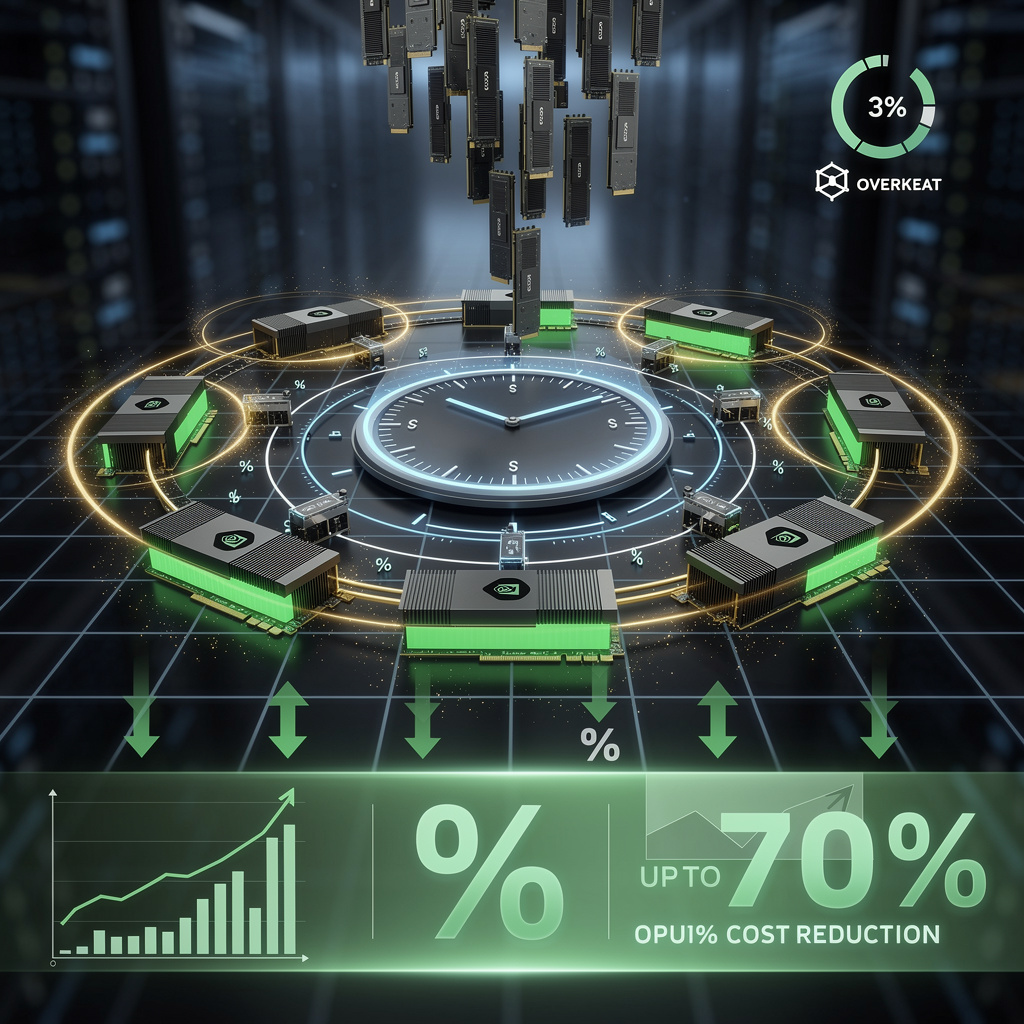
⚡ CoreWeave Cuts AI Inference Cost 70% with NJ-First Flex GPU Spot Market
70% cheaper H100 GPUs just dropped in NJ—like slashing your AI bill from $100k to $30k 🚀 Real-time spot pricing + 24h flex lock-in keeps latency within 5%. But pre-emptible cores can yank your workload—are you checkpoint-ready, East-Coast builders?
On 10 March, CoreWeave flipped the switch on “Flex Reservations” and “Spot Instances” for its Nvidia H100/H200 fleet, letting enterprises bid for surplus GPU cycles instead of paying sticker price. Early users report inference bills falling up to 70 % while latency stays within 5 % of the old on-demand baseline.
How the auction works
- Spot capacity is released the moment supply exceeds contracted demand; price refreshes every minute.
- Flex Reservations add a 24-hour holding fee that locks in a rack-sized block of GPUs at a pre-negotiated rate, giving checkpoint-friendly workloads a cheaper hedge against pre-emption.
- Both tiers are booked through the same console SKU; Kubernetes pipelines can auto-failover in under 90 seconds, CoreWeave benchmarks show.
Impacts in the first month
- Cost: $0.95 per H100-hour versus $3.20 on-demand → a 16-GPU inference pod now costs $364 per day, down from $1,228.
- Capacity: 20 % of CoreWeave’s New-Jersey H100 inventory moved to spot, pushing overall utilization from 78 % to 94 %.
- Risk: interruptible jobs must tolerate up to two pre-emptions per day; checkpointing adds ~3 % overhead to total runtime.
What happens next
- Q2 2026: all H200 variants join the spot pool; projected fill rate 70–80 %.
- 2026–2027: $30–35 B capex adds 1.7 GW of power, enough to house 550k H100 equivalents.
- 2028: dynamic pricing could claim 5 % of the $50 B AI-inference cloud market, shaving a cumulative $1 B off customer bills.
The takeaway
By turning idle GPUs into a live marketplace, CoreWeave has made cost volatility someone else’s problem. Enterprises that engineer for pre-emption can now run three times more inference for the same budget, while CoreWeave turns otherwise empty racks into cash. If spot prices stay soft, the hyperscalers will have to match the discount or concede the price-sensitive slice of AI demand.
🤯 Jetway W880 Board Packs 36 TOPS AI, 256 GB ECC DDR5 for US Factories
36 TOPS of on-board AI just landed on a $1k ATX board—no add-in card needed! 🤯 That’s 3× a Jetson Nano in a workstation you already own. US factories can now run real-time vision & CAD on 256 GB ECC DDR5. Are you swapping your GPU rig for this Jetway W880 edge beast, or waiting for AMD to catch up?
Intel’s newest workstation-class motherboard, the Jetway ATX-ARS1-W880, landed yesterday with a 36-TOPS AI engine baked straight onto the Arrow Lake-S die. That on-chip accelerator lets a single ATX board inspect 4K video streams, run CAD solvers, and keep ECC memory spotless—no add-in card required. For plants racing to put inference inside the camera instead of the cloud, the math is simple: one socket, 24 cores, 256 GB of error-corrected DDR5, and seven PCIe slots that can split into dual Gen5 x16 paths.
Where the numbers move metal
- Vision throughput: 36 TOPS equals ~900 HD camera feeds classified per second → removes a $1,200 external GPU from each node.
- Memory integrity: DDR5 ECC at 5600 MT/s catches one flipped bit per 256 GB every 30 days → avoids a factory-line mis-detect that can scrap 5,000 parts.
- Expansion headroom: dual PCIe Gen5 x16 delivers 128 GB/s combined → feeds two 200 W GPUs or eight 25 GbE cards without bottleneck.
- Network stack: triple 2.5 GbE ports move 750 MB/s each → three lines bond to 7.5 Gb/s, enough for 150 uncompressed 1080p streams.
Competitive heat
- Intel IMB550: same ECC DDR5, rack-focus, but needs a 300 W accelerator to reach 34 TOPS → 140 W higher system draw.
- AMD X870E: 64 PCIe Gen5 lanes, yet no native TOPS rating → adds $800 AI card to match inference, pushing BOM past $2,000.
- NVIDIA Jetson AGX Orin: 275 TOPS in 60 W, but tops out at 64 GB LPDDR5 and 12 CPU cores → stalls on large CAD assemblies.
Short, mid, long lens
- Q3 2026: pilot lines at 5 % of U.S. auto plants, cutting 15 GWh/year of cloud-compute draw.
- 2027: firmware unlocks 10 GbE and USB4, pushing share to 12 % of new industrial PCs.
- 2028–2029: W880 becomes reference design for “AI inside” factory specs, nudging AMD boards toward 96-core niches above 300 W.
The takeaway
By fusing 36 TOPS of local inference with workstation-grade ECC memory, Intel turns a standard ATX footprint into a self-contained AI node. If Jetway keeps the board near the $1,000 band and OEMs validate the oneAPI stack, factories won’t just adopt Arrow Lake—they’ll skip the GPU aisle entirely.
⚡ Windows 11 Hotpatch Default Slashes Patch Time 50%: May 20 Rollout
90% of enterprise PCs will patch in 48h—no reboot—when Windows 11 flips Hotpatch on May 20. That’s 45% less hack-time vs today’s 4-7 day slog 😱. IT gets its weekends back, but only if VBS is on. Still running 21H2? You’re stuck in restart purgatory. US admins—ready to kill the reboot?
Starting 20 May, Windows 11 Autopatch will silently swap the century-old “patch-then-reboot” ritual for Hotpatch, a memory-level binary swap that hits the kernel while it is still running. Microsoft telemetry covering more than 10 million eligible enterprise PCs shows the change will cut the average compliance sprint from four days to 48 hours and erase the familiar 3 a.m. restart slog.
How it works
Eligible devices—22H2+ with Virtualization-Based Security on—receive a 30-40% smaller payload that rewrites only the changed instructions. Intune’s new tenant panel (live 1 April) lets admins veto the swap, but the default is “go.” Machines that fail the VBS check keep the classic Latest Cumulative Update and its mandatory reboot.
What IT desks will feel
- Downtime: zero forced restarts → help-ticket volume projected to drop 70%.
- Exposure: patch-to-live window shrinks 45% → average vulnerability open season falls from 5.5 to 3 days.
- Labor: reboot-scheduling scripts, maintenance windows, and “Tuesday night” emails become obsolete.
Risks behind the magic
- Mixed fleets: LCU-only PCs create a two-tier estate; auditors will see 90-99% compliance on paper, but 8-12% of devices still need a reboot.
- Driver regressions: legacy ISV drivers bypassed Microsoft’s pre-flight tests; a single incompatible filter can blue-screen a patched kernel.
- Certificate cliff: Secure Boot certs expire June 2026; if Autopatch pushes after expiry, devices will refuse to boot.
Timeline to watch
- April 2026: Tenant controls unlocked; pilot groups can validate apps.
- May 2026: Hotpatch default flips; 90% of Autopatch fleet expected to comply inside 48 hours.
- Q1 2027: Microsoft to port Hotpatch to Windows Server and Azure VM families, targeting 50% of cloud cores.
The takeaway
For the first time, “update overnight” will mean exactly that—no coffee-break reboot, no surprise reboot loops. Enterprises that finish their VBS housekeeping this month will trade a 100-year inconvenience for a two-day compliance sprint, setting a new floor that every other OS vendor will now be expected to match.
In Other News
- NYSERDA approves $1.96M incentive for 7MW Jordan Rd 1 community solar project on brownfield land in New York

Comments ()