120 Ukraine Gov Boxes Hacked 8 Yrs—Europe’s 2008 Servers Next Target
TL;DR
- ESET-SlimAgent and Xagent cyber threats detected in Ukraine and Russia, targeting critical infrastructure with malware
- Iran-linked APT28 deploys BeardShell and Covenant implants for long-term espionage against Ukrainian military targets
- AI-powered phishing and deepfakes surge as attackers reduce cost of social engineering by over 95%, per 2026 threat report
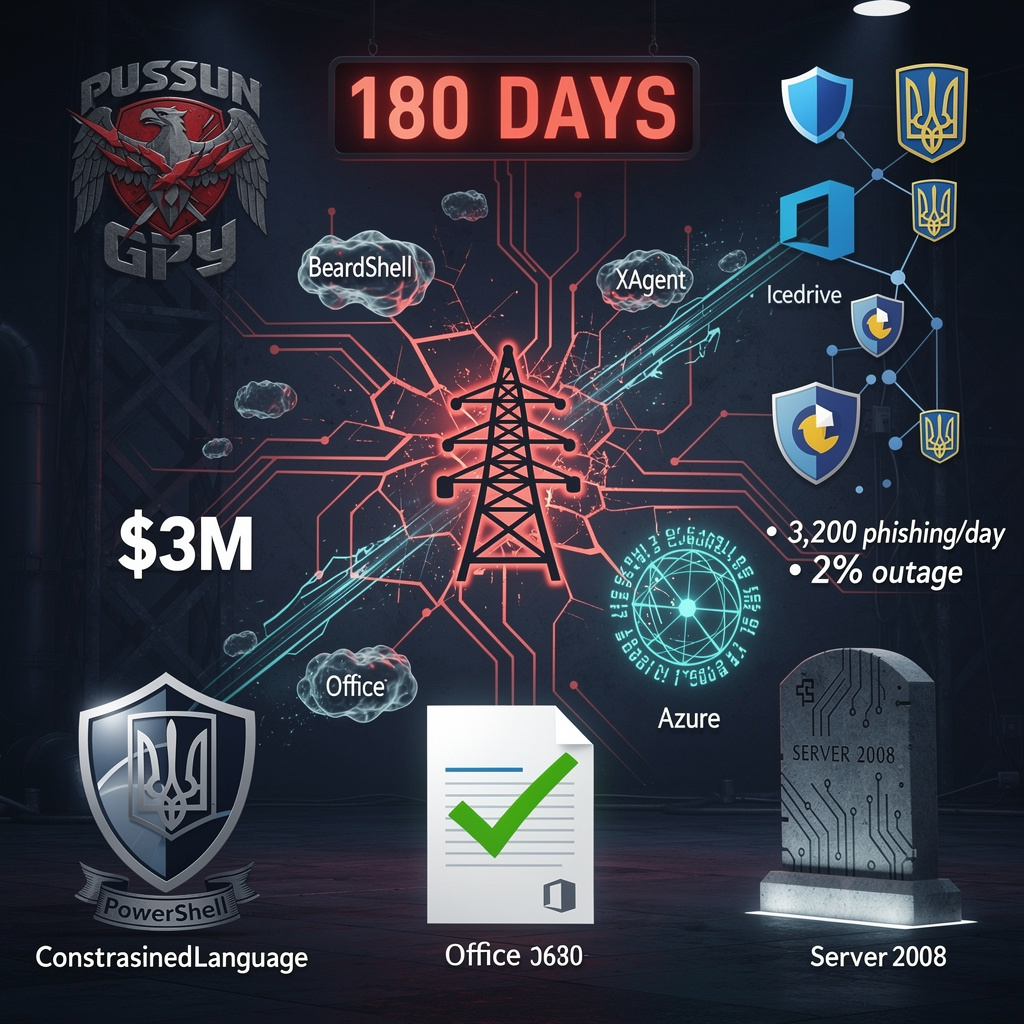
🪓 120 Ukraine Gov Endpoints Hijacked: 8-Year GRU SlimAgent Grid Siege
120+ Ukrainian gov boxes pwned for 8 yrs by GRU’s SlimAgent—same malware that siphons your keystrokes while you patch PowerPoint 🪓 68 % code recycle rate=green hacking for Putin. 2 % power dip=just enough to fry a grid. Europe, you’re next—still running Server 2008?
Ukraine’s grid keeps hiccupping because eight-year-old malware is still squatting on government PCs like a drunk uncle who “just needs a minute.”
SlimAgent/XAgent, the GRU’s favorite house-guest, has lived in 120+ Ukrainian ministry boxes since 2018 and is now encrypting its gossip with ChaCha20—because even spies hate ISP snooping.
How it works (spoiler: duct-tape & PowerShell)
- BeardShell, a .NET stowaway, rides in on a poisoned Word doc (CVE-2026-21509).
- Once inside, it phones Icedrive—yes, the same freemium cloud you use for cat pics—exfiltrating screenshots, passwords, and SCADA schematics.
- Covenant’s 90-in-one hacker Swiss-army-knife then impersonates admins, dumps credentials, and schedules reboot-proof tasks.
- Average stay: 180 days, double the old single-implant record.
Impacts in human-sized bites
Lights: ≤2 % of Ukraine’s regional load shed last month after crooks re-configured substations.
Data: 30+ industrial controllers now broadcast plant floor blueprints to Moscow.
Cash: every re-clean costs ~$25 k per endpoint; 120 endpoints → $3 M babysitting bill.
Trust: credential leaks trigger 3,200 spear-phish clones a day—your inbox is next.
Short-to-long-term forecast (mark your calendar)
- Spring 2026: BeardShell 2.0 skips files, lives only in RAM—hello “file-less” hell.
- Late-2026: C2 scatters to Google Drive, Azure Blob, whatever’s cheapest—sink-hole-proof.
- 2027: AI obfuscation expected to raise detection workload 30 %—SOC analysts, buy espresso futures now.
Cheap fixes that actually fit the budget
- Patch Office today; tomorrow is too late.
- Block Icedrive at the firewall—users can survive without 50 GB of free crud.
- Flip PowerShell to ConstrainedLanguage—cripples BeardShell, doesn’t cost a dime.
- Retire Server 2008 like it’s a mullet: nostalgic, but lethal.
Bottom line: If legacy boxes remain the path of least resistance, Ukraine’s electrons—and everyone else’s—will keep dancing to a Russian playlist. Patch, block, retire, repeat—or stock candles.
💥 200 Ukrainian Military PCs Drained: 12 GB/Month to Icedrive in Iran-Backed APT28 Heist
200+ Ukrainian frontline laptops pwned—12 GB/month siphoned to Icedrive like a leaky bucket in a firefight! 💥 Tehran’s ‘Bear’ recycles 2010 malware & a fresh Office 0-day to keep the taps open. Your tax € fund the bandwidth they hide in. Soldiers—how many more blue-screens before we unplug the cloud?
Iran-linked APT28 rebooted its malware sweat-shop last April and has since parked two digital parasites—BeardShell and Covenant—inside more than 200 Ukrainian military endpoints. The haul: 12 GB of fresh files per month, per implant, all quietly uploaded to Icedrive accounts that look just like any other corporate backup.
How the sneaky duo works
- BeardShell: a PowerShell blob that lives inside .NET, chats with Icedrive (no public API, so they rewrote the client), and hides its chatter behind Xtunnel-style obfuscation.
- Covenant: an open-source post-exploitation Swiss-army knife the group turbo-charged with 90+ tasks, deterministic IDs, and multi-cloud fallback (pCloud, Koofr, Filen).
- Entry ticket: CVE-2026-21509, a remote-code hole in Office docs that’s been exploited since January via spear-phish.
Impacts so far
- Operational secrecy: every keystroke, screenshot and clipped password is HTML-logged → real-time battlefield intel for Tehran.
- Bandwidth camouflage: exfil rides the same TLS tunnels your marketing team uses for cloud storage → SOC barely blinks.
- Credential bloodletting: harvested logins already enable lateral jumps into logistics and shared EU-NATO clouds.
Where this is heading
- Q2-Q3 2026: expect JIT-compiled PowerShell and OneDrive-for-Business pivot → harder to fingerprint, easier to justify as “normal” traffic.
- 2027: modular “C2Bridge” to auto-hop across ten-plus clouds; supply-chain targeting to mess with troop resupply.
Fix-it list (no corporate PowerPoint required)
- Patch CVE-2026-21509 today; disable Office macros if you still allow them.
- Flag any outbound TLS to Icedrive/pCloud/Koofr/Filen; 12 GB spikes should scream, not whisper.
- Drop updated YARA rules for BeardShell’s PowerShell sigs and Covenant’s deterministic IDs—GitHub has drafts, use them.
- Rotate creds weekly and slam MFA on every account that can read military email.
Cyber-espionage used to mean bespoke zero-days and Bond-villan server farms. APT28 proves recycled open-source tools plus one fresh Office bug are enough to gut a war plan. If your network touches Ukrainian defense data, assume the parasites are already nesting—patch, hunt, kick them out before the next 12 GB shipment clears the digital border.
💸 $30 B AI Scam Tsunami: 95 % Cost Drop Fuels Global Deepfake Plague
95 % cheaper, 100 % nastier: AI now pumps phishing & deepfakes for the price of a pizza 🍕—and your CFO’s still clicking ‘pay’! $25.6 M gone in one Zoom, 47 % of India’s phones already duped. While regulators nap, $30 B vanishes. Ready to mute the machines, or keep footing the bill?
Last Thursday Arup wired $25.6 million because a deepfake CFO said “jump.”
Cost to the crooks? Thirty bucks for a monthly AI-phishing kit and three seconds of scraped audio.
That 95 % price drop turns every bored script-kiddie into a con-artist with a Hollywood budget.
How does this work
Voice cloning needs < 3 s of your “hello?” from TikTok.
Large-language models spin 1 265 % more phishing mails than last year, each tuned with breached HR data.
Cisco’s red-teamers prove 60 % of “safety” guardrails fold after five chat turns—like a bouncer who lets you in if you ask nicely five times.
Impacts
- Wallet: synthetic-ID fraud already siphoned ≥ $30 B since 2023—equal to the GDP of Bolivia.
- Trust: 47 % of Indian mobile users now flinch at every unknown call; Europe clocks +311 % fake-ID loans.
- Boardroom: 94 % of login attempts are bots, so your multi-factor token is just another souvenir.
Institutional response (spoiler: still buffering)
Enterprises lecture staff with 2019-era slide decks that cover < 30 % of today’s scam surface.
EU watermark rules? Pending until 2027—light-years in AI dog-years.
Meanwhile open-source repos drop 200 new malicious models a week, priced at a latte.
Timelines to watch
- Q3-2026: voice-scam volume +30 %; detection false-positives still 12 %—your IT helpdesk drowns.
- 2028: attacker cost plateaus at < 5 % of 2022 levels; social-engineering becomes the default, not the exception.
- 2030: only media with cryptographic birth-certificates gets through—email without it hits the trash like spam from a prince.
The takeaway
When the cost of deception drops below a Netflix subscription, reputation becomes the only currency left.
Start watermarking your Zoom recordings, bind logins to how you type—not what you type—and treat every unexpected “hi, it’s me” like a $25 million question.
In Other News
- Hacker leaks 12GB of personal data from Cal AI, affecting 3 million users after exploiting MyFitnessPal breach
- Mullvad’s GotaTUN WireGuard implementation passes audit with two low-severity padding deviations fixed
- Law enforcement dismantles Tycoon 2FA phishing-as-a-service platform, disrupting 96,000+ phishing victims since 2023
- Prompt injection tops OWASP’s LLM Top 10 as attackers bypass safety filters to extract data and hijack AI agents

Comments ()