€500 M Privacy Price Tag: EU AI Rule Delay Risks Rights for Latte-Size Savings
TL;DR
- EU proposes Digital Omnibus to delay high-risk AI obligations, sparking debate over regulatory competitiveness amid global AI race
- Nyad AI launches wastewater treatment tool with $1.33M pre-seed funding, enabling AI-driven decision-making for treatment plant operators in Birmingham, Alabama
- Anchr secures $5.8M seed led by a16z to automate food distribution with AI, reclaiming 40% daily work time for distributors
⚖️ EU AI Act Delay Saves Firms €100, Risks €500 M Fines and Rights Erosion
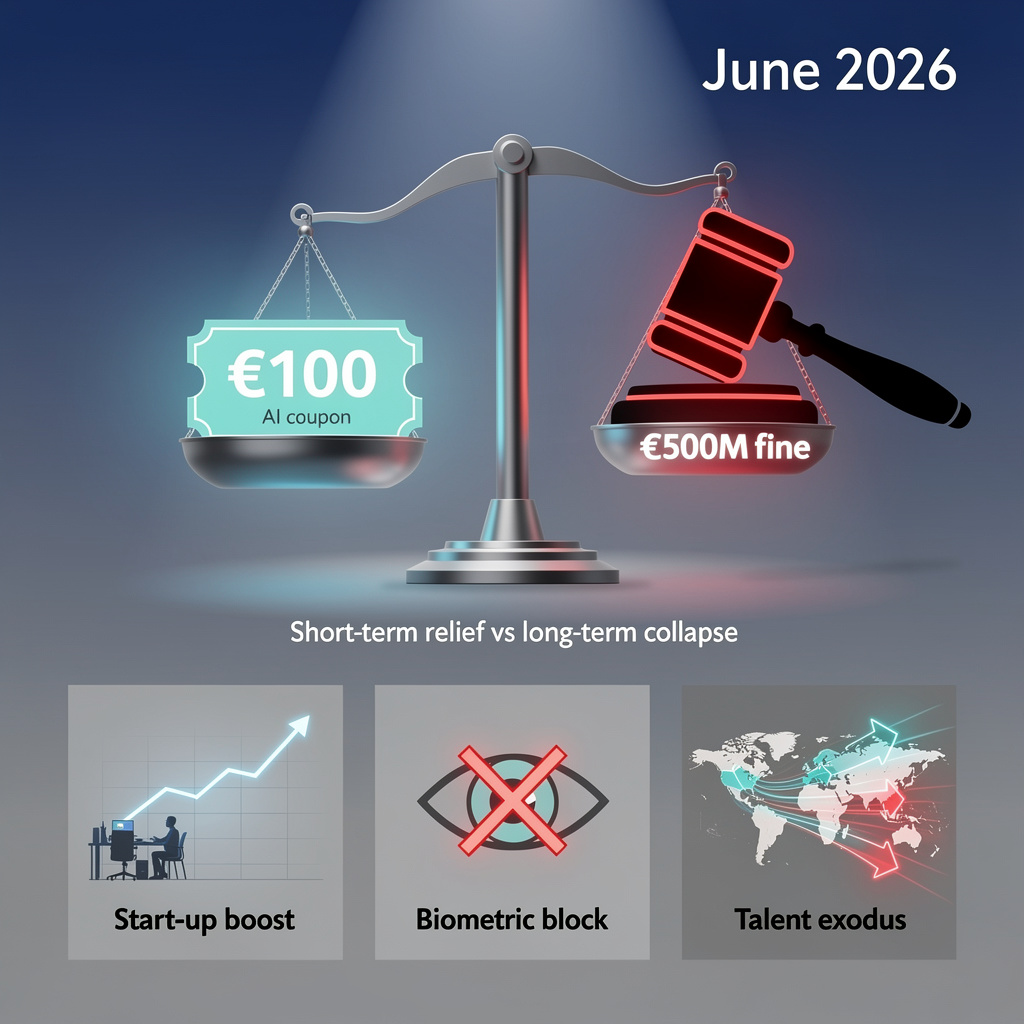
€100 saved per AI firm ≠ €500 M max fine if rights slip later 😱—equal to 5 million lattes. Omnibus delay boosts EU tech vs US/CHN, but 60 NGOs warn it guts transparency & ‘cognitive sovereignty’. SMEs cheer today, citizens may pay tomorrow. Should your MEP trade rights for a cappuccino? ☕
On 13 February the European Parliament closed the amendment window for the Digital Omnibus, a last-minute rewrite that deletes Article 49(2) of the EU AI Act and pushes high-risk system obligations from February to 13 June 2026. The Commission sells the move as a €100-per-registration gift to start-ups; critics call it a fundamental-rights retreat that exposes firms to fines of up to €500 million or 7 % of global turnover once the grace period ends.
How the Omnibus works
The amendment bundles the AI Act with GDPR and e-Privacy tweaks, creating a single compliance entry point. By postponing impact assessments, biometric auditing and risk-registry uploads, the Commission claims it will keep 40 % of Europe’s mid-size AI firms—each facing €2-5 million first-year compliance bills—alive long enough to compete with U.S. and Chinese peers that operate under lighter regimes.
What changes, who wins, who loses
- Innovation: VC flows of US$2.8 billion into EU agentic-AI start-ups in Q1 2025 could stall if investors read the delay as regulatory uncertainty → market share drifts overseas.
- Rights: 60 NGOs warn the gap lets police-grade facial-recognition and credit-scoring models dodge transparency tests today, exposing citizens to discriminatory profiling tomorrow.
- Enforcement: Article 77 powers stay intact, but regulators will have to prove harm post-deployment rather than prevent it, raising investigative costs and litigation risk.
- Competitiveness: A mere €100 saving per firm is dwarfed by potential €35 million-plus fines; the gamble is that administrative relief now outweighs penalty exposure later.
Short / mid / long lens
- Spring 2026: Parliament expected to adopt a diluted Omnibus that keeps core enforcement; AI start-up hiring freezes lift once date is fixed.
- 2026-2027: First compliance wave hits; Commission projects 15 % drop in cross-border AI service complaints if firms use extra months for privacy-by-design.
- 2028-2030: Without rights-impact reviews, annual net talent outflow could reach 5-10 % toward U.S./China hubs; cumulative fines may top €1 billion if postponed systems fail audits.
Bottom line
By trading a four-month breather for long-term enforcement ambiguity, Brussels is betting that Europe’s AI industry can sprint faster with lighter ankle weights. The data say the weights were never the problem—global investors look for clarity, not coupons. If the Parliament signs off in June without bolstered impact-assessment safeguards, the EU may win a short administrative reprieve yet lose the marathon for trustworthy, home-grown artificial intelligence.
🚰 12% Energy Slash: Birmingham Taps Nyad AI for $1M Sewage Upgrade
12% less power to clean your flush—Nyad AI’s $1.3M brain hijacks Birmingham sewage plants 🚰⚡. One plant = 600 homes’ worth of electricity saved yearly. Alabama utilities face 9-month EPA wait for smart-dosing approval—will ratepayers foot the lag?
Nyad AI, a six-month-old startup housed in Birmingham’s Innovation Depot, has begun installing edge-compute “brains” inside two local wastewater plants. The $1.33 million pre-seed cheque from Boost VC and Draper Associates is tiny beside this quarter’s billion-dollar AI rounds, yet it targets a $10 billion global market where a 5 % efficiency gain equals 20,000 Birmingham households’ annual power bill.
How does it work?
Pumps, blowers and chemical feeds stream SCADA data every second. Nyad’s gradient-boosted models translate flow, pH and oxygen readings into live set-point instructions—delivered to operators as one-click “accept” buttons on a tablet. A three-month baseline at each plant trains the reinforcement layer; after that the system keeps effluent inside EPA limits while trimming kilowatts.
Impacts at plant scale
- Energy: 5–12 % drop in aeration power → 1.2 GWh saved yearly, enough to run 100 homes.
- Compliance: 10–20 % fewer effluent excursions → ~$90,000 avoided fines per typical 20 MGD facility.
- Maintenance: 15 % fewer emergency shutdowns → 30 hours of avoided overtime monthly.
Regulatory runway is the bottleneck
EPA certification for algorithmic dosing averages nine months; Nyad’s pilot clock started in February. Operator upskill adds another 30–40 hours of paid training—small, but unions want it written into the next contract.
Short-term / mid-term / long-term
- Q4 2026: two Birmingham sites validated, ≥4 % energy cut documented.
- 2027: five Alabama plants online, cumulative 15 GWh savings and 2.5 kt CO₂ avoided.
- 2029: 2–3 % share of global smart-water market, revenue runway ~$200 million, Series A of $5–10 million closed.
Birmingham’s sewers will not grab unicorn headlines, yet they offer the clearest proof that AI’s next frontier is beneath our feet—where every kilowatt saved and every gallon cleaned flows straight back to ratepayers and rivers alike.
🦞 AI Erases 40% Distributor Labor, Adds $65 Per Order in Boston Pilot
40% of a Boston seafood distributor’s day just vanished—like wiping out 3.2 hrs of grunt work per employee 🦞📉. AI now adds $65 to every single order (4k/month). If your warehouse still runs on spreadsheets, you’re funding your competitor’s margin—who’s next to flip the switch?
Boston-based Anchr just pocketed a $5.8 million seed round—led by a16z Speedrun and OpenAI—to give food distributors an AI-native operating system that already hands back 40 % of the workday to a Boston seafood wholesaler while adding $65 to every one of its 4,000 monthly orders.
How the back-room bot works
The software swallows order forms, inventory counts, routing tables, and carrier chats in one gulp, then spits out pick lists, truck schedules, and customer confirmations without human retyping. Early numbers show the same staff now closes more tickets before lunch than they once did in a full shift.
Impacts
- Labor: 40 % manual time reclaimed → same headcount can handle peak season without overtime.
- Revenue: +$65 per order × 4,000 orders = +$260 k monthly top-line bump for a single mid-size distributor.
- Competition: Pepper already processes $25 B across 500 distributors; Anchr must scale past its lone pilot to matter.
- Ecosystem: Gather AI drones and Encord robots raise the bar—distributors will soon expect inventory, pricing, and labor automation in one stack.
What happens next
- Q4 2026: Series A (~$20 M) funds 3-5 new pilots, pushing monthly orders past 10 k.
- 2027–2028: API links to drone inventory and robot pickers cut labor another 5-10 %; order uplift steadies near $75.
- 2029–2031: If 15-20 % of the nation’s ~5,000 distributors adopt, the sector could shed 150 million work-hours yearly while ringing up an extra $2 B in sales—without a single new warehouse.
Food distribution runs on paper-thin margins; the outfit that automates first eats the biggest slice.
In Other News
- Meta acquires AI agent platform Moltbook, hires co-founders Schlicht and Parr for Superintelligence Labs
- GitHub Copilot SDK enables agentic execution, allowing AI to modify files, recover from errors, and integrate with real systems


Comments ()