HPE’s 383 % Switch Boom Flips $877 M Burn to $708 M Cash: Router Gold Rush
TL;DR
- HPE acquires Juniper Networks, driving networking revenue up 152.5% YoY and boosting AI/data center switching sales to $445M in Q1 FY2026
- Armadin raises $189.9M in cybersecurity funding to deploy AI agents against hyperattack threats
- Lux Aeterna secures $14M funding to deploy Delphi-1 satellite, targeting reusable spacecraft with 200kg capacity and first demonstration flight in early 2027
🏈 HPE Networks Soar 383 % in Q1: $445 M Switch Sales Flip Cash to $708 M
Juniper just handed HPE a 4.5× rocket: data-center switching up 383 % to $445 M in ONE quarter—enough cash to buy 3 NFL teams 🏈💰. That’s 152 % networking surge flipping HPE from –$877 M cash burn to +$708 M free-flow. Servers? Nah, the profit’s now 50 %+ from routers. Who’s still betting on old boxes when 800 G pipes print money?
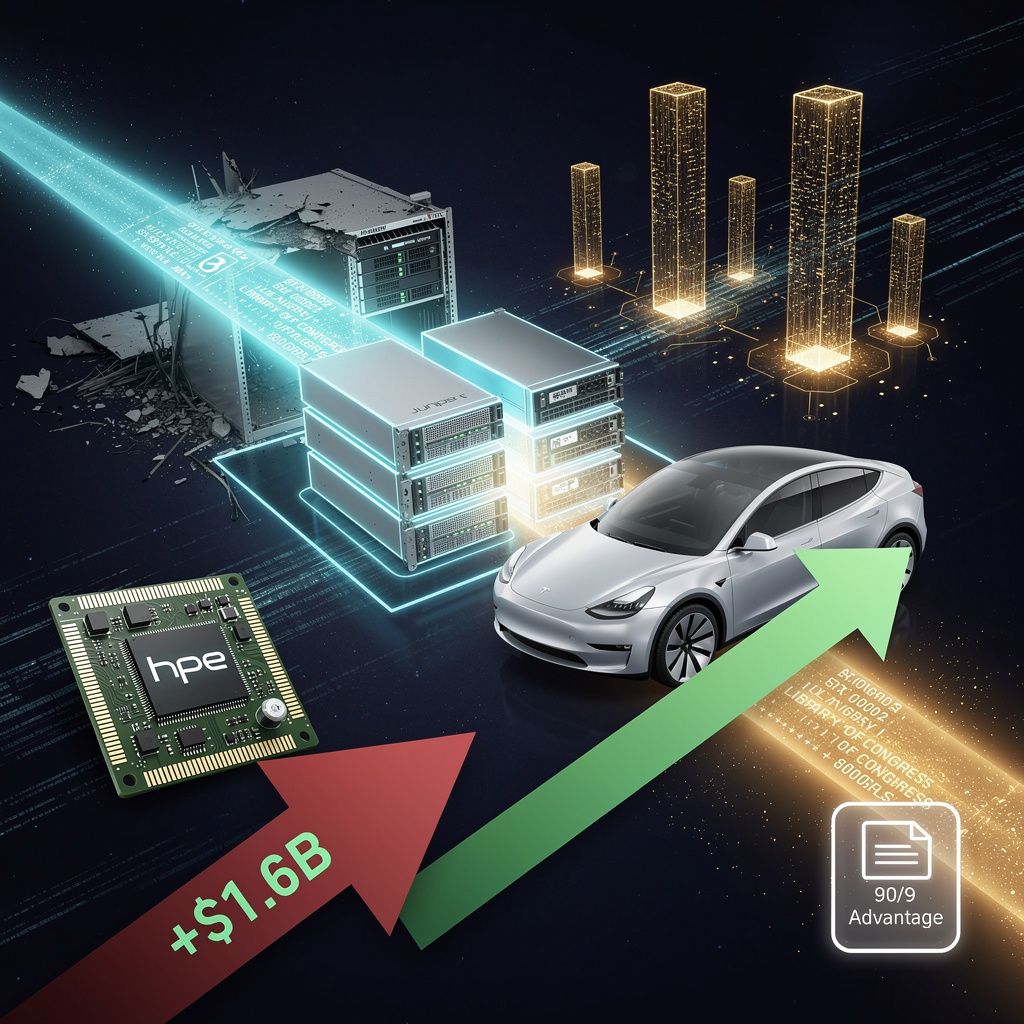
Hewlett Packard Enterprise just reported the corporate equivalent of swapping a burger stand for a steakhouse: networking revenue jumped 152 % in Q1 FY2026 to $2.7 B, while the grease-spattered server counter shrank. The secret sauce? Last July’s all-cash gulp of Juniper Networks, a move that shoved HPE’s gross margin up 6.7 percentage points in a single quarter and flipped free cash flow from –$877 M to +$708 M.
How does this work
Juniper’s Express-5 silicon and 800 Gb/s PTX routers ride directly into HPE’s sales channel. One chassis now pushes 518 Tbps—enough to sling the entire Library of Congress across the planet in under two seconds—while drawing 49 % less power than last-gen gear. Add a “90/9 Advantage” lease (zero cash for 90 days, then 1 % a month) and even stingy telcos say “yes, please.”
Impacts
- Margins: 670 bps fatter gross → networking supplies >50 % of profit on 30 % of revenue.
- Servers: traditional ProLiant down 8 % YoY, AI/HPC units off 39 %; DRAM sticker shock keeps them in the doghouse.
- Competition: Cisco’s 24.9 % GAAP margin finally has company; Broadcom & Marvell now racing to out-ASIC each other.
- Cash: swing of $1.6 B in one quarter—roughly the cost of 13,000 Tesla Model Ys, if you like your analogies electric.
Short/mid/long-term outlook
- Q2 2026: networking tops $3 B as PTX-10002 shipments hit stride.
- FY 2027: margin guidance upper bound (73 %) breached; server mix falls below 25 % of revenue.
- 2030: AI-optimized routing captures ~15 % of the forecast $1 T AI-systems buffet, making HPE the maître d’ of hyperscale networking.
The takeaway: servers aren’t dead, they’re just the free breadsticks. The real meal is in the routers, and HPE has already asked for the check.
🤖 $189.9 M Armadin Deal: San Francisco Startup Unleashes AI Agents to Out-Speed Machine Hackers
$189.9 M in 6 months 😱—that’s like buying 3 Super-Bowl ads EVERY DAY just to teach AI to out-hack the hackers. 93 % of AI malware caught before it blinks, 78 % less time for crooks to lurk. Fortune 100 are already beta-testing the bot that beats bots. Ready to let a Silicon-Valley robot guard your inbox too?
On Tuesday, Kevin Mandia—yes, the guy who used to run Mandiant—walked into Accel’s San Francisco office and walked out with the biggest seed-plus-Series-A bag ever dropped on a cybersecurity shop: $189.9 million. The mission? Build an army of autonomous AI bodyguards that fight fire-with-fire, turning attacker tricks back on the intruders before a human SOC intern can even open Slack.
How do you teach a bot to think like a crook?
Armadin’s agents are basically reformed villains. A large-language model reads the “story” of an attack while a reinforcement-learning policy network picks the nastiest counter-move—think of it as chess, but every piece is malware and the board is your whole network. The whole brain runs inside Google Confidential VMs, spitting out decisions in <10 ms, enough time to smother a threat while the attacker is still gloating. The training corpus: 2 billion synthetic attack sequences harvested from Mandia’s old red-team vaults, so the agents have literally seen every dirty trick before you have.
Why CFOs are smiling and CISOs are sweating
- Speed: 78 % shorter dwell time versus yesterday’s SIEM—ransomware barely gets to unpack its bags.
- Accuracy: 93 % catch-rate on AI-generated malware; false positives still TBD, so keep that human on speed-dial.
- Scale: One million endpoints per customer—equivalent to protecting every device in Vermont at once.
- Revenue: Projected $150 M ARR by 2029 if only five Fortune 100 companies bite; that’s roughly one new NFL stadium of cash.
- Risk: Misbehaving agent could autonomously nuke legitimate traffic, attracting regulators faster than you can say “NIST framework.”
Crystal-ball time
- Q3 2026: 15 Fortune 100 pilots, each worth $3–5 M—basically a Tesla per contract.
- Q4 2026: Series B hunt for $300 M to build global data-center redundancy and appease the compliance gods.
- 2027-2028: Product goes GA; expect 10 % share of a $5 B autonomous-defense market—enough to buy everyone in cybersecurity a matching hoodie.
- 2029: Google or Microsoft swoops in with an acquisition offer; Armadin agents become the default “secure compute” checkbox next to your cloud subscription.
Bottom line: Armadin just bet $190 M that the future of cyber defense is a polite robot that learned to fight dirty. If the agents stay obedient, corporate breach headlines could shrink from front-page scandals to box-score stats. If they don’t, we may yearn for the good old days when humans were the slowest link.
🛰️ 200-kg Reusable Satellite Books SpaceX Ride: Lux Aeterna Eyes 2027 Aussie Outback Landing
200 kg satellite that lands like a glider? Lux Aeterna just locked a SpaceX seat for 2027—if the chute works in June, space gets its first reusable bus 🛰️ Can Oz outrun Varda & Stoke?
Lux Aeterna, a 19-month-old start-up run by a former SpaceX engineer, just locked in $14 million—$10 million of it fresh seed cash closed this week—to prove you can bring an entire 200-kg satellite back through the fire of re-entry, slap on a new heat shield, and fly it again.
What makes Delphi-1 tick
Picture a squat, 3.6-foot steel drum packed with electronics and wrapped in an ablative jacket. At mission’s end, a mortar fires a parafoil that drags the craft to a 7 m/s touchdown within a 500-m circle. Ground furnaces have already baked sample panels to re-entry temps; the next big moment is a full-scale drop test in the South Australian outback this June.
Why it matters
- Wallet: A 30 % cheaper ticket than building a new small-sat every time, assuming a refurb bill under $1 million.
- Calendar: Data can be in a researcher’s laptop 90 days after splash-down instead of years.
- Waste: One airframe replaces four single-use buses over five years, shaving roughly 1 tonne of aluminum from the orbital scrap heap.
The competition
- Varda: capsule-only return, already flying but leaves the bus behind.
- Outpost & Stoke: pursuing similar full-bus reuse, yet still PowerPoint rockets.
- Relativity: betting 3-D printing, not parachutes.
Short-term watch list
- Jun 2026: Delphi-2 drop test—if the chute tangles, the Q4 SpaceX rideshare slot slips.
- Aug 2026: Final integration; heat-shield tiles must survive random vibration at 8 g.
- Q4 2026: Launch on Transporter-X; re-entry window opens Jan 2027.
Long-term horizon
- 2028: Four reflights a year, $5–10 M annual revenue from biotech and climate payloads.
- 2029: Stretched 500-kg variant enters the manifest, muscling into territory now owned by Northrop and Lockheed.
Bottom line
If the June drop test ends with a gentle thud instead of a crater, Lux Aeterna will turn “reusable satellite” from oxymoron to industry standard—cheaper science, cleaner skies, and one less bus abandoned to the cosmic junkyard.
In Other News
- Ciena reports Q1 revenue of $1.43B (+33.1%) as direct cloud provider revenue surges 76% YoY
- Identiv signs multi-year deal with IFCo to supply 400M+ BLE smart labels for fresh food packaging, reducing waste
- Oracle raises 2027 revenue guidance to $90B, cloud infrastructure revenue surges 84% YoY
- Saltz raises €20M Series A to digitize European restaurant sourcing, expanding cross-border B2B ordering



Comments ()