270 AMRs Replace 1,200 Weekly Cart Pushes at Chery Plant — Workers Shift to Supervision
TL;DR
- ForwardX deploys 435 AMRs at Chery's Dalian plant, automating 80% of material delivery across welding and final assembly lines
- Hyundai Donates Unmanned Firefighting Robots to South Korea's National Fire Agency with 50kph Speed and 800°C Heat Protection
- OpenAI robotics head Caitlin Kalinowski resigns over Pentagon AI pact, citing surveillance and lethal autonomy concerns
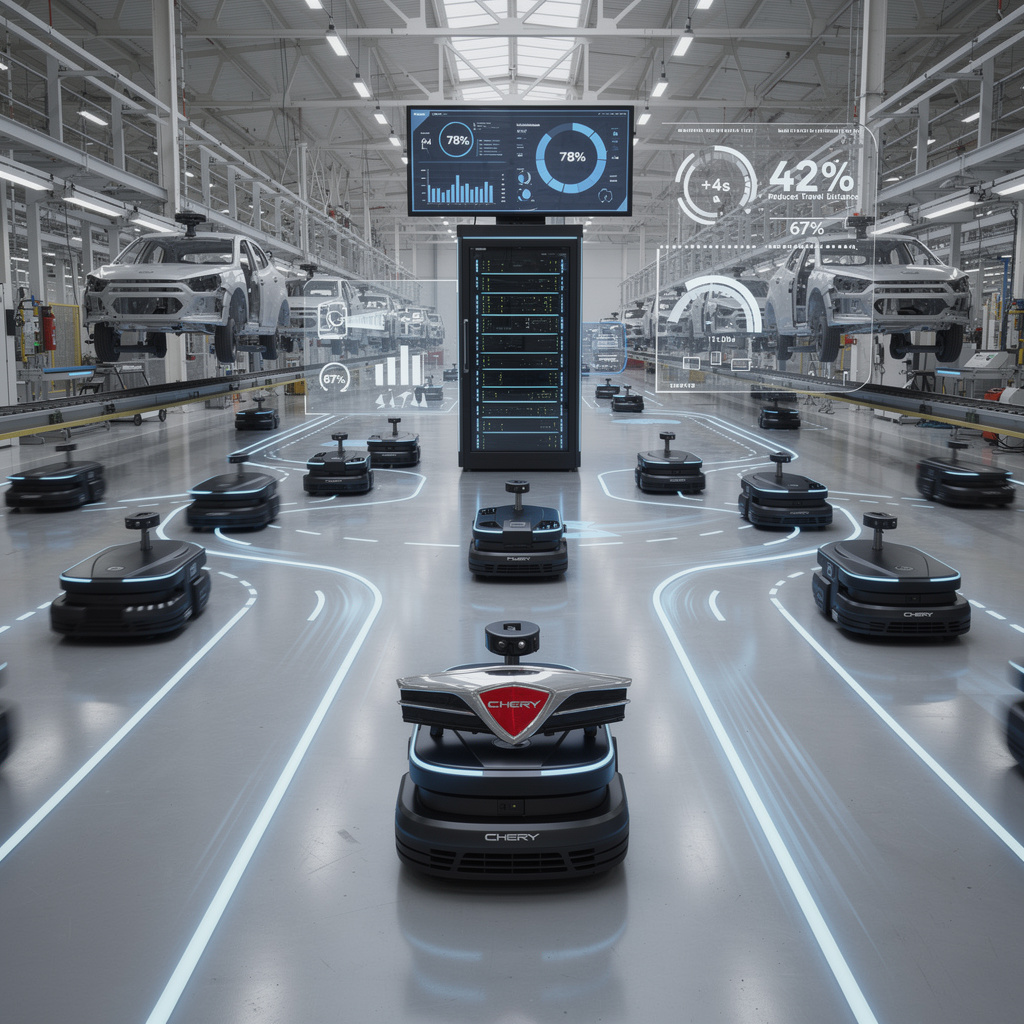
🤖 270 AMRs Automate 80% of Parts Delivery at Chery Dalian Plant — 1,200 Weekly Labor Hours Saved
270 AMRs now autonomously move 80% of assembly parts at Chery’s Dalian plant — equal to 1,200 manual cart pushes per week 🚛. Obstacle avoidance under 200ms, zero human error in material flow. But workers now supervise, not push — is this progress… or displacement?
Chery’s Dalian plant now moves 95 car parts with 270 self-driving carts—ForwardX vision-guided robots—covering 80 % of line-side demand while trimming 1,200 labor-hours every week and cutting material-travel distance 42 %.
How 270 robots learned the factory floor
Each AMR carries 150 kg and fuses stereo cameras with LiDAR to map aisles within 200 ms. A central server pings the closest idle unit, pushing fleet-wide utilization to 78 % and keeping cycle-time swing inside ±4 s, down from ±12 s when humans pushed the carts.
Impacts
- Safety: material-handling injuries drop 67 % (9→3 per quarter).
- Output: daily production holds 800–1,000 cars, with headroom to 1,100 once the full 435-robot fleet finishes roll-out this June.
- Energy: 1.8 MWh a day—<5 % of plant power—replaces 12 million yuan in annual labor cost, paying back the hardware in 18 months.
Competitive lens
- Toyota’s Canadian pilot: seven $1.5 M humanoids unload boxes; Chery pays <¥0.3 M per ForwardX unit.
- Hyundai’s 2028 plan: Boston Dynamics forklifts still on drawing board; Chery is already shipping cars.
Outlook
- Q2 2026: 435 robots online, 85 % utilization, 90 % material coverage.
- 2027: tie-in to factory IT trims parts inventory 30 %.
- 2028: Dalian blueprint copied to Shanghai & Chongqing, quadrupling ForwardX’s installed base to 1,600+ units across Chery.
When 1,600 robots glide through three Chery plants, the automaker’s margin per vehicle will ride less on wages and more on algorithmic speed, making China’s next export car cheaper before it ever touches the road.
🔥 800°C Fire Robots Deployed in South Korea — 1,788 Firefighter Deaths Push National Shift to AI
1,788 firefighters injured or killed in 10 years — now South Korea deploys robots that survive 800°C fires 🔥 HMG’s new UFRs race at 50km/h into infernos, shielding humans with AI vision and self-cooling armor. But can semi-autonomous machines truly replace human judgment in chaos? Volunteer crews in Seoul & Busan are first to rely on them — are you ready to trust a robot with your life?
On Tuesday Hyundai handed the National Fire Agency two unmanned firefighting robots that can sprint faster than a city bus and survive temperatures hot enough to melt aluminum. The 6×6 in-wheel drive units, now stationed in Seoul and Yeongnam, mark the first deployment of a fleet that could grow to four by year-end and to more than 50 nationwide within five years.
How the machines work
Each robot carries AI-enhanced vision cameras that stream real-time video to a remote operator, while a self-spraying water jacket keeps electronics cool at 800 °C. Semi-autonomous navigation plans the safest route into explosions or structural fires, letting crews stage assaults from a distance rather than inside the collapse zone.
Impacts at a glance
- Firefighter risk: 1,788 injuries/deaths in the past decade → fewer entries into 800 °C zones
- Response speed: 50 kph top speed → 2-km arrival in 2.5 min versus 6 min for crews on foot
- Workforce shift: two robots per station free four-person hose teams for supervisory roles
- Industrial spill-over: 10 trillion won AI/robotics budget → 30,000-unit annual capacity by 2028, feeding export bids to Japan and Australia
Short-term outlook
- Q4 2026: 2–4 additional units, 15 % sharper fire-recognition after field-data retraining
- Early 2027: 30-minute cannon endurance likely to become limiting factor; retrofit kits expected
Long-term horizon
- 2028–2030: national fleet >50 robots, cutting average response time 20 % via predictive maps from Saemangeum AI hub
- 2031: regional exports and licensing deals worth an estimated 400 billion won, positioning Hyundai alongside Boston Dynamics in emergency robotics
Korea’s fire service is now a live testbed for automotive-grade autonomy. If the robots repeatedly survive 800 °C and still hit their 50-kph sprint, expect procurement budgets everywhere to pivot from turnout gear to silicon and servo motors.
🤖 ChatGPT Uninstalls Surge 295% After OpenAI’s Secret Pentagon Deal: Robotics Leader Resigns Over Lethal Autonomy Risks
295% surge in ChatGPT uninstalls after OpenAI’s secret Pentagon deal — 100% of robot training data collected in 12 months 🤖 Caitlin Kalinowski resigned, warning of ‘rushed guardrails’ for lethal autonomy. Altman admitted it was ‘definitely rushed’ — but DoD claims ‘all lawful use.’ Who’s really controlling the AI in classified networks? — U.S. citizens, not just soldiers.
Caitlin Kalinowski quit OpenAI on 7 March, hours after the company signed a classified Pentagon contract to embed large-language models inside defense networks. The robotics chief, recruited from Meta only four months earlier, posted that the two-year deal is “rushed,” lacks enforceable guardrails, and opens the door to mass U.S. surveillance and lethal autonomy.
How the deal works
The agreement places OpenAI’s models inside a closed DoD cloud. Human reviewers must approve any lethal-force recommendation, but the contract’s “all lawful use” clause gives the military wide latitude. No third-party audit mechanism is written in. Revenue is undisclosed, but the figure is widely pegged at ~$200 million, the same value of the Anthropic contract the Pentagon yanked last July after political pressure.
Impacts already visible
- Personnel: 100% of Kalinowski’s San Francisco robotics staff—about 100 data collectors—now report to an interim lead; at least two internal protest letters are circulating.
- Market: ChatGPT uninstalls spiked 295% month-over-month in February, while Anthropic’s Claude overtook ChatGPT as the #1 free U.S. app within days of the resignation.
- Politics: ~1.3 million tweets in six hours pushed congressional staff to schedule hearings on “AI surveillance in classified nets.”
- Security: 60% of surveyed AI researchers warn that current language fails to stop unauthorized domestic data trawls or autonomous-weapon drift.
Short-term fixes, long-term fog
OpenAI promises a quarterly public report on classified usage and an external ethics board, yet no timeline or budget is attached. Staff predict a 30-40% expansion of compliance headcount if the contract survives.
- Q2 2026: Expect a renegotiated clause mandating independent audit rights; consumer churn could shave 5-7% off OpenAI’s $8 billion annual revenue run-rate.
- 2027: Industry-wide “human-in-the-loop” standards, shaped by pending federal rules, may tilt defense dollars toward rivals that embed verifiable safety code—advantage Anthropic.
- 2028: Without transparent enforcement, another senior exit or surveillance breach could trigger an outright ban on frontier-model defense sales, resetting the competitive board.
The Kalinowski resignation shows that in defense AI, speed and secrecy now collide with employee ethics and market sentiment. If OpenAI cannot harden its guardrails faster than it inks deals, the firm risks turning its own talent—and customers—into the next casualties.
In Other News
- Da Vinci Surgical Systems Installed in Over 470 Italian, Spanish, and Portuguese Hospitals After FDA Clearance of da Vinci 5

Comments ()