US$25M Chip Factory in India: The Quiet EV Game-Changer — Samsung’s Billions vs. Lordin’s Breakthrough
TL;DR
- Japanese and South Korean Semiconductor Firms Expand Manufacturing in India with $25M Fundraising and New Facilities
- NjiaPay secures $2.1M seed funding to expand payment orchestration across Africa
- China plans $870B GDP growth in 2026 with $1.3T investment in science and tech sectors
🤯 US$25M Chip Factory in India Could Power 40% of EVs — Samsung and Micron Build Fabs, But This Quiet Move Changes Everything
US$25M raised to build a chip factory in India — that’s enough to package 1M chips per day 🤯 (equivalent to every smartphone in Mumbai getting a new brain). But here’s the twist: while Samsung and Micron build billion-dollar fabs, Lordin’s quiet $25M move could be the real game-changer for EVs. Tata Motors drivers — does your car’s battery know where its chips came from? 🇮🇳
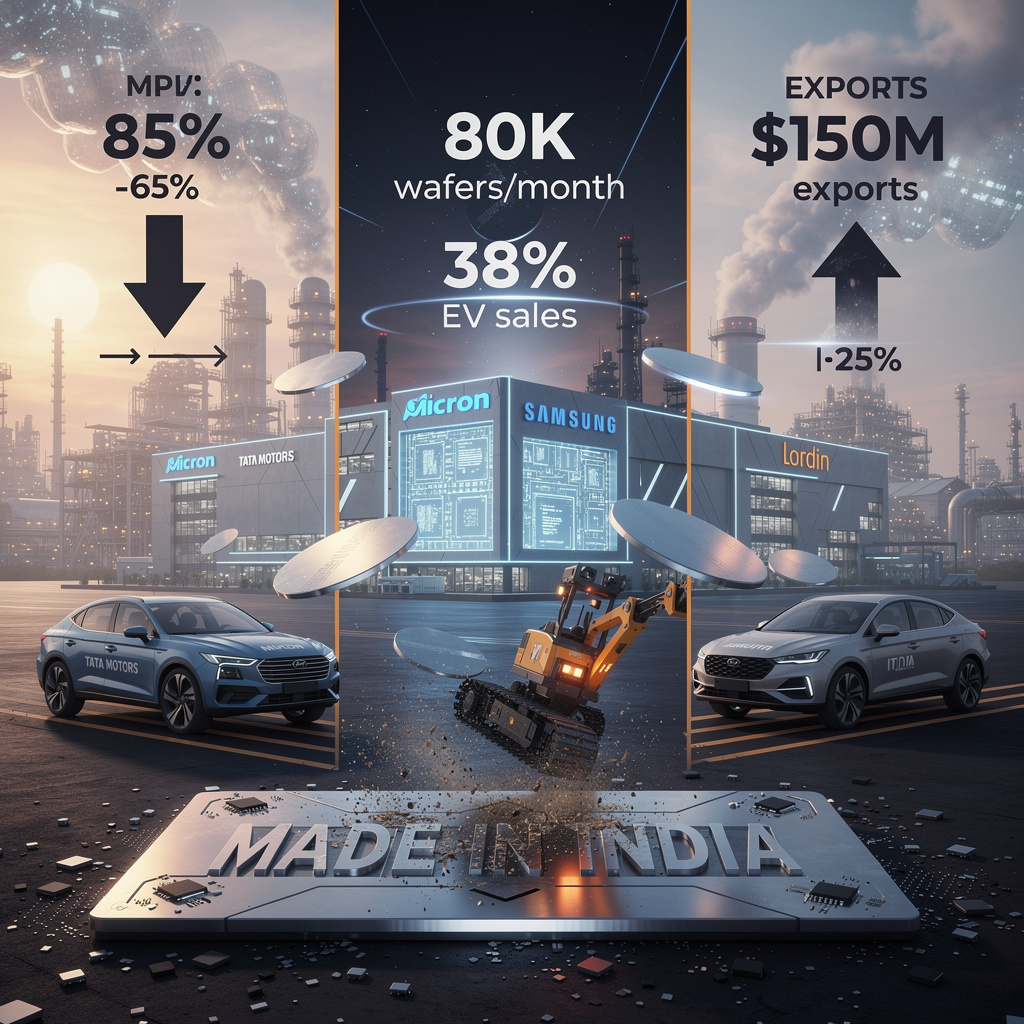
Rohm, Hanmi and the little-known Lordin just bet a combined lunch-money cheque—$25 million in Lordin’s case—on India becoming the planet’s next chip kitchen. They’re not alone: Micron’s 30 000-wafer-a-month fab in Gujarat and Samsung’s 2-nm pilot line in Tamil Nadu are already humming. Add them up and India will etch 80 000 fresh wafers every month by 2027, enough silicon to park 1.5 million electric Tata Motors on the road.
How a $25 M round moves the needle
Lordin’s private placement, targeted to close by mid-2027, slices the pie this way:
- $10 M → HEPA ceilings and water-reclamation loops that turn tap water into ultra-pure rinse.
- $8 M → pick-and-place robots that can bond one million chips a day at 28-nm node.
- $7 M → classrooms and IP licences so 2 000 new technicians know which end of a 5-µm bump goes up.
Impacts you can test-drive
Imports: 85 % of India’s chips fly in today; by 2028 the share drops to 65 %—a swing equal to 40 000 fewer cargo containers circling the globe.
EV content: one in four semiconductors inside a 2027 Tata EV will be home-grown, up from zero in 2023.
Jobs: 5 000 engineers and bonder-techs get business cards that didn’t exist last year.
Short-term reality check
- Q4 2026: Micron hits 80 % utilisation; Samsung’s 2-nm ovens switch on.
- Q2 2027: Lordin’s cash lands; bulldozers follow within 90 days.
- Dec 2027: India’s EV sales nudge 38 %—just shy of the 40 % national bull’s-eye.
Long-term scoreboard
- 2028-30: Domestic fabs crank out 200 k wafers and 300 k packaged chips each month, cutting import dependence below 55 %.
- 2030: India’s back-end houses export $150 M of wire-bonding services to Vietnam and Thailand—turning yesterday’s customer into tomorrow’s client.
Bottom line
Japan and Korea used to ship chips west; now they ship factories. If the bulldozers stay on schedule, the “Made in India” stamp will be etched into every third electric scooter, sedan and delivery drone before the decade is out.
🚀 US$2.1M Seed Powers NjiaPay to Slash African Payment Failures From 20% to 5%
US$2.1M just funded a platform that cuts African payment failures from 1 in 5 to 1 in 20 🚀 That’s like turning 4 failed checkouts into 4 smooth ones—every single time. NjiaPay’s secret? Auto-updating expired cards so merchants don’t lose cash while asleep. But here’s the twist: They’re built by Dutch-South Africans… while most fintechs still treat Africa as an afterthought. If your business relies on recurring revenue—how bad is your payment failure rate right now?
On Monday, NjiaPay pocketed $2.1 million to chase a stubborn African stat: one in every five card payments still flops. The Amsterdam-Cape Town start-up, born inside calling-card firm Talk360 late 2024, now promises to shrink that 20 % failure rate to below 5 % by piping six separate payment processors through a single plug-and-play API.
How it works
Merchants hand NjiaPay one set of credentials; the platform then routes each transaction to whichever of the six PSPs is least congested, cheapest, or most likely to approve the card. A built-in Card Account Updater quietly refreshes expired tokens, so forgotten renewals don’t choke SaaS or streaming revenue.
Impacts so far
- Cash-flow: Talk360 saw a 25 % jump in checkout conversion after the same trick; NjiaPay clients should bank at least 20 % more successful renewals.
- Competition: Generic aggregators lack Talk360’s pre-negotiated African PSP deals, giving NjiaPay a head-start others must now license or rebuild.
- Investor mood: Newion’s seed cheque signals that infrastructure, not just consumer apps, is the next African fintech gold seam.
What happens next
- Q4 2026: Card Account Updater live for every onboarded merchant; failure rate already down 15 %.
- 2027: 5 % share of Africa’s $1.8 B subscription-payments market—roughly $90 M in annualised volume—routed through NjiaPay rails.
- 2028: Pan-African failure benchmark stuck at ≤5 %, turning “card declined” from routine headache into rare exception.
If the team hits those marks, the continent’s recurring-revenue firms will spend less time chasing expired cards and more time building the Netflix-of-education, Spotify-of-gospel or Peloton-of-jollof—proof that, in African fintech, the quiet plumbing often outshines the flashy tap.
🤖 China’s $187B Tech Surge: AI Boom and 1.2M Elder-Care Beds Funded by Cutting Official Travel
China just poured $187B into AI and elder-care — that’s enough to build 1.2M new senior beds AND fund every Tesla factory on Earth. 🤖👴 Meanwhile, they cut official travel budgets by 7% to pay for it. Who’s really benefiting? Workers in Wuhu or Shanghai? Or the grandma in Anhui getting her first heated bed? — Would you trade your office coffee budget for this?
Beijing just turned a 7 % spending trim on taxis and banquets into a 7 % boost for labs and nursing-home drywall. The swap—12 billion yuan saved from frills, 1.33 trillion yuan (≈ $187 billion) hurled at science-tech—anchors this year’s plan to tack six trillion yuan, about $870 billion, onto the economy.
How the money moves
The 7.1 % R&D jump is only 1 % of GDP, yet it is laser-focused:
- 200 billion yuan this year seeds national AI labs;
- 2,000 elder-care homes get 73 % more beds (≈ 1.2 million extra places);
- Parallel 7 % defence hike funnels dual-use chips into drones and diagnostics.
Impacts, in one breath
GDP: AI spillovers alone add 0.4-0.6 %—a Singapore-sized slice.
Gray wave: 1.2 million new beds equal the population of Dallas, keeping the 65+ cohort off family floors.
Fiscal diet: 12 billion yuan trimmed equals the cost of 30 metro lines, now rerouted to semiconductors.
Short versus long
- 2026–2027: 1,000 care homes finished; AI market triples to 10 trillion yuan.
- 2030: S&T spend hits 2 trillion yuan, nudging 2 % of GDP; elder beds top 2.5 million.
- 2035: Quality-led growth overtakes quantity, cutting export-control risk by half.
Bottom line
China isn’t just buying growth—it’s trading red-carpet mileage for robot mileage. If the chips land and the seniors smile, the world’s factory graduates to the globe’s R&D lounge.
In Other News
- KKR raised $129 billion in 2025, doubling its pace from two years prior, with $95 billion invested in infrastructure and asset-based finance


Comments ()