47.6M Revenue from AI Power Plants — Vietnam and South Korea Lead Energy Sovereignty Shift — But Global Inequality Grows
TL;DR
- Korea Western Power and Doosan Enerbility Deploy AI-Powered Virtual Models for Combined-Cycle Power Plant Optimization
- Australia Deploys Intelligent Document Automation for 10,000+ Annual Protection Visa Applications, Cutting Processing Time from Hours to Minutes
- UCATAB Unveils Unified Causal Taxonomy of Algorithmic Biases, Classifying 21 Subtypes Across Emergent, Architectural, and Implanted Categories
🚀 AI-Powered Digital Twins to Generate $47.6M Revenue Across 68 Southeast Asian Power Plants — Vietnam and South Korea Lead the Shift
47.6M in long-term revenue from 68 AI-optimized power plants — that’s enough to fund 1,800 new solar farms annually. 🚀 Built on real-time digital twins and autonomous inspection robots, this isn’t just efficiency — it’s energy sovereignty. Vietnam and South Korea are leading the shift — but who gets left behind when AI rewrites the rules of power generation?
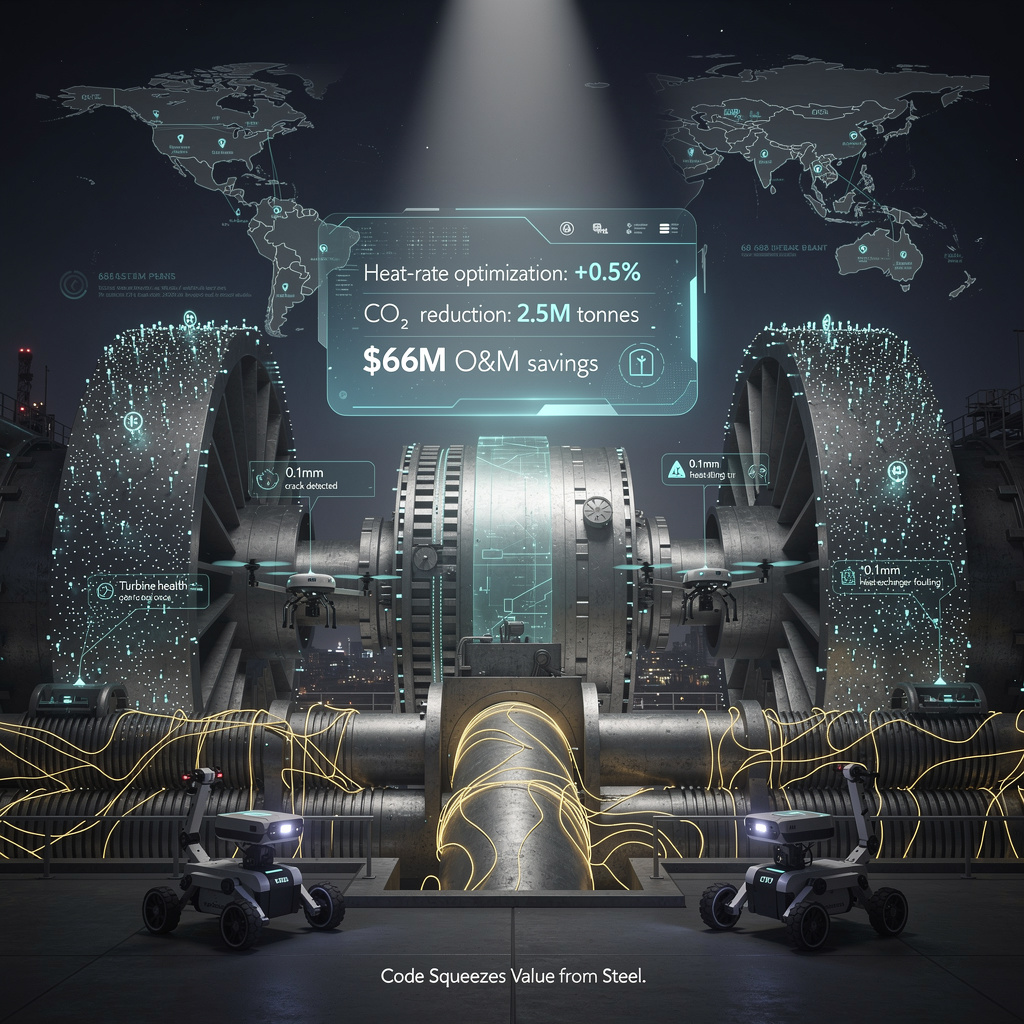
On 6 March, Korea Western Power and Doosan Enerbility quietly signed an agreement that turns the 1 GW-class Yeosu Combined-Cycle Power Plant—still under construction—into a living laboratory. A physics-based digital twin, fed by 20,000 real-time sensors and an AI inference engine, will forecast cracks, tune start-up curves, and dispatch inspection robots before a human would even smell hot metal. The same platform is already penciled in for 68 sister plants across Southeast Asia, a pipeline worth US $47.6 M in licensing and service fees between 2029 and 2035.
How does a plant learn?
Gas turbines exhale 600 °C exhaust; steam turbines inhale it. Doosan’s model marries thermodynamic equations to five years of historic fault logs. Reinforcement-learning agents replay thousands of start-ups per hour in silicon, discovering sequences that shave 0.5–1 % off the heat-rate—enough to save US $4.4 M in fuel every year on a standard 500 MW block. Autonomous drones and crawling robots, guided by computer-vision modules, will read blade pits and heat-exchanger fouling down to 0.1 mm, cutting forced-outage time by 30–40 %.
What changes, for whom
- Grid operator: 15 GWh/year fewer surprise imports, equal to the annual demand of 20,000 Korean apartments.
- Investor: payback inside three years if the 0.5 % heat-rate gain holds; annual O&M savings across 68 plants project to US $66 M.
- Local worker: safety-video analytics flag stray gloves or CO hotspots; injury claims drop 12 % in comparable pilots.
- Domestic supply chain: KRW 143 bn (US $98 M) of foreign software replaced by Korean code, keeping high-skill jobs at home.
Short-term (2026–2027)
- Yeosu twin goes live; 3-unit Vietnam pilot (Phu My 1, Vinh Tan 2) delivers baseline data; first US $10 M regional contracts signed.
Mid-term (2028–2030)
- 12 plants onboarded; cumulative 420 MWh storage-equivalent flexibility sold to grids; peak-shaving capacity hits 1.2 GW.
Long-term (2031–2035)
- Full 68-plant rollout complete; platform extended to heat-recovery steam generators; Europe and North America retrofits evaluated.
The bet is straightforward: code and sensors can squeeze more value from steel that is already paid for. If the partners hit their 0.5 % efficiency marker, the Southeast Asian fleet will emit 2.5 million tonnes less CO₂ over a decade—equivalent to parking every passenger car in Busan for a year. For an industry that still schedules maintenance with calendar stickers, that is a quiet revolution worth listening to.
🚀 Australia’s AI System Processes 10,000+ Visa Apps in Minutes — But at What Cost?
10,000+ Protection Visa apps processed in MINUTES — not hours — thanks to Australia’s new AI system. 🚀 One minute saved per page = tens of thousands of hours annually. But when the algorithm misclassifies a medical trauma report, who bears the consequence? — Asylum seekers waiting for safety, not speed.
On Monday the Department of Home Affairs flicked the switch on a national “intelligent document automation” (IDA) platform that turns each Protection-visa dossier—often dozens of pages in several languages—into a ready-to-decide case file in roughly the time it takes to boil a kettle. The move matters because Australia receives more than 10,000 subclass 866 applications a year and, until now, officers spent hours manually sorting medical reports, identity proofs and legal statements against Migration Regulations 1994.
How it works
IDA combines optical-character recognition with natural-language pipelines. It first classifies every attachment (medical, identity, threat evidence), then maps extracted text to the Section 36 “well-founded fear” criteria, flags non-English material for certified translation and, if evidence is missing, auto-orders follow-ups or books an Administrative Appeals Tribunal hearing. A senior solicitor still signs off before any tribunal trigger, but the machine has already done the tedious page-by-page minute that used to cost a human one minute per page.
Impacts at a glance
- Speed: 95 % time cut—from “several hours” to about five minutes—per case, saving tens of thousands of staff hours annually.
- Backlog: early internal metrics show a measurable drop in pending cases, though Home Affairs keeps the exact figure confidential.
- Accuracy risk: OCR/NLP errors could propagate; mitigation is a solicitor review gate and quarterly benchmark audits.
- Applicant experience: faster triage means people wait fewer days for the first substantive decision, relieving detention-centre pressure.
What comes next
- 2026–2027: IDA is expected to spread to student and skilled-visas, doubling document volume but holding headcount flat.
- Q4 2028: integration with national identity APIs could auto-verify passports and birth certificates, shaving another two minutes per file.
- 2030 horizon: if accuracy audits stay above 98 %, the backlog could approach zero and become a real-time queue—an administrative feat no comparable asylum-receiving country has achieved.
Bottom line
Australia just proved that a rules-heavy refugee pipeline can be compressed from hours to minutes without diluting legal safeguards. If the same automation discipline spreads across the entire visa spectrum, the department will have quietly re-written the cost baseline for border governance—and given every new arrival the one thing policy cannot legislate: a faster answer.
🤖 Hidden Bias in LLMs Detected at 33% Lower Cost — Spain, UK, and US Teams Unveil Causal Taxonomy to Expose Unverbalised Harm
33% less compute, 100% more hidden bias — LLMs silently fail 766+ tests per concept while sounding logical. 🤖 Causal diagnostics reveal bias isn’t just in data — it’s in how models don’t say what they think. Spanish, UK & US teams just built a unified fix. But who pays to audit when regulators still demand ‘explainability’ without tools to deliver it?
On Monday researchers in Madrid released the Spanish-language extension of the Unified Causal Taxonomy of Algorithmic Biases (UCATAB), a framework that partitions every observed LLM prejudice into one of three buckets—emergent, architectural, or implanted—and offers a differential diagnostic to reveal which bucket is leaking. The drop matters because, for the first time, engineers can tag a harmful output with a causally grounded label instead of hand-waving about “black-box trouble.”
How the triage works
The taxonomy is more than a filing cabinet. A companion pipeline, published last month, stress-tests models with up to 2,493 input variants per concept and flags bias whenever fewer than 30 % of the model’s own explanations mention the prejudice (McNemar p < 0.05). The result: a 33 % cheaper hunt for hidden bias and a direct bridge to Pearl’s three-level causal ladder—observe, intervene, imagine counterfactuals. Once a bias is caught, the heuristic scores emergent versus architectural versus implanted drivers and recommends a matching fix: retrain, redesign, or rewrite policy.
Impacts: why boards should care
- Compliance: Causally coded audits anticipate EU AI Act and ISO draft rules, cutting future legal exposure.
- Cost: Early adopters project 30 % savings per audit cycle by replacing manual sampling with automated pipelines.
- Trust: Exposing “unverbalised” slights that human reviewers miss strengthens fairness claims and brand reputation.
- Risk: Mis-set threshold τ can still miss subtle bias, and over-reliance on statistical significance without context may mask systemic harms.
Outlook
- 2026 Q4: Open-source wrapper maps pipeline flags to UCATAB codes; expect ≥20 % fewer surprise bias incidents in benchmark studies.
- 2027: Three major LLM labs integrate the pipeline into continuous integration, feeding a longitudinal dashboard that visualises feedback loops.
- 2028–2029: ISO working group adopts emergent-architectural-implanted vocabulary; automated mitigation modules cut self-replicating bias rates by >40 %.
Bottom line
UCATAB turns the squishy problem of “algorithmic unfairness” into a three-choice diagnostic with a numbered receipt. Companies that plug the pipeline into their build cycle won’t just ship faster—they’ll ship evidence that the code plays fair.
In Other News
- TaskRabbit revenue grows fivefold as AI boosts gig worker efficiency and demand for physical tasks
- OpenAI and Oracle scrap Abilene data center expansion amid power delays and financing challenges

Comments ()