Hypersonic Missiles Deployed on USS Zumwalt: U.S. Naval Shift Sparks Pacific Tensions
TL;DR
- U.S. Navy’s Zumwalt-class destroyers retrofitted with 12 Conventional Prompt Strike (CPS) hypersonic launchers, transitioning to hypersonic strike platform
- NASA’s Lunar Trailblazer Mission Fails Due to Lockheed Martin Software Flaw, Exposing $55M Budget Overrun and Pre-Launch Testing Gaps
🚀 U.S. Navy Converts Zumwalt Destroyer Into Hypersonic Strike Platform — 12 Missiles, 900 Miles, Mach 5+ — Pascagoula, Mississippi
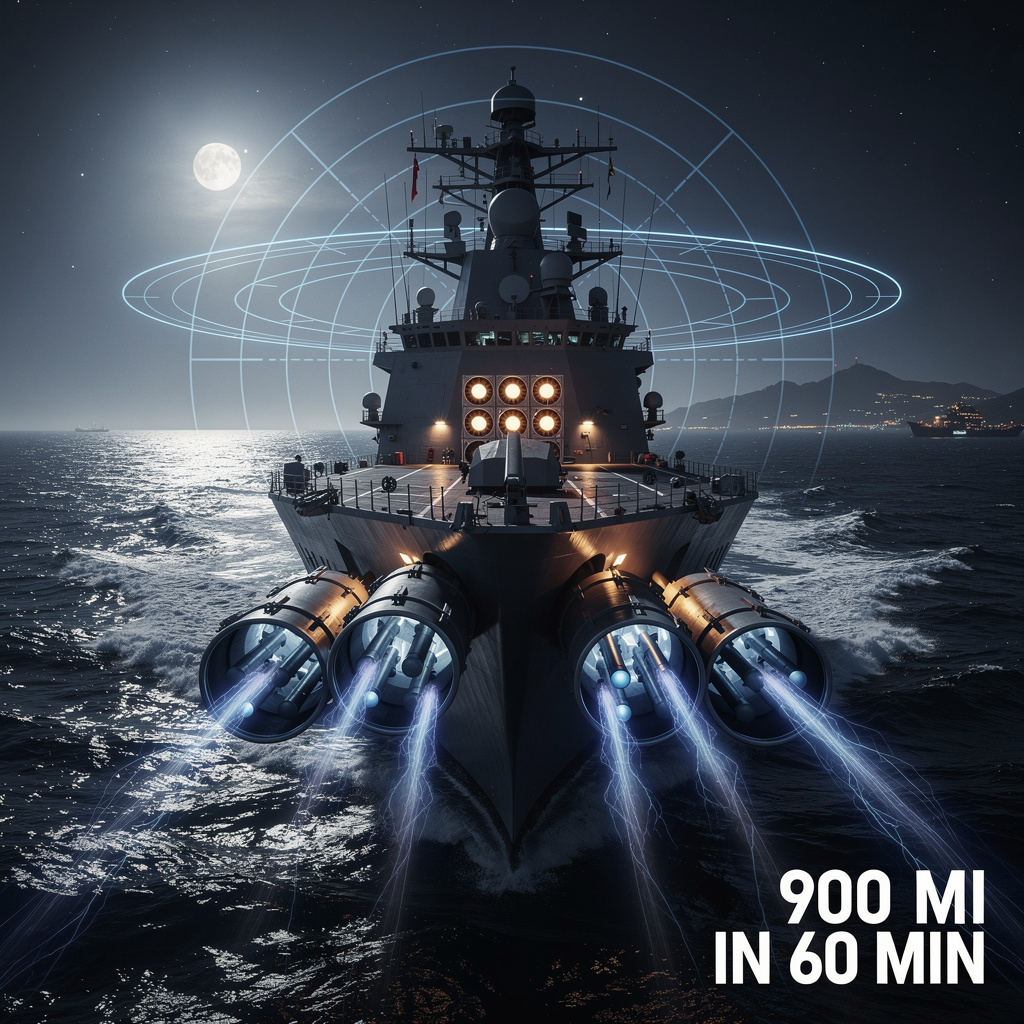
12 hypersonic missiles. $900K each. 900 miles. Mach 5+. 🚀 The USS Zumwalt just shed its failed gun system to become the Navy’s first surface-based hypersonic strike platform. No more $800K per shell. No more slow cruise missiles. But who pays the price if this shifts regional balance — and who’s left vulnerable when China matches it? — Pacific naval crews, U.S. allies, and global stability.
The U.S. Navy has quietly turned a $7.5-billion white elephant into a 900-mile sniper. After January’s successful sea trials, USS Zumwalt now carries twelve Conventional Prompt Strike hypersonic missiles—each capable of Mach-5 flight and a one-hour journey to any target within the Indo-Pacific—where its failed 155-mm gun once sat. Two sister ships will follow by late 2027, giving the fleet its first surface-born hypersonic punch against China’s anti-access network.
How the conversion works
Ingalls Shipbuilding cut away the two 155-mm Advanced Gun System turrets, modules that never fired a shot in anger because each $800,000 Long-Range Land-Attack Projectile became unaffordable. In their place, four 87-inch tubes were welded into the bow; each tube houses three Lockheed Martin CPS missiles—two-stage solid rockets that loft an unpowered hypersonic glide body 900 miles in 60 minutes. The ship’s 80 Mk-57 vertical cells remain untouched, so Zumwalt can still sling Tomahawks or SM-6s while the new forward magazine adds a dedicated hypersonic dozen.
What changes on the battlefield
- Range: 900 mi in ≤60 min → compresses commander’s kill-chain from hours to minutes.
- Cost: $900,000 per CPS round versus $800,000 for a single 155-mm shell that flew only 60 mi.
- Payload flexibility: conventional VLS load preserved, so one hull can mix long-range land strike, anti-air, and now hypersonic attack.
- Deterrence: a 16,000-ton destroyer can now hold Beijing’s inland targets at risk from the Philippine Sea without crossing the first island chain.
Gaps and trade-offs
The retrofit adds 180 tons forward, yet builder’s trials show no speed loss past 30 kt. Stealth survives new thermal shields that hide booster plume, but the fleet still depends on a single Lockheed production line for all CPS rounds—an industrial chokepoint if demand scales beyond the planned 100-plus missiles. Meanwhile, China’s DF-21D and DF-26 retain twice the range, forcing Zumwalt to operate under carrier-group air cover.
Timelines
- Late 2026: USS Zumwalt declared operational; first West-Pacific patrol with live CPS load.
- 2027: DDG-1001 and DDG-1002 complete conversion; trio forms a rotational hypersonic squadron.
- 2028–30: Navy evaluates 12-missile salvo doctrine; decision point for inserting CPS into DDG(X) successors.
Bottom line
By swapping an expensive, short-range howitzer for a hypersonic bayonet, the Navy has salvaged a $24-billion ship class and gained a 60-minute global strike lever. The Zumwalt trio will not win a war alone, but their presence forces any adversary to defend 900 miles of coastline it once wrote off—proof that even the most troubled platform can regain relevance when speed, not slogans, defines firepower.
🌑 72M Lunar Mission Lost After Software Error Flips Solar Arrays Away From Sun—NASA Forced to Overhaul Small-Sat Protocols
72M mission lost to a 180° solar array flip 🌞➡️🌑 Software glitch made Lunar Trailblazer point away from the Sun—power died in 24h. No backup. No recovery. $55M extra spent just to investigate why. NASA’s small-sat rules just changed. Taxpayers paid for this—was it worth the risk?
At 02:14 a.m. on 26 Feb 2025, NASA’s 210-kg Lunar Trailblazer slipped into space atop a Falcon 9. Twenty-four hours later the same craft lay silent, batteries at –20 °C, its solar panels staring into blackness instead of the Sun. A single software sign error—180° instead of 0°—flipped the arrays, drained the power, and killed a $72 million mission meant to map the Moon’s water before Artemis astronauts arrive.
How a minus became a mission-killer
Lockheed Martin’s attitude-control script told the arrays to “rotate +180°” when Sun-angle > 90°; the correct call was “–180°.” No end-to-end test ever exercised that exact thermal-sun-pointing combination, so the fault escaped. Once voltage fell below 12 V, the wheels could not desaturate, the high-gain antenna lost Earth lock, and the spacecraft became a $127 million tombstone.
Impacts ripple outward
- Science: 100% loss of 1 m-resolution H₂O maps → Artemis-II/III landing-site planners fly blind.
- Budget: $55 M overrun equals the entire 2026 NASA astrophysics CubeSat line.
- Transparency: FOIA filings now exceed 1,200 pages—five times the mission’s software code base.
- Industry: Lockheed’s small-sat division forfeits $18 M in award fees and faces third-party code audits on every future NASA contract.
What happens next
- Q3 2026: NASA releases root-cause report; new “point-once-verify-twice” clause inserted into all Class-D contracts.
- 2027: Lunar Trailblazer-2 rides share with CAPSTONE-2, but only after 1,000 h of hardware-in-the-loop testing.
- 2028–29: Revised water-data delivery keeps Artemis-III on schedule; projected overrun drops to < 5%.
The episode exposes a hard truth: when price caps trump test rigs, code becomes the single point of failure. If NASA wants both bargain satellites and reliable data, it must pay for the lines of verification before it pays for the lines of code.

Comments ()