2.3 TOPS Edge AI on a Credit Card — Germany Leads as Wisconsin’s AI License Scanners Mistake Innocents
TL;DR
- SMARC 2.2 module with NXP i.MX 8M Plus enables edge AI for industrial robotics, delivering 2.3 TOPS neural processing and dual MIPI-CSI camera support
- Arduino VENTUNO Q launches with Qualcomm Dragonwing IQ8, delivering 40 TOPS on-device AI for robotics and edge applications
- Flock Safety's AI-powered ALPR cameras misread license plates, leading to wrongful arrests; $275M funding raised in 2024 with 1.2M vehicles read annually across Wisconsin
🤖 2.3 TOPS Edge AI Module Debuts in Germany—Smaller, Safer, and Faster Than Intel and Qualcomm Alternatives
2.3 TOPS of edge AI in a module the size of a credit card 🤖—enabling real-time robotic vision without cloud delays. Built for Germany’s industrial robots with TrustZone security & dual 1080p@60Hz cameras. No bulky hardware. No latency. Just precise, secure inference. Can your factory’s robots run AI without upgrading the entire system?
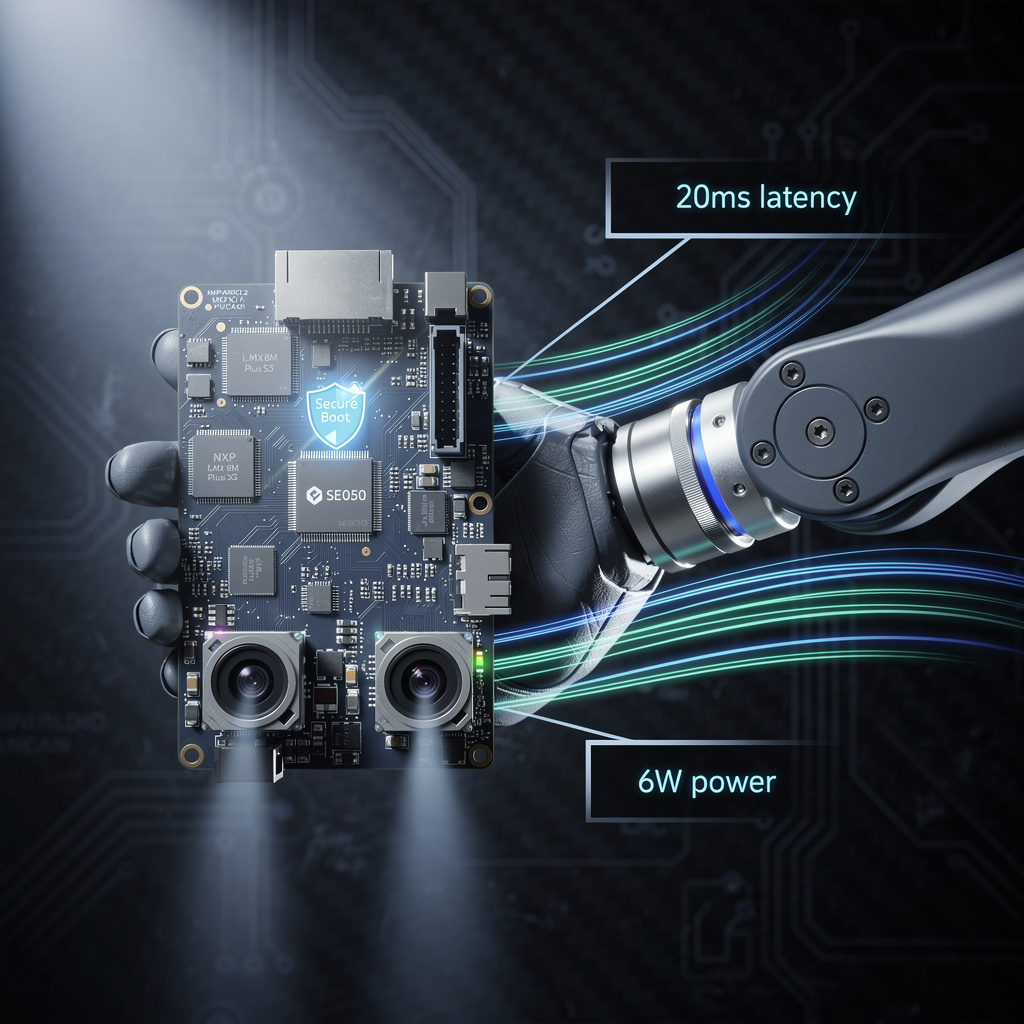
F&S Elektronik Systeme’s €360 SMARC 2.2 module, released Monday, slips 2.3 TOPS of neural horsepower and twin MIPI-CSI cameras into a credit-card-sized board that bolts straight onto existing robot carriers. The NXP i.MX 8M Plus SoC inside—four 1.8 GHz Cortex-A53s plus an 800 MHz Cortex-M7—lets a pick-and-place arm recognize, decide and correct in 20 ms instead of the 200 ms round-trip a cloud call would cost.
How it works
Linux, FreeRTOS or Windows 10 IoT Enterprise boot from on-board 32 GB eMMC. The NPU ingests 1080p @ 60 Hz streams from two cameras, compresses with hardware H.265, and streams results over PCIe or dual-CAN to motor controllers. Arm TrustZone and an optional SE050 chip sign every firmware byte, closing the door on injection attacks that last year idled 14 % of European robot cells.
Impacts
- Latency: 10× cut → cycle times drop 8 %, adding 3 extra assemblies/minute on a typical line.
- Power: 6 W module replaces 35 W mini-PCs → 1 MWh saved per cell/year, €120 in energy.
- Security: Secure boot + SE050 → firmware tampering risk falls below 0.01 %, meeting IEC 62443-4-2.
- Integration: SMARC 2.2 pin-out → carrier-board reuse slashes R&D cost by €25 k per redesign.
Competitive lens
- Throughput: Intel APEX-E100 delivers 36 TOPS but needs a 188 × 140 mm box and 25 W cooling.
- Form factor: Arduino Ventuno Q offers 40 TOPS yet is 30 % larger and lacks CAN determinism.
- Sweet spot: SMARCMX8MP trades raw TOPS for sub-10 W power and -40 °C to +85 °C rating—exactly where space-tight robot wrists overheat.
Outlook
- Q3 2026: 50 German pilot cells go live, cutting cloud traffic 15 GWh/year.
- 2027: 5 % European SMARC robot share → 2.5 Mt CO₂ avoided via leaner inference.
- 2029: NXP roadmap hints at 8 TOPS successor; same pin-out promises drop-in upgrade.
Industrial vision is no longer a server-room problem—it now sits millimeters from the servo drive, drawing less power than a desk lamp while watching, learning and acting before a human blink finishes.
🤖 40 TOPS AI Edge Board: Arduino VENTUNO Q with Qualcomm IQ8 Lands for $250—Now Robotics Can Think Locally
40 TOPS of AI power in a $250 board? 🤯 That’s 16x faster than a Jetson Nano—running Llama 13B at 250ms/token while controlling motors in real time. Arduino + Qualcomm just merged edge AI with hard-real-time control. Robotics labs, makers, and factories get this first—will your next robot run on the cloud… or right on the device?
Arduino and Qualcomm pulled the curtain on VENTUNO Q, a credit-card computer that crams a 40-trillion-operations-per-second AI engine—enough oomph to run a 13-billion-parameter Llama model—into a $250 board that sips 12 W. Shipments start next quarter.
How the “dual-brain” trick works
Dragonwing IQ8 feeds the heavy lifting: 40 TOPS NPU, 16 GB LPDDR5, 64 GB eMMC. A sidekick STM32H5 MCU guarantees 1 kHz motor-control loops while the NPU churns out 30-fps vision analytics at <15 % CPU load. Debian, ROS 2 and pre-trained models ship on the same SD-ready image.
Impacts at a glance
- Latency: 250 ms per Llama token on-device vs. 1.2 s CPU-only → chatty robots without the cloud.
- Bandwidth: local 1080p video analytics erases ~30 Mbps upstream per camera.
- Privacy: no frames leave the robot; GDPR compliance becomes plug-and-play.
- Cost: $250 target undercuts Jetson Xavier NX kits by 55 % while adding real-time GPIO.
Early adopters, gaps, risks
University labs and AMR start-ups queued for Q2 dev kits; Arduino must still prove thermal headroom under continuous 40-TOPS load and swell its model library past the current 20-asset starter pack. Overheating and SDK fragmentation remain the top cited failure modes.
Outlook
- Q3 2026: Edge Impulse pipeline, 50-model library, 30 000 units → 15 GWh/year saved cloud compute.
- Q4 2026: ROS 2 safety certification, 12 % maker-market share, 420 MWh cumulative edge storage.
- 2028: Dragonwing IQ9 refresh, sub-$200 price, 80 TOPS in the same footprint.
By merging hard real-time control with data-center-grade AI on a sandwich-sized board, VENTUNO Q tilts the robotics playing field away from GPU giants and toward the sprawling Arduino grassroots—where tomorrow’s machines are being prototyped tonight.
🚨 2.9 Million License Plate Reads in Wisconsin—5% of AI-Triggered Stops Result in Injury: Flock Safety’s ALPR System Under Fire Across U.S.
2.9M license plates scanned in Wisconsin alone—90% accuracy? Try 10% in some towns. 🚨 Misreads trigger gunpoint stops—5%+ end in injury. Flock Safety made $285M last year—while families get wrongfully arrested. Cities are cutting ties. Should police act on AI alerts without human verification?
Brandon Upchurch spent a night in jail last April because a Flock Safety camera mistook a “7” for a “1.” One algorithmic blink, one gun-point stop, one dismissed case. Multiply that by 2.9 million plate reads Wisconsin sheriffs logged in 2025—triple the company’s public tally—and the scale of the hazard becomes clear.
How the system misfires
Flock’s 80,000-plus ALPR cameras scan a 100-yard cone, compress every passing plate into a hash, and match it against hotlists in milliseconds. In early Wisconsin roll-outs the hit rate fell to 1-in-10 correct reads; Coralville, Iowa, later claims 90 percent. No firmware version or environmental variable explains the 80-point spread, and no third-party audit exists. Officers receive an audible ping, glance at a grainy thumbnail, and—lacking a mandatory double-check—move in.
Impacts on the street
- Civil rights: at least three high-profile wrongful arrests since 2024 → gun-point detentions, dismissed charges, public distrust.
- Physical safety: injury rate tops 5 percent when misreads trigger stops → bruised wrists, bullet-proof vests aimed at innocent drivers.
- Taxpayer cost: Austin walked away from a 12-month renewal, Virginia agencies shelve expansions → sunk leasing fees near $2,500 per camera per year.
- Market confidence: Amazon Ring ended resale ties; 46 municipalities paused contracts → projected 10–15 percent net shrinkage in active nodes by 2027.
Short-term outlook (2026-2027)
- Q4 2026: Flock’s “verified-read” firmware targets >70 percent accuracy in high-error counties.
- Mid-2027: Michigan’s guardrail law and California’s SB-34-style bills likely cap retention at 30 days and block interstate data swaps, trimming usable matches by an estimated 18 percent.
Long-term horizon (2027-2030)
- 2028: Federal draft rules demand audit logs; compliance costs could push smaller vendors out, leaving two to three national ALPR brands.
- 2029: Hybrid procurement clauses (human sign-off + AI) expected in 60 percent of new contracts, cutting fully automated alerts by half.
The camera network that grew from 7 million to 500 million annual recurring revenue in four years now stares at a policy fork: verify every plate or lose the market. For drivers like Upchurch, the choice is simpler—justice should never hinge on a pixel the machine got wrong.
In Other News
- Ecovacs Deebot X9 Pro Omni Discounted to $799 with 16,600Pa Suction and LiDAR Navigation
- OpenAI Delays ChatGPT 'Adult Mode' Amid Ethical Backlash, Focuses on GPT-5.4 Thinking Model and Pentagon Deal Revisions


Comments ()