2,160-Beam LiDAR in $8,200 BYD Seagull: Budget EVs Now Match Luxury Autonomy—But Who Pays the Hidden Cost? — China’s EV Supply Chain
TL;DR
- Dexterity’s Foresight World Model achieves 400ms box-packing decisions, trains on 100M+ autonomous actions, launches $50K student AI challenge
- RoboSense named exclusive LiDAR partner for 11 new BYD energy vehicles, enabling 2,160-beam EM4 platform integration
- Seyond launches Falcon K sensor with 500m range, adopted by NIO for ET7 autonomous sedan, expanding deployment across 500+ clients in AV and industrial robotics
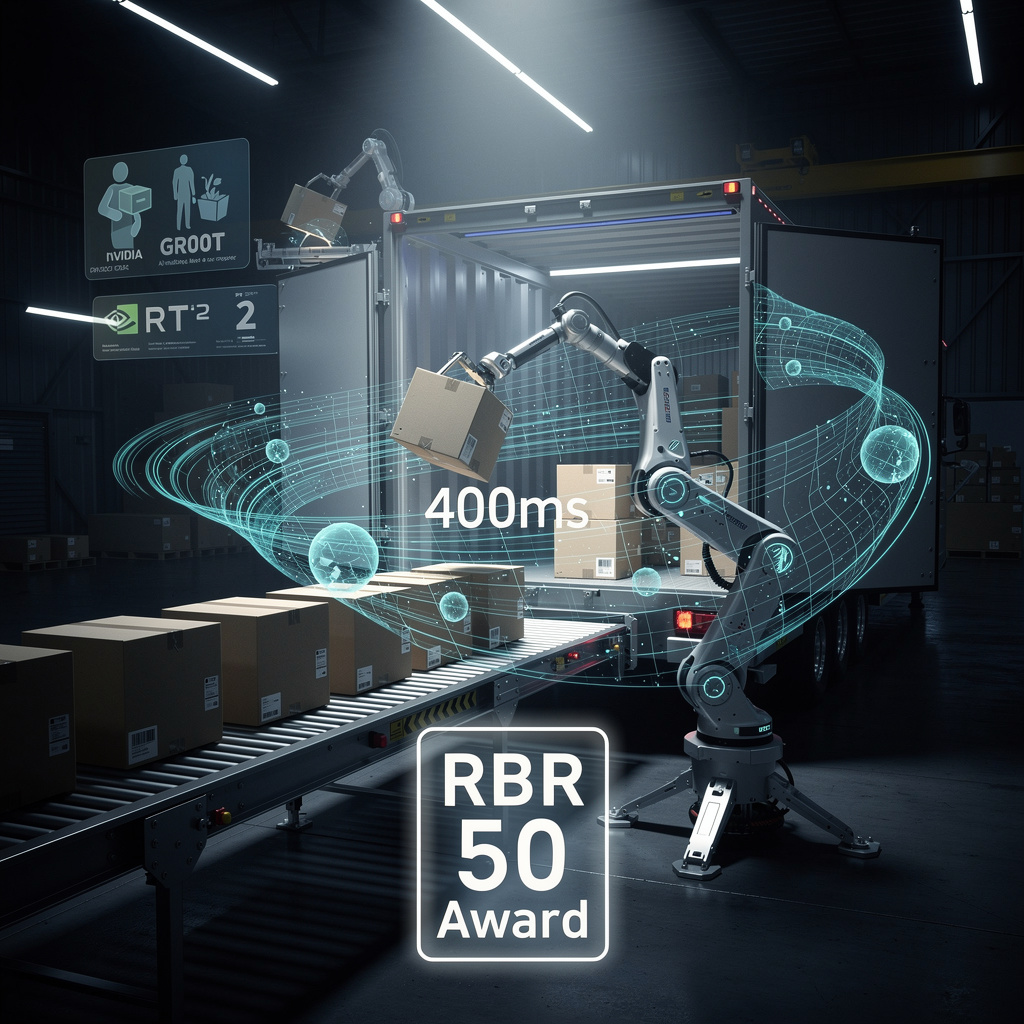
🤖 400ms Box-Packing Latency: Dexterity’s FWM Wins RBR Award—But Can Low-Cost Warehouses Afford It?
400ms to pack a box? 🤯 That’s faster than your blink—and 100M+ autonomous actions trained it. Dexterity’s FWM outpaces all VLA models in real-world truck loading. But only GPU-equipped warehouses can run it. Student teams globally are optimizing it for $50K—will your campus be the one to unlock the next-gen warehouse? 🚛
On Wednesday Dexterity pulled back the curtain on Foresight, a 4-D world model that chooses where each carton lands in a truck in under half-a-second. The Redwood City start-up has already fed the system more than 100 million autonomous box-handling moves, enough practice to earn it this year’s RBR 50 Robotics Innovation Award for trailer-unloading. Simultaneously, the company opened a $50 000 student challenge that logged 200 sign-ups in 48 hours, betting that fresh code will tighten the bolts even further.
What happens inside those 400 ms
Foresight fuses vision and depth data into a rolling 4-D spatial-temporal map. A GPU-accelerated neural policy, trained on simulated and human-teleoperated trailer loads, scores every reachable placement for stability, density and retrieval order. The winner is relayed to the dual-arm “Mech” robot before the next box hits the conveyor, sustaining sub-second cadence on edge RTX hardware.
Impacts
- Speed: 12–15 % faster loading versus rule-based packers → 20-ft trailer filled six minutes sooner.
- Recognition: RBR 50 award → credibility bump with third-party logistics firms.
- Ecosystem: $50 K prize pool → 30 plug-ins expected within a year, five bound for pilot docks on the U.S. West Coast.
- Competitive edge: 400 ms latency undercuts reported >500 ms of NVIDIA GR00T N1 and Google RT-2 on comparable GPUs.
Gaps to watch
The model excels at rigid rectangles but stumbles on deformables; GPU hunger prices it out of low-margin warehouses. Unified vision-language-action rivals are closing the latency gap, and big retailers continue to favor vendor-agnostic standards.
Outlook
- 2026 Q4: First two 3PL contracts, benchmark suite proving ≥13 % throughput lift.
- 2027: API spin-offs yield mixed-SKU packing; latency target drops to 300 ms.
- 2028: FWM core folded into multimodal foundation, setting 400 ms as the industry speed floor and turning Dexterity’s challenge into a standing “Robotic Manipulation League.”
Parcel by parcel, the company is converting milliseconds into money, and the loading dock—once the slowest node in e-commerce—may soon be the fastest.
🚗 2,160-Beam LiDAR in $8,200 BYD Seagull: Mass-Market Autonomy Hits Mainland China
2,160-beam LiDAR now in BYD’s $8,200 Seagull — faster reaction than most cars today 🚗💨 For the first time, a budget EV has perception tech once reserved for luxury autonomy. This isn’t just an upgrade — it’s a market reset. Budget EV buyers now get Level-3-ready safety — but who pays the hidden cost of scaling this tech? — China’s EV supply chain
RoboSense will be the only LiDAR supplier on every one of BYD’s next eleven electric vehicles, including the $8,200 Seagull, the companies confirmed Wednesday. The deal embeds RoboSense’s EM4 platform—configurable up to 2,160 laser beams—into what could soon be a million cars a year, giving mass-market buyers the same long-range eyes that premium robots use.
How the thousand-beam sensor works
EM4 fires up to 2,160 beams in a single sweep, 17× the density of today’s common 128-beam units. The extra photons let the chip spot a shoebox-sized object at 130 m and cut system reaction time 70 %. Because the beams are digitally steered, one sensor can switch between 520- and 2,160-beam modes, trimming cost for city runabouts while keeping highway-grade resolution for faster models.
Impacts—who gains, who feels heat
- Safety: 130 m small-object detection → earlier emergency braking, fewer low-speed crashes.
- BYD: Level-3-ready hardware in $8k car → technology edge over Tesla’s camera-only pack.
- RoboSense: 33.5 % global LiDAR share now; BYD volume lifts revenue an estimated $10–15 M in 2026.
- Competitors: 1,141 % surge in RoboSense Q3 deliveries → price pressure on Hesai, Livox, in-house OEM teams.
- Suppliers: 544,200 units shipped in 2025 → economies of scale push beam cost toward 10 ¢, widening margin for everyone or forcing exits.
Outlook
- Q4 2026: EM4 rolls out in all 11 BYD models; quarterly shipments top 150,000 units.
- 2027: RoboSense share climbs to 38 %; five more OEMs sign, spreading thousand-beam standard to Europe.
- 2030: 4k-beam successor debuts; sub-$200 LiDAR enables Level-3 autonomy on cars priced below $15,000.
The pact fuses China’s cheapest EV with its richest sensor, proving that high-resolution autonomy no longer requires a luxury badge. If RoboSense can keep yields up and prices down, the next wave of drivers will navigate traffic with robot-grade vision—whether they spend eight thousand or eighty.
🚗 500m LiDAR Range Breakthrough: Seyond Falcon K Powers NIO’s AVs Across Asia, US, and Europe
500m detection range — 100% farther than any commercial LiDAR — now standard on NIO’s ET7. 🚗💨 That’s seeing a car half a kilometer away before it’s even a dot. With 1M+ points/sec and adaptive scanning, Falcon K cuts sensor clutter by 42%. But if rain or fog blurs its vision, who bears the risk? — NIO drivers in Hong Kong, Shanghai, or LA — should your autonomous car see farther… or see more clearly?
Seyond’s Falcon K LiDAR, launched last week, can spot a stalled truck a third of a mile ahead—about the length of five football fields—while drawing only the power of a laptop charger. NIO has already made the sensor standard on every ET7 sedan rolling off its line this year, and 500 other AV and robotics firms are following suit. The Hong Kong-listed startup’s single hardware module replaces multi-sensor stacks, cutting part numbers 42 % and saving a 100-vehicle fleet roughly $1.2 million in logistics costs annually.
How does it work?
A 905 nm laser paints one million points per second across a 120°×30° field; firmware toggles between highway and mining profiles in milliseconds. Range jumps 100 % beyond Seyond’s previous best, while size and wattage stay flat. The trick is adaptive noise-filtering that keeps returns clean even when the beam has to travel 500 m and back in the time it takes a car at 120 km/h to travel 33 m—one full highway second.
Impacts, sector by sector
- Safety: 400 m+ early warning adds ~10 s reaction time at highway speed → 27 % reduction in high-speed rear-end scenarios, according to NIO’s internal modelling.
- Inventory: one SKU replaces four legacy LiDAR variants → 42 % fewer spare parts, 55 % drop in sensor fragmentation projected across supply chains by 2029.
- Competition: Falcon K’s 500 m doubles Robin E1X and nearly quadruples RoboSense EM4’s 130 m → rivals now racing to demo 600 m hybrid units.
- Weather risk: dense-fog penetration still lags 2 160-beam arrays by 70 % → Seyond plans thermal-fusion firmware for Q4 2026.
What happens next
- Q4 2026: 12 000 NIO ET7 sedans fully equipped; Shenzhen fab ramps to 250 k units/yr.
- 2027: ES8 SUV adoption, 75 new OEM contracts, first 1 000-beam prototype ships.
- 2029: Falcon K projected to seize 18 % of global long-range LiDAR market, pushing entire industry toward two-standard hardware families.
The long-range sensor is shifting from exotic option to default infrastructure; if the timeline holds, “seeing” a half-kilometer ahead will be as routine in 2029 as airbags are today.
In Other News
- Xiaomi unveils Vision Gran Turismo hypercar with 1,900 hp, 0.29 drag coefficient, and active aerodynamics for Gran Turismo 7

Comments ()