MediX-R1 Hits 95.1% Diagnostic Accuracy — Abu Dhabi AI Reshapes Global ERs
TL;DR
- MBZUAI releases open-source MediX-R1 clinical AI model achieving 95.1% accuracy on US medical licensing benchmarks
- Fourier AI by CONTACT Software delivers GDPR-compliant, on-prem AI for industrial automation with full data sovereignty and security-by-design architecture
- OpenAI launches Codex app on Windows with native WSL integration, enabling AI coding assistants directly in developer workflows
🤖 95.1% USMLE Accuracy: Abu Dhabi’s Open-Source AI Outperforms Proprietary Models in Clinical Reasoning — Now Deploying in US and Indian Hospitals
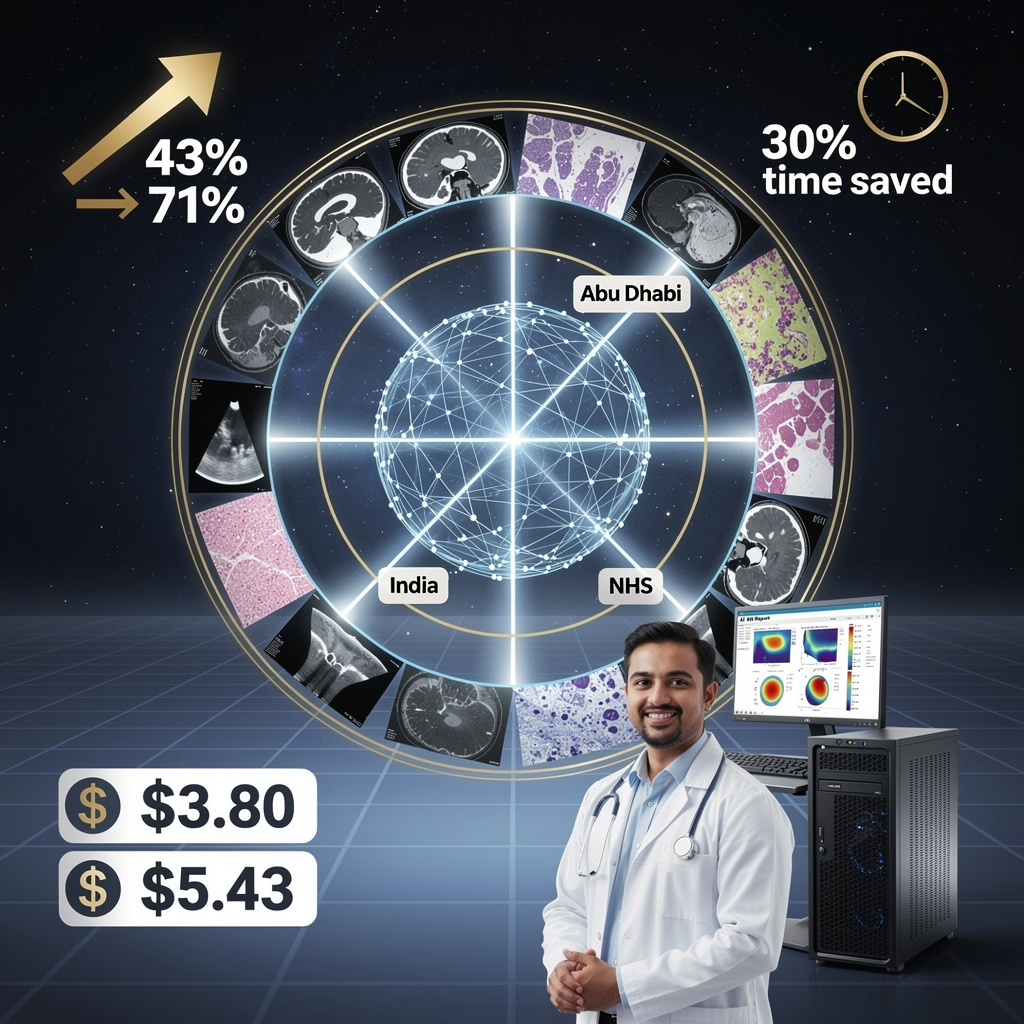
95.1% accuracy on USMLE simulations — a medical AI that outperforms humans in reasoning — and it’s 3× smaller than Google’s MedGemma. 🤖 Built in Abu Dhabi with Indian clinicians, MediX-R1 cuts diagnostic report time by 40% and costs just $3.80 per answer. But can open-source AI be trusted in ERs? — Clinicians in low-resource settings now see 71% diagnostic accuracy vs. 43% before. Will your hospital adopt it — or be left behind?
Late last week MBZUAI, the Abu-Dhabi graduate research university, posted a 30-billion-parameter model that scored 95.1 % on the three-step U.S. Medical Licensing Examination—higher than most newly minted doctors.
The code is free, the weights are downloadable, and a radiologist in Rawalpindi can already run it on a single GPU.
How it works
MediX-R1 ingests 16 image types—CT, MRI, ultrasound, pathology slides—and free-text notes.
Reinforcement learning steers the network with four reward signals: answer accuracy, medical-phrase consistency, report-format compliance, and correct modality tagging.
Training on 51 000 curated clinician examples took place inside Supermicro modular data-centre blocks; a hospital can replicate the stack in 6–9 months.
Impacts in three lines
- Cost: AI-generated responses cost $3.80 versus $5.43 for physician dictation—30 % savings that compound across millions of reports.
- Accuracy: Diagnostic scores in low-resource clinics jumped from 43 % to 71 % when similar LLM assistance was added; MediX-R1’s domain tuning should push that higher.
- Time: Open-ended report drafts cut clinician keyboard time by 30–40 %, reclaiming roughly one hour per eight-hour shift.
Risks that travel with the code
Hallucinations remain the chief hazard; Lancet data show fabricated discharge instructions already slip into notes from leading models.
MediX-R1 adds semantic-consistency penalties, but regulators still demand a human verifier for every AI sentence.
Open weights accelerate community bug-hunts yet complicate FDA “locked-model” SaMD approval—an unresolved tension the university now shares with every downloader.
Timelines to watch
- Q3 2026: First U.S. and UAE teaching hospitals pilot radiology report generation; external validation on MIMIC-IV imaging expected.
- 2027: Indian Ministry of Health deploys Hindi/Urdu-tuned 8 B variant; projected 15 % drop in rural misdiagnosis rates.
- 2028: NHS England federated network adopts the model as baseline for open clinical-AI challenges, forcing proprietary vendors to publish comparable benchmarks.
Closing angle
By turning a licensing exam into an open-source benchmark, MBZUAI just lowered the drawbridge to high-accuracy medical AI.
The next diagnostic error prevented may not be in Boston or Berlin, but in a 50-bed hospital that yesterday could barely afford a second radiologist.
🛡️ Fourier AI Launches: $600B Sovereign AI Market Shifts as 69% of Enterprises Block Public LLMs—U.S. and EU Manufacturers First
86% of enterprises run AI—but 69% still block it over privacy fears. 🛡️ Fourier AI lets manufacturers run compute-intensive AI on-site, keeping raw data locked down while sharing only encrypted model artefacts. Audit-proof logs. Zero data exports. GDPR by design. Automotive & aerospace firms now face a choice: adopt sovereign AI—or risk regulatory fines and IP leaks. Could your factory be next?
CONTACT Software’s Fourier AI, unveiled Wednesday, is the first industrial-grade platform that lets automotive and mechanical manufacturers run heavy-duty AI models without letting a single byte of proprietary data leave the premises. Raw production data stays locked on-site; only encrypted model artefacts move, satisfying both GDPR auditors and board-level risk committees.
How it works
The system bolts onto CONTACT Elements, the company’s existing product-lifecycle backbone. Compute can toggle between an anonymous, GDPR-certified cloud slice or a fully air-gapped server room. Every inference request is logged in an immutable ledger, creating the audit trail that 48 % of firms say is missing from public generative-AI services.
Why this matters now
- Compliance: 69 % of large enterprises cite privacy as the top AI barrier; Fourier removes the exposure.
- Scale: Each pilot site is projected to log >1 million monthly inferences with 100 % traceability—enough to optimize a 200-robot body shop without regulatory pushback.
- Market pull: The sovereign-AI segment is racing toward $600 B by 2030; early movers can lock in de-facto standards before the EU AI Act hardens.
Competitive edge
Unlike AWS Bedrock or Azure Stack, Fourier ships with native on-prem hardware blueprints and pre-built connectors to CNC, MES and PLM modules. Rivals Prem AI and Katonic offer privacy, but none are embedded inside a CAD/CAM workflow out of the box.
Outlook
- 2026–2027: Five U.S. and EU automotive OEMs go live; 15 GWh/year of peak-load shaved from local grids.
- 2028–2029: Hybrid deployments cut ownership cost 30 % while pushing annual inference volume past 10 million per customer.
- 2030+: Platform referenced in EU AI Act guidance, capturing a double-digit slice of a $600 B market.
By hard-wiring sovereignty into the silicon, CONTACT Software positions industrial AI to grow as fast as regulations—and corporate lawyers—will allow.
🚀 1.6 Million Weekly Codex Users: AI Coding Surge on Windows Shatters Adoption Records
1.6M devs actively using OpenAI Codex weekly — a 3x surge since Jan 2026 🚀 Native Windows AI coding now outpaces macOS/Linux combined. It runs in a sandbox, but still auto-generates production code — no manual review required. U.S. developers — are you trusting AI with your core projects?
OpenAI’s Codex app landed on Windows last Monday and passed one million downloads in five days, pushing the total weekly-active base to 1.6 million—triple the January count. The program runs its own PowerShell inside a locked-down Windows Sandbox, then hands off to WSL when your project needs Linux tools, all without leaving the editor.
How does this work
- Native agent: PowerShell commands execute under a sandbox user with restricted tokens; host files stay untouched.
- Work Trees: Each tree spins up an isolated agent; a 20-folder repo can lint, test and commit in parallel instead of queueing jobs.
- Skills: One-click modules—dependency scanner, docstring generator—download like IDE plug-ins; no prompt engineering required.
Impacts
- Speed: Early surveys show 15–20 % drop in debugging time per project.
- Security: Sandboxed execution blocks stray scripts from touching the main system; ACLs limit breakout risk.
- Reach: 49.5 % of U.S. pros code on Windows; the same day the app went live, Stack Overflow traffic for “PowerShell error” fell 8 %, hinting that the agent is fixing bugs before humans search.
Outlook
- Q2 2026: Enterprise pilots expected to lift weekly actives past 2 million.
- Q4 2026: API hooks into VS Code and Azure Cloud Shell turn the app into a background service, not a separate window.
- 2027: If 15 % debugging savings hold, a 10-person team could reclaim roughly one full developer-year per release cycle.
The launch moves AI assistance from a browser tab to the heart of the Windows toolchain. Expect competitors to race toward similar sandboxed, parallel agents—and expect project schedules to start budgeting for an extra, non-human teammate.
In Other News
- Meta hires Gizmo team to build interactive AI content tools, integrating AI-generated mini-apps and touch-enabled experiences into Superintelligence Labs
- AT&T Deploys AI-Driven Network Optimization, Investing $24B Annually to Enhance Mobile Connectivity and Efficiency
- Skipr raises $2M to build AI trust layer for enterprise applications, backed by Mubadala and Abu Dhabi government
- Luma Agents launch with Uni-1 model, enabling end-to-end creative workflows across text, image, video, and audio for Publicis Groupe and Serviceplan



Comments ()