20% Lower Cost Per Seat-Mile: Air Canada Rouge Swaps Airbus for 737 MAX 8s—Passenger Space Grows, Costs Drop
TL;DR
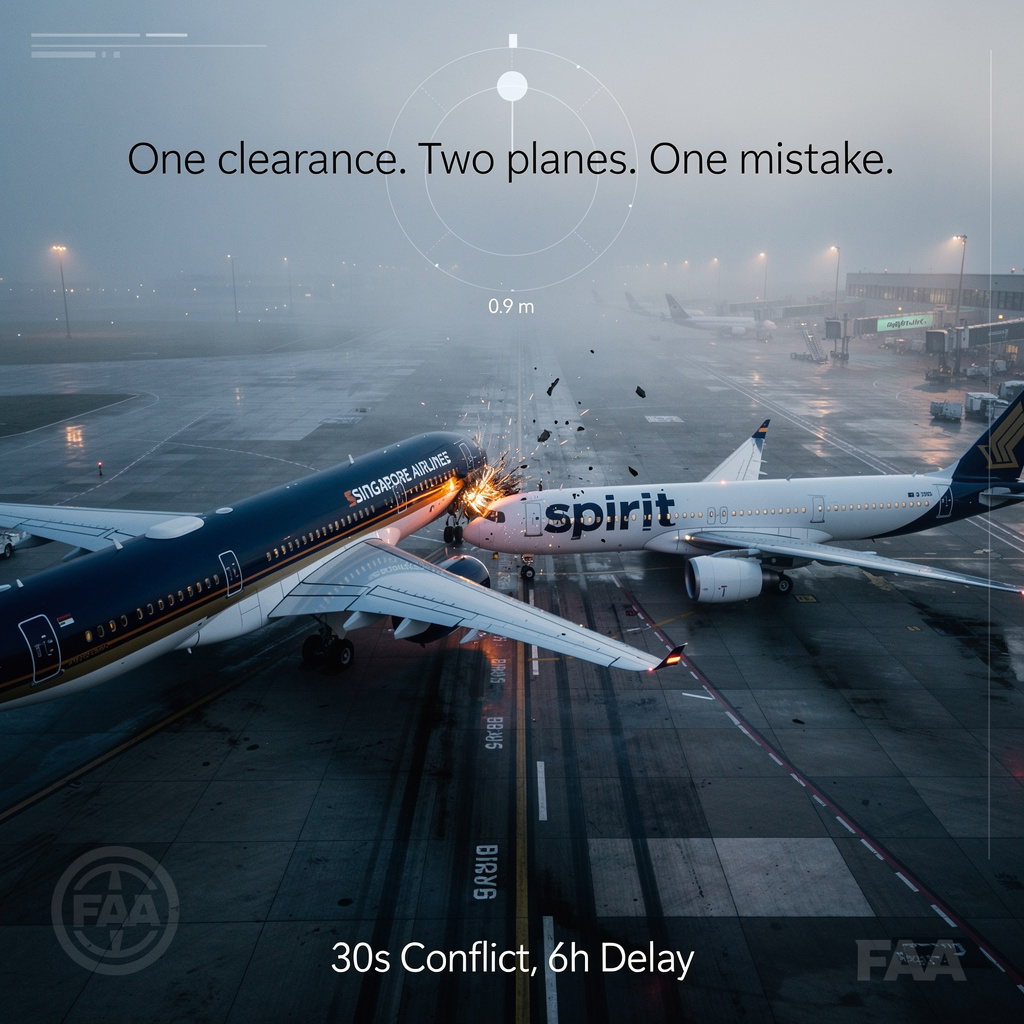
- Singapore Airlines and Spirit Airlines aircraft collide at Newark Airport, causing six-hour delay and rudder damage; FAA investigates
- Boeing 737 MAX 8 enters service with Air Canada Rouge, replacing A320s on North American leisure routes as of March 5, 2026
- H.R. 7525 introduced to permanently authorize state and local law enforcement to deploy counter-drone systems against unauthorized UAS operations
🚧 6h 34m Delay After Singapore Airlines and Spirit Airlines Collide on Ground at Newark—FAA Investigates Push-Back Protocol
6h 34m delay for a 19h flight—because two planes bumped while being pushed back. 🚧 No injuries. No fire. Just miscommunication on the ramp. Singapore Airlines and Spirit Airlines both grounded over a 20-second collision. Passengers paid for this—while ground crews relearn how to talk to each other. Could this happen at your airport?
At 10:20 a.m. on 5 March, Singapore Airlines Flight 21 and Spirit Airlines Flight 992 began routine push-backs from adjacent gates at Newark Terminal B. Within two minutes the A350’s tail grazed the A320’s rudder, slicing a 0.9 m gash through the composite fin and forcing both aircraft—and 450 passengers—into an unscheduled six-hour limbo. No one was hurt, but the Federal Aviation Administration’s joint inquiry with airport control already points to a single flaw: simultaneous clearances issued to the same alleyway.
How does a 19-hour nonstop get stalled by a 30-second conflict?
Ground-control transcripts show both crews received “push approved” inside a 20-second window. The Spirit jet, bound for Orlando, was angled 30° outward; the SIA wide-body, starting its 19 h 10 min haul to Singapore, rolled straight back. Radar logs record the merge at 3 kt, enough to crack the rudder spar yet leave the A350 with only paint scuffs. Mechanics immediately red-tagged the Spirit aircraft; Newark’s ramp tower halted all Terminal B departures for 27 minutes while safety crews photographed debris scattered across taxi-lane Bravo.
Impacts at a glance
- Structural: Spirit rudder assembly requires full replacement → 48 h out-of-service, $1.2 m repair bill.
- Operational: 6 h 34 min delay for SIA, 6 h for Spirit → 450 passengers rebooked, 15 connecting itineraries missed.
- Financial: Estimated $180,000 overtime and compensation costs for the two carriers; Newark on-time rating drops 2% for the day.
- Regulatory: FAA preliminary report due within 48 h; possible revision of simultaneous push-back protocols at 34 U.S. airports.
Short-term outlook
- 0–24 h: Spirit rudder replacement begins; SIA cleared after minor inspection.
- 24–48 h: FAA issues safety bulletin mandating staggered push-back spacing at Newark.
- 1 week: Both airlines absorb delay-related penalties; quarterly punctuality scores dip 0.3 points.
Long-term takeaway
The collision underscores a congestion choke point: Newark averages 1,250 daily departures yet retains 1970s-era gate geometry. If the FAA adopts staggered clearances nationwide, expect an extra 90 seconds per push-back—small for safety, but enough to nudge peak-hour capacity down by 4%. For passengers, that translates to tighter connection windows and, inevitably, more stories beginning with “We were just sitting on the tarmac…”
🛫 Air Canada Rouge Deploys 45 MAX 8s: 20% Cost Drop Slashes Leisure Fare Barriers Across North America
20% lower cost per seat-mile — Air Canada Rouge just swapped 36 Airbus jets for 45 Boeing 737 MAX 8s 🛫. That’s enough fuel savings to fly Vancouver to Cancún 1,200 extra times annually. With premium-economy seats expanding on 7 key routes, passengers get more space — while airlines cut expenses. But who really wins? Crews in Vancouver? Travelers? Or shareholders? 🤔
Air Canada Rouge flew its first Boeing 737 MAX 8 on Wednesday, March 5, 2026, from Vancouver to Cancun, Las Vegas and Miami. The 177-seat jet cuts operating cost 20 % per available seat-mile versus the 36 outgoing A320-family aircraft and adds 12 business-class pods to every leisure leg. By New Year’s Eve, 45 MAX 8s will complete the swap, turning the charter-style carrier into the lowest-cost wide-aisle vacation flyer in North America.
How the numbers work
- Fuel burn: 15 % lower than A320 → saves ~550 L per sector on a 1,900-km Cancun run.
- Seat-mile cost: 20 % drop → Rouge can undercut WestJet and Delta by $6–8 per ticket while keeping margins flat.
- Premium pitch: 12 business seats (versus zero on A320) → each round-trip to Cancun adds ~$4,200 incremental revenue at 75 % load.
Impacts at a glance
Passengers: 9 % more leg-room in economy, 20 % faster boarding via 737’s twin-door layout.
Environment: 2.5 t less CO₂ per Vancouver-Cancun flight → 38,000 t annual cut once 45 jets rotate.
Competition: Rouge’s CASM falls to 7.3 ¢, narrowing the gap with ultra-low-cost rivals Flair (6.9 ¢) and Swoop (6.8 ¢).
Workforce: 220 pilots and 430 cabin crew transfer to a new Vancouver MAX base opening April 2026.
Outlook
- Q3 2026: 30 MAX 8s flying; Rouge reports first profitable quarter since 2019 as unit cost drops below 7 ¢.
- 2027: Remaining A320s parked; single-aisle spare-part inventory shrinks 40 %, freeing $18 m in working capital.
- 2028–30: Evaluation of MAX 10 for 200-seat Caribbean shuttles; decision hinges on 2027 fuel-price corridor above $85 bbl.
The MAX 8’s entry is more than a fleet tweak—it rewrites the economics of Canadian leisure travel. If Boeing’s delivery cadence holds, Rouge will own the lowest seat-mile cost in the vacation segment, forcing rivals to match fares or surrender sun-route share.
🚨 $250M in C-UAS Funding Arms U.S. Police — Laser Drones Deployed Ahead of 2026 World Cup
$250M in federal cash just armed 4,000 police departments with laser drones — enough to shoot down a UAV from 30km away. 🚨 This isn't sci-fi: Kansas City and NYC already deployed them ahead of the 2026 World Cup. But one misfire killed an officer. Who gets held accountable when a laser misses its target — and hits a fan, a bird, or a medical helicopter? — Police departments across America are now armed with drone-killers. Are you safer… or more exposed?
Representative Eric Burlison’s H.R. 7525, filed Thursday, would let every city cop, county deputy, tribal officer and territorial agent detect, jam or even seize rogue drones—no federal warrant required. The bill couples that authority to a $250 million FEMA purse tied to World Cup security, vaulting local departments from bystanders to front-line air defenders.
How the gear works
Kits already shipping to Kansas City and New York combine 30-km-range micro-radars, AI cameras and 150-kW lasers that can fry a quadcopter’s circuits in three seconds. GPS spoofers and net-capture drones add non-kinetic options; all tools must steer clear of medical helicopter corridors by at least 500 m.
Impacts at a glance
- Security: 12 documented stadium incursions since 2023 drive demand for sub-3-second “detect-to-defeat” latency.
- Budgets: Missouri pockets $14.2 million, four NY agencies share $17.2 million; another $250 million competitive pool opens FY-27.
- Liability: FAA fines for unauthorized flights already reach $75,000 apiece; collateral damage from lasers could multiply lawsuits.
- Privacy: no unified data-retention rule—engagement logs may sit in 4,000 separate evidence lockers for five years or more.
What happens next
- June 2026: 12 Missouri agencies field full kits before the World Cup’s first kickoff.
- July 2026: radar-net rings go live at MetLife and Arrowhead stadiums.
- 2027–2029: pilot graduates to permanent statute, scaling to 4,000 departments if Congress keeps appropriating.
Bottom line
H.R. 7525 turns local police into a distributed anti-air network, promising safer skies over mega-events but scattering high-power lasers and sensitive data across a patchwork of state privacy laws. The World Cup will be the first stress test; whether the republic outruns its own Fourth-Amendment questions depends on the oversight Congress has yet to write.
In Other News
- NASA's Dragonfly mission to Titan faces $3.35B cost overrun, four times original budget, with OIG flagging financial mismanagement
- Six U.S. service members killed in Kuwait drone strike as Iran escalates attacks on American and Israeli bases
- Israeli F-35I Adir shoots down Iranian Yak-130 in first manned air-to-air kill by stealth fighter, March 4, 2026
- U.S. Pentagon orders 30,000 one-way attack drones under $5,000/unit via Drone Dominance Program, first deliveries begin March 2026



Comments ()