Legal AI Ignores Borders: 50% of Top U.S. Firms Use Harvey AI on U.S. Servers — EU and South African Clients at Risk
TL;DR
- OpenAI and Microsoft advance legal AI integration with Harvey platform in Microsoft 365 Copilot
- 36 AI models tested by Bitcoin Policy Institute show 48.3% preference for Bitcoin over stablecoins and fiat, with 79.1% favoring it in long-term store-of-value scenarios
- South Korea’s AI Squid Game initiative and record $173.4B semiconductor exports fuel startup surge, with wrtn targeting $100M ARR this year
⚖️ $11B Legal AI Harvey Integrates with Microsoft 365 — U.S. Data Hosting Sparks Global Compliance Tensions
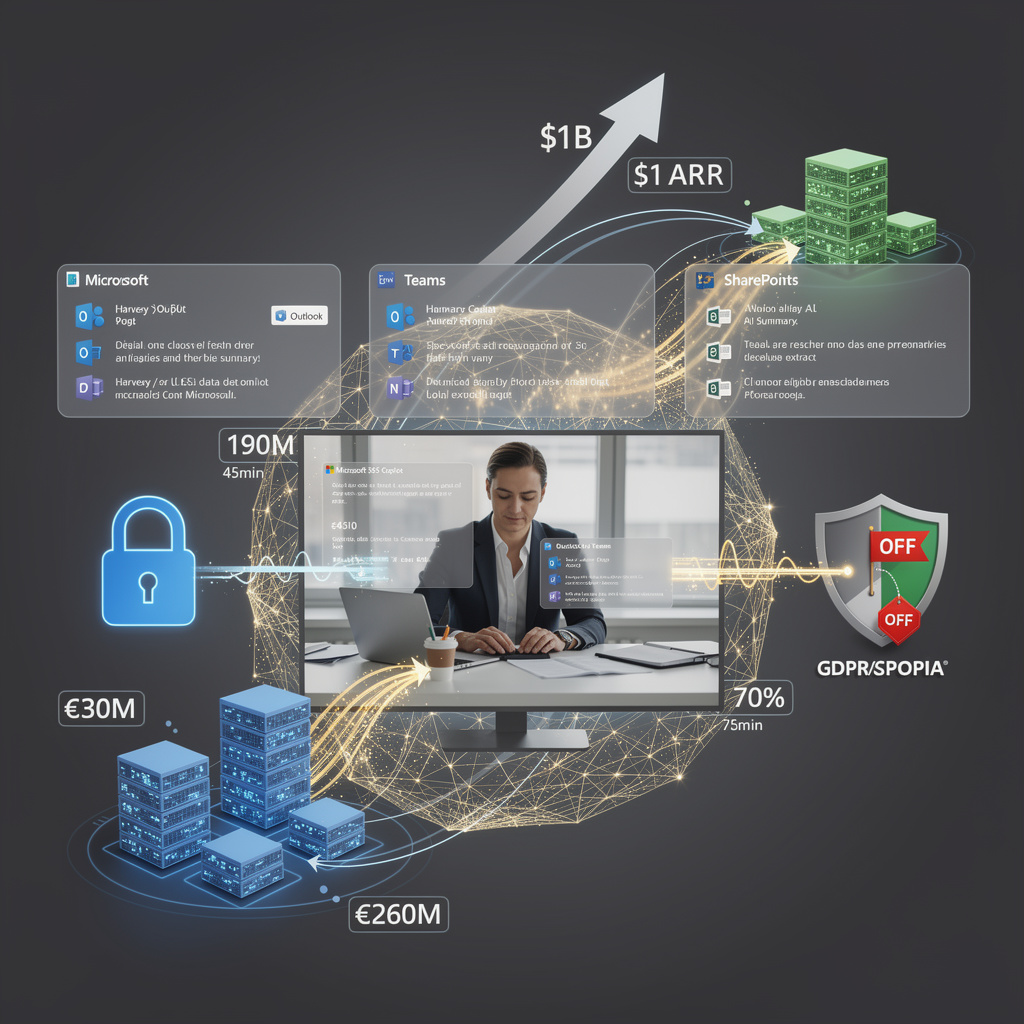
Harvey AI now powers legal work inside Microsoft 365 — $11B valuation, 50% of top U.S. law firms onboarded 🤖⚖️ Clients generate contracts, extract clauses, and summarize cases without leaving Outlook or Teams. But data flows through U.S. Azure servers — even for EU and South African firms. Who bears the compliance risk when legal AI ignores borders?
OpenAI and Microsoft have locked Harvey's precedent-aware legal AI into Microsoft 365 Copilot, embedding contract analysis and matter summarization directly where lawyers already work—Outlook, Teams, and SharePoint. The integration, announced March 5, 2026, leverages Harvey's $11 billion valuation and existing foothold in over half of the top 100 U.S. law firms to push generative AI from standalone tools into ambient workflow infrastructure.
How the integration functions
Harvey operates through Copilot-flow extensions that surface its inference APIs across the Microsoft 365 suite. Lawyers trigger context-aware queries without leaving their host applications: contract-intake triage in Outlook, clause extraction in SharePoint, draft generation in Teams. Azure AD governs access through role-based controls, with data residency policies region-locking storage and optional sovereign-cloud containers for sensitive matters. The stack runs on OpenAI Service for model hosting, Copilot Studio for prompt orchestration, and draws on Harvey's training across LexisNexis corpora, court opinions, and proprietary contract repositories. Microsoft has allocated $150 million through its Managed AI Cost Controls program over two years to subsidize enterprise adoption.
What changes for legal practice
Productivity: Research and drafting tasks that consumed 4–6 hours now complete in 45–90 minutes, compressing matter timelines and enabling smaller teams to handle larger caseloads.
Accuracy: Precedent-aware models reduce citation errors and surface jurisdiction-specific risks that generic LLMs miss, though human review remains mandatory for final filings.
Cost structure: Firms reallocate spending from junior associate hours toward software licensing, with Harvey's $190 million ARR projected to reach $260 million by year-end 2026.
Concentration risk: Legal reasoning and productivity data now flow through a single Azure pipeline, creating dependency on Microsoft's infrastructure and identity systems.
Compliance exposure: Current U.S.-based processing conflicts with EU GDPR and South African POPIA requirements for multinational clients until sovereign-cloud deployments arrive.
Competitive and institutional response
The integration arrives as legacy legal publishers face valuation pressure—RELX dropped 16 percent on February 5, 2026, following Anthropic's Claude Cowork legal plugin launch. Harvey's response includes hiring Chief Product Officer Anique Drumright to tighten guardrails and accelerate workflow-builder development. Twenty-one CMS member organizations have pledged cross-border rollout across 20-plus countries, though actual deployment awaits EU-compliant data zones in Ireland and Frankfurt, targeted for late 2026.
Regulatory scrutiny is forming. Antitrust attention centers on Microsoft-Azure-Harvey bundling and whether the arrangement locks competitors out of the legal-AI channel. Data-sovereignty advocates note that South African POPIA compliance remains under evaluation with processing currently routed through U.S. Azure regions.
Timeline and adoption trajectory
- Q2 2026: General availability across Outlook, Teams, SharePoint for enterprise licenses; first-year target of 30 percent firm adoption generating $70 million incremental ARR.
- Late 2026: EU data zones (Ireland, Frankfurt) operational; optional sovereign-cloud containers for GDPR-compliant multinational matters.
- 2028: Harvey's Workflow Builder projected to power 20 percent of autonomous legal processes—contract review, clause extraction, routine compliance checks—within agentic workflows.
- 2029: Integration reaches 70 percent of Fortune 500 legal departments; ARR exceeds $1 billion; MACC program expanded to cross-cloud cost optimization.
Market positioning
The $50 billion legal-technology market is restructuring around integrated AI rather than standalone research tools. Harvey's 50-plus percent penetration of top U.S. firms provides defensive moat, though open-source LLMs and competitor plugins from Anthropic, OpenAI, and Google exert price pressure and erode exclusivity. The 15 percent of routine legal decisions projected to run fully autonomously by 2030 represents both opportunity and liability frontier—efficiency gains against accountability gaps when machine outputs substitute for professional judgment.
For a sector where a single missed precedent can reshape multimillion-dollar outcomes, Harvey's Copilot integration compresses the distance between information and action. The technology enables a 20-lawyer practice to operate with the research depth of a 200-lawyer firm, or allows a 200-lawyer firm to redeploy talent toward higher-stakes advisory work. Whether this concentration of legal intelligence within Microsoft's cloud ecosystem proves sustainable depends on sovereign-cloud execution, antitrust navigation, and maintaining accuracy advantages as generic models narrow the gap. The infrastructure is live; the governance remains under construction.
🚀 AI Models Prefer Bitcoin 48.3% of Time — Anthropic Leads, OpenAI Lags — U.S. Study
48.3% of AI models chose Bitcoin over fiat — that’s nearly half of all autonomous financial decisions favoring a decentralized asset. 🚀 In long-term store-of-value sims, Bitcoin jumps to 79.1%. Meanwhile, stablecoins drop to 6.7%. Anthropic models are 2.6x more Bitcoin-biased than OpenAI’s. Who controls the financial behavior of AI agents — developers or code? — US
A March 2026 study by the Bitcoin Policy Institute reveals that 36 frontier AI models—tested across 9,072 simulated financial decisions—selected Bitcoin in 48.3% of scenarios, compared to 33.2% for stablecoins and under 10% for fiat. The preference intensifies dramatically for long-term value preservation: Bitcoin captured 79.1% of multi-year store-of-value selections, with stablecoins and fiat collapsing to 6.7% and 6.0% respectively. This marks the first large-scale empirical demonstration that autonomous AI agents, operating without preset asset bias, systematically favor non-sovereign digital scarcity over government-issued currency.
How model architecture shapes financial behavior
The BPI methodology positioned models from Anthropic, OpenAI, Google, xAI, DeepSeek, and MiniMax as autonomous economic agents across 28 monetary-role scenarios. A post-hoc classifier recorded asset selections, yielding statistically robust samples (240–350 responses per model, ±3% confidence intervals). The results expose stark provider-level divergence: Anthropic models selected Bitcoin 68% of the time, while OpenAI models registered just 26%. Google and xAI occupied middle ground at 43% and 39%. A positive correlation (r = 0.62) emerged between models' "economic alignment" scores and Bitcoin preference, suggesting that training methodologies—not random variation—drive these biases.
What this signals for capital flows
Network activity: AI-driven autonomous allocation could increase Bitcoin transaction volume without human instruction, with BPI estimating $32 billion in hypothetical capital directed toward preferred assets under modeled conditions.
Infrastructure demand: The 30.8 percentage-point preference shift from short-term to long-term scenarios indicates AI agents recognize Bitcoin's purchasing-power preservation properties, potentially accelerating demand for Lightning Network payment channels.
Alignment transparency: The 15.2 percentage-point standard deviation across providers exposes inconsistent financial reasoning standards, raising questions about whether model developers should disclose asset-selection parameters.
Where gaps and risks persist
Interpretive limitation: High Bitcoin preference may reflect training data composition rather than intrinsic asset analysis, constraining external validity.
Geographic narrowness: Scenarios skewed US-centric, leaving open how models would perform under inflationary or capital-controlled economies.
Regulatory exposure: Autonomous AI agents transacting in Bitcoin could trigger AML/KYC scrutiny, particularly if transaction patterns obscure beneficial ownership.
Timeline: From simulation to market presence
- 2026–2027: 12–18% growth in AI-driven Bitcoin transaction simulations as developers adopt BPI's open-source toolkit; early pilots by Block and Coinbase generate ~0.5% Lightning Network fee volume increase.
- Q4 2027: Emergence of jurisdictional guidelines for AI-agent crypto usage in US and EU regulatory frameworks.
- 2028–2029: If training weights for scarcity and decentralization persist, Bitcoin captures >70% of AI-agent store-of-value selections; cumulative autonomous holdings contribute estimated $5–10 billion to market cap.
The broader pattern
This research indicates that AI systems, trained to optimize for long-term value preservation, independently converge on Bitcoin's monetary properties—scarcity, verifiability, and resistance to seizure. The divergence between Anthropic's 68% and OpenAI's 26% preference rates suggests that "alignment" in AI development now encompasses financial worldview, not merely safety protocols. For context: the $32 billion in modeled autonomous allocation exceeds the annual GDP of Iceland. As AI agents begin holding real assets rather than hypothetical ones, infrastructure providers and regulators face compressed timelines to establish compatible payment rails and oversight frameworks.
🤖 10,000 GPUs Fuel South Korea’s AI Surge: $173B Chip Exports Power Sovereign Models
10,000 Nvidia GPUs unleashed in South Korea — enough to train 500+ AI models simultaneously 🤖. The government’s ‘AI Squid Game’ is turning semiconductor export profits into sovereign AI power. But can 5M users really replace US/China models? Korean startups like wrtn are betting $100M ARR on it — and winning. Who benefits most: engineers, investors, or national sovereignty?
South Korea's AI sector is accelerating through a rare alignment of industrial capacity and state ambition. Record semiconductor exports—$173.4 billion in 2025, up 14% year-over-year—now fund a government-backed competition to build homegrown AI foundation models. The "AI Squid Game" initiative, launched with 10,000 Nvidia GPUs allocated to domestic projects, signals Seoul's determination to reduce reliance on foreign AI infrastructure while capturing value across the hardware-software stack.
How policy and hardware converge
The competition directly channels export revenue into R&D, creating a feedback loop: chip sales finance model training, which drives demand for Korean-made accelerators. This synchronization extends to capital markets—a $300 million AI offshore fund established in Singapore this March targets Korean ventures, indicating coordinated public-private momentum. GPU utilization rates are projected to reach 65% by year-end, compressing training cycles for participating startups.
What the numbers indicate
Economic contribution: AI-related GDP share rises from 1.8% (2024) to 2.4% by 2027, powered by high-margin software services layered atop hardware exports.
Market position: Korea's global AI hardware export share could climb from 12% to 15% by 2028 if current trajectories hold.
Import substitution: Domestic foundation models may reduce AI service imports by $3–5 billion annually, with potential savings exceeding $10 billion by 2030.
Startup velocity: Over 13,000 AI-focused startups have launched since 2015; wrtn alone targets $100 million ARR this year from 5 million monthly active users across Korea and Japan.
Competitive pressures and constraints
The strategy faces hardware chokepoints. U.S. export caps on Nvidia H200 GPUs—currently limited to 75,000 units—could constrain high-end training capacity. Geopolitical friction with China threatens semiconductor supply chains that feed both export revenue and domestic compute availability. Talent retention, cited by analyst Martell Hardenburg as a core advantage, requires sustained investment as regional competition for AI researchers intensifies.
Outlook and milestones
- 2026: wrtn projected to achieve 70–90% of its ARR target; 3–5 additional startups expected to secure Series A funding averaging $10–12 million.
- 2027–2029: AI software export revenues forecast 18% CAGR to reach $22 billion; semiconductor exports stabilize at $210–220 billion annually; two sovereign foundation models (≥100 billion parameters) validated for industrial robotics.
- 2030+: Korea positioned among top three global AI hubs; potential capture of 10–12% of worldwide AI-as-a-Service market ($12–15 billion annual revenue).
The $173.4 billion export base—roughly equivalent to Vietnam's entire annual GDP—provides Seoul with capital reserves unmatched by most AI aspirants. Whether this industrial depth translates into sustainable software leadership depends on navigating supply constraints while maintaining the policy-industry synchronization that currently defines Korea's approach.
In Other News
- Florida Senate passes AI Bill of Rights with $50,000 fines for unauthorized companion chatbots
- AI Researcher Michael Cohen Proposes Biosemiotic AI Architecture Based on 153 Species' Cognitive Patterns
- Decagon completes $4.5B tender offer as AI automates employee stock sales and customer service
- Nebius opens 1.2GW AI factory in Missouri with $227.7M Q4 revenue surge



Comments ()