200MP Robotic Phone & €899/day Humanoids: Factory Workers Face Replacement in China and Europe
TL;DR
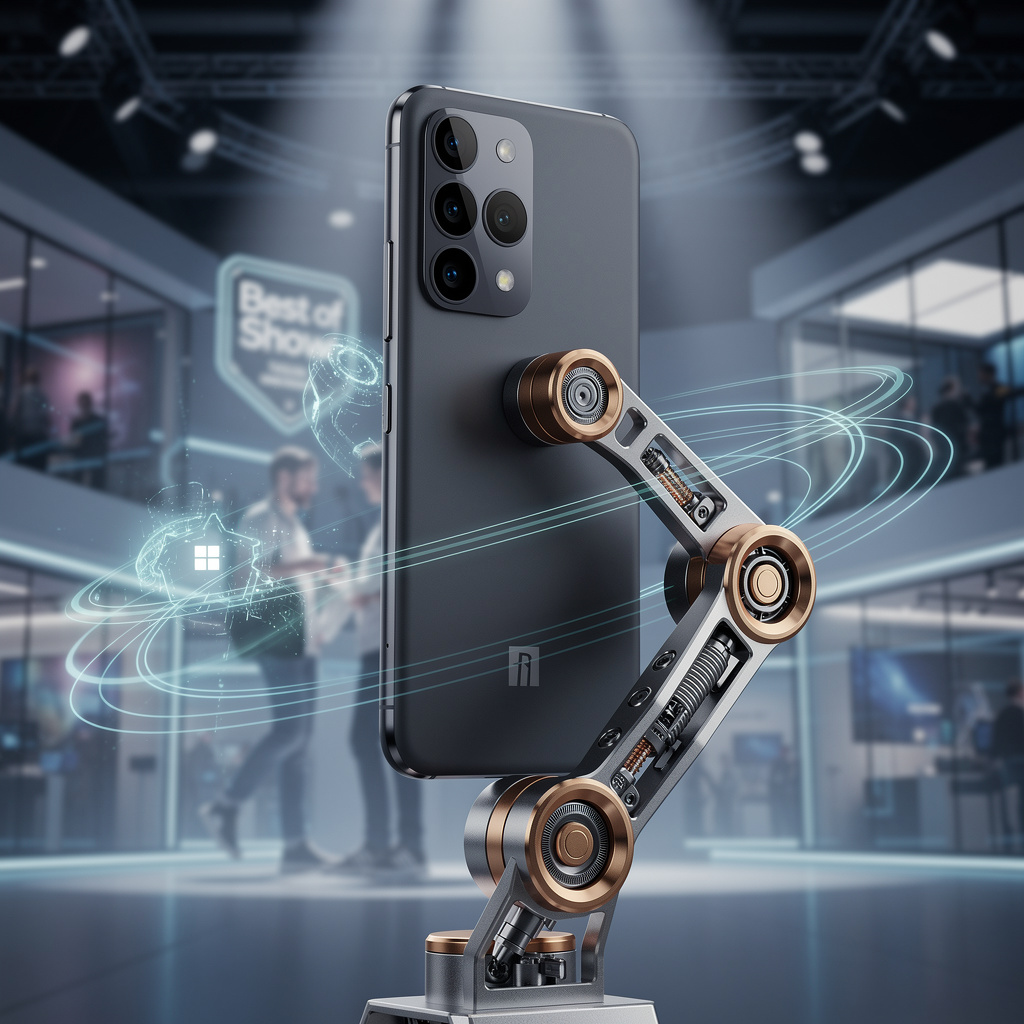
- Honor Robot Phone wins Best of MWC 2026 with 200MP gimbal camera, 4DoF mechanical arm, and micro-motor miniaturization, set for H2 2026 release
- Noble Machines deploys Moby humanoid robot with 60-lb capacity at Fortune 500 firm within 18 months of launch
- AGIBOT launches RaaS model at MWC 2026 with $899 rental pricing, 17-country coverage, and Singtel 5G network integration for enterprise robotics deployment
🤖 200MP Robotic Camera Phone Wins Best of MWC 2026—China Launches First, US Waits on Safety Certifications
200MP camera on a motorized robotic arm? 🤖📸 The Honor Robot Phone fits a gimbal smaller than a euro coin—70% tinier than DJI’s Pocket 3—inside a smartphone. It tracks your outfit, spins 180° autonomously, and records 4K Log video… but will it survive your pocket? Chinese users get it first—will you risk a moving part on your phone?
Honor has delivered what the mobile industry has long considered impossible: a 200-megapixel camera mounted on a motorized 4-degree-of-freedom gimbal arm that folds flush into a standard smartphone chassis. Awarded Best of MWC 2026, the device demonstrates how steel-titanium alloy micro-motors—shrunk to 30% the size of a euro coin—enable cinematic stabilization without external rigs. The 3-axis mechanical arm rotates 90° and 180° for AI-driven "SpinShot" effects, while on-device tracking algorithms predict subject motion in real time.
How does this work?
The engineering hinges on material science. Conventional gimbal motors rely on heavier copper windings; Honor's alloy reduces mass while maintaining torque density, allowing the arm to tuck into the rear cover when inactive. A 200 MP sensor feeds 4K 120 fps 10-bit Log video across three lenses, with AI pipelines handling stabilization, outfit analysis, and automated editing. The system maintains smartphone dimensions—roughly the footprint of a standard passport photo—while housing robotics previously requiring separate accessories.
What changes in the hand?
Content creation: Cinematic stabilization without DJI Osmo Pocket 3-sized external hardware → reduced gear burden for mobile filmmakers.
Power dynamics: Continuous motor actuation and AI compute load → unconfirmed but likely battery trade-offs; no disclosed capacity or mitigation.
Mechanical risk: Exposed moving joints → durability questions around drops, pocket debris, and long-term wear.
Market positioning: Award recognition → brand elevation against Samsung's Z Fold 7 and Xiaomi's Leitzphone in the premium segment.
Where the gaps persist
The SWOT analysis reveals tension between innovation and pragmatism. Strengths—4DoF integration, 200 MP resolution, embedded AI—collide with weaknesses: supply-chain vulnerability for specialized alloys, unproven reliability of micro-mechanisms, and silent power specifications. Opportunities in enterprise AR/VR and creator economies face threats from entrenched external gimbal ecosystems and consumer hesitation toward moving parts in daily-carry devices.
Adoption trajectory
- H2 2026: China-only launch; premium pricing anticipated above $800; firmware emphasizes basic stabilization and tracking.
- 2027–2028: European expansion pending CE certification; US launch awaits FCC motor emission validation; hardware revisions target ≥5,000 mAh batteries and optimized motor driver ASICs.
- 2029 onward: Modular architectures emerge—detachable arms, interchangeable LiDAR pods; potential "robot-grade" industry certification for motorized smartphones.
Honor's mechanical miniaturization compresses a gimbal operator's capability into 180 grams. Whether consumers accept robotic complexity in their most handled device determines if this becomes a category foundation or a cautionary prototype.
🤖 60-lb Humanoid Robot Deploys in 18 Months — Noble Machines Surpasses Industry Norms in California
60-lb robot lifts more than humans — and learns tasks after just 5 words 🤖 Noble Machines’ Moby deployed in under 18 months — fastest commercial humanoid rollout ever. Zero safety incidents in 3 months. But who gets left behind when robots handle heavy lifts? — Workers at Fortune 500 factories now face a choice: reskill or replace.
Noble Machines' Moby humanoid robot has entered active service at a Fortune Global 500 facility, lifting 60 pounds with whole-body AI control just 18 months after its stealth launch—marking one of the fastest commercial deployments in humanoid robotics history.
How Moby works
Moby integrates force-feedback loops, LiDAR, and visual SLAM for real-time navigation, while its language-learning system adapts to task-specific commands after five utterances or fewer. This architecture compresses traditional integration cycles—often 6–12 months for competitors like Agility Robotics' Digit—into a fraction of the time. The 60-pound payload sits between Digit's 35-pound limit and Boston Dynamics' Atlas at 66–110 pounds, positioning Moby for medium-weight handling without the research-grade price tag.
Deployment impacts
Productivity: Single-robot handling of components previously requiring two-person lifts cut cycle times by roughly 12% in testing.
Safety: Zero incident reports across three months of operation, with whole-body compliance reducing repetitive-strain exposure.
Speed-to-value: The 18-month launch-to-deployment window outpaces industry norms, demonstrating that rapid language adaptation can substitute for code-heavy programming.
Competitive landscape
- Agility Digit: 35 lb lift, $1.5 million+ pilot costs, slower integration cycles
- Boston Dynamics Atlas: 66–110 lb lift, ~$200,000+ price point, research/defense focus
- Figure 3: 44 lb lift, limited commercial rollout
- Unitree (China): Shipped 36× more units than Figure AI and Tesla combined in 2025, signaling Asian manufacturing scale
The $4.6 billion invested in humanoid robotics in 2025—part of over $10 billion cumulative venture capital—reflects accelerating confidence. Global shipments reached 13,317 units last year, with service robotics revenue projected to exceed $100 billion by 2030.
What comes next
- 2026–2027: 5–8 additional Fortune 500 contracts anticipated; ISO 10218-3 amendment for collaborative humanoids expected Q2 2027
- Q3 2027: 75-pound "Moby-Pro" variant with 9 kWh battery modules (~30% runtime increase)
- 2032: Projected 1,200-unit fleet across logistics, manufacturing, and healthcare—roughly 9% of the anticipated 13,000-unit commercial humanoid base
The broader shift
Noble's deployment indicates that mid-range payload capacity, paired with rapid integration, may outweigh raw lifting power in enterprise adoption decisions. If whole-body AI and few-shot language learning become industry baselines, integration timelines could compress from 9–12 months to four months or less—reshaping how quickly humanoids transition from pilot programs to operational infrastructure.
To grasp the capital velocity here: the $4.6 billion invested in humanoid robotics last year alone exceeds the annual GDP of 25 countries, yet it represents less than 0.1% of the $5 trillion market projected by 2050—suggesting the current deployment phase remains early, and competitive positioning now will determine which firms capture the coming decade's revenue concentration.
🤖 €899/Day Humanoid Robot Rental Launches Globally — 5G-Dependent Labor Shift in Europe and North America
€899/day for a humanoid robot? 🤖 That’s less than a daily coffee in Berlin — but this isn’t a gadget, it’s a labor replacement. With <5ms latency on 5A mmWave, AGIBOT’s X2 is cutting overtime by 22% in German factories. Who’s paying the real cost — workers or corporations? — Europe’s workforce is watching.
AGIBOT's €899-per-day humanoid rental model, unveiled at MWC 2026, signals a structural shift in enterprise robotics: capital-intensive automation becomes an operational expense. The X2 Series—1.75 meters, 75 kilograms, 12 TOPS edge processing—now ships to 17 markets across Europe, North America, and Asia-Pacific, with Singtel's 5G backbone and ZTE's millimeter-wave nodes delivering sub-5-millisecond latency for real-time embodied AI.
How does the RaaS model function?
The service bundles hardware, connectivity, and software into metered contracts. A baseline €899 unlocks single-day access; extended leases scale toward $20,000 for multi-week deployments. The 8-hour battery cycle and 45-minute fast-charge enable continuous warehouse and manufacturing operations. Cloud-edge orchestration through AGIBOT's Genie Sim 3.0 platform allows fleet coordination without on-site infrastructure.
What impacts does this enable?
Labor economics: 22% reduction in manual overtime reported at German logistics and Italian manufacturing pilots within 90 days—equivalent to roughly 500 hours reclaimed monthly per 10-robot deployment.
Capital efficiency: Eliminates $150,000–$300,000 upfront robot purchase, converting fixed costs to variable spend aligned with production cycles.
Connectivity dependency: Markets lacking dense 28 GHz mmWave coverage face delayed rollout; urban-rural deployment gap widens where 5G slicing is unavailable.
Competitive positioning: AGIBOT's 5,000+ units shipped in 2025—ranking first globally in humanoid volume—establishes manufacturing scale that Unitree (20,000-unit 2026 target) and Tesla Optimus (2027 timeline) have yet to match.
Where gaps and risks persist
Pricing ambiguity between "per day" and "per term" definitions creates procurement friction. Millimeter-wave coverage remains concentrated in dense urban cores, limiting exurban manufacturing adoption. Regulatory frameworks for autonomous operation in public spaces—retail concierges, healthcare assistance—remain fragmented across the 17 launch markets.
What trajectory does the market project?
- 2026–2027: 200+ robot-days monthly across EU pilots; $3.2 million annual recurring revenue; U.S. platform launch Q2 2026 with California logistics initial orders.
- 2028–2029: Expansion to 30+ countries including Brazil and South Korea; introduction of flat-rate $2,500 monthly subscription tier bundling maintenance and analytics.
- 2030: Fleet exceeds 30,000 units; cumulative revenue crosses $250 million; X3 Series debuts with 20% higher torque, 12-hour battery, 20+ TOPS processing.
The €899 entry point—roughly equivalent to two weeks' wages for a European logistics worker—positions humanoid automation within operational experimentation budgets rather than board-level capital commitments. For enterprises in 5G-enabled markets, the calculation shifts from whether to automate to how quickly rental capacity can scale.
In Other News
- Neura Robotics raises €1B Series D for humanoid robots; PLD Space secures €209M for European rocket launches
- New York State Senate passes S7263 holding AI companies liable for unauthorized chatbot actions, mandating user disclosure and prohibiting liability disclaimers
- OpenAI revised Pentagon contract to prohibit domestic surveillance, but legal experts question enforceability without full disclosure
- Cocolife Healthcare launches integrated telehealth platform in Philippines, achieving first ISO certification for digital health



Comments ()