78 Cloud Outages in 4 Days — AWS Middle East Crippled by Drone Strike — Oil Spikes, Banks Freeze
TL;DR
- AWS Middle East data centers hit by drone strikes, causing regional outages and triggering DR plan reviews
- DIDU launches 3D-printed hypersonic testbed Cassowary Vex via Rocket Lab’s HASTE, advancing US hypersonics program
- Canada unveils $81.8B Defence Industrial Strategy to boost sovereign aerospace, drone, and munitions production by 2035
🚨 78 Service Outages After Drone Strike Cripples AWS Middle East Data Centers — UAE, Bahrain in Crisis
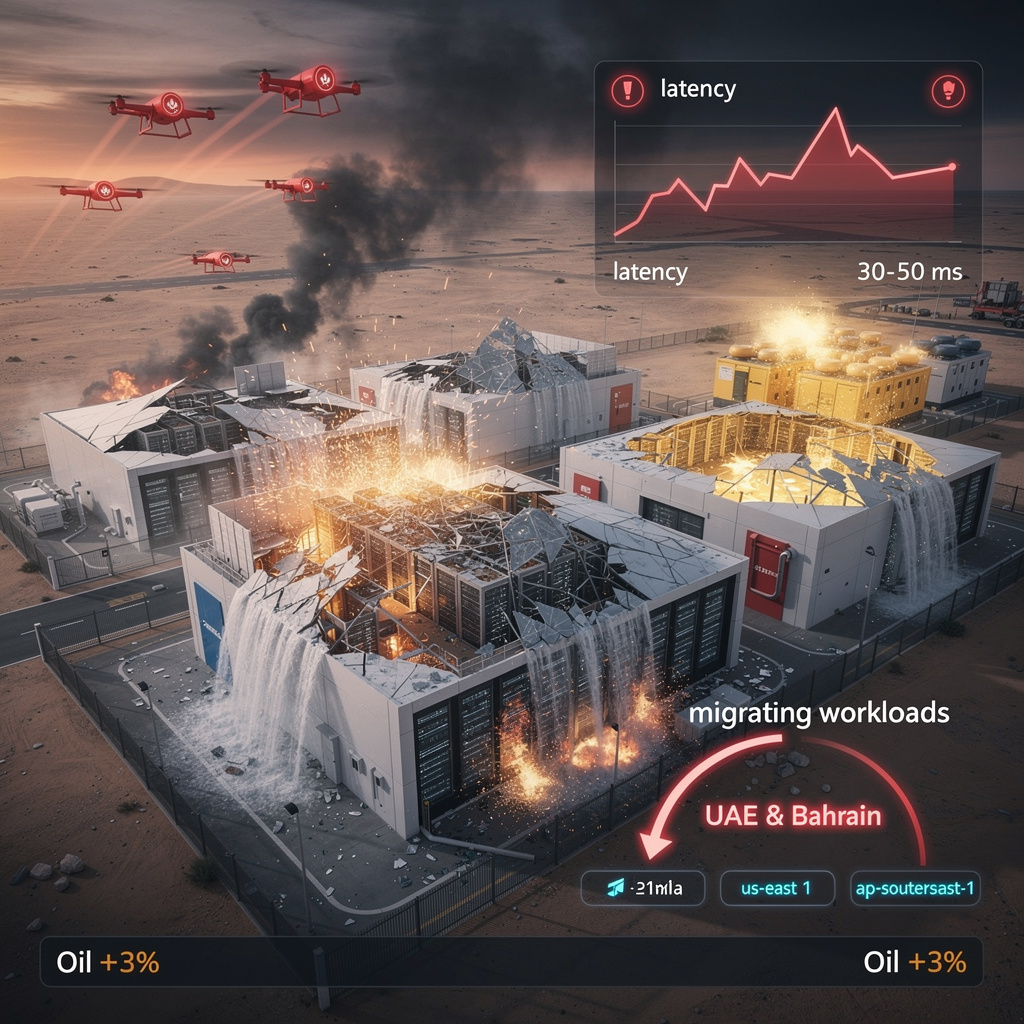
78 service outages in 4 days — a drone strike just crippled 2.4% of AWS’s Middle East cloud — but that’s the equivalent of wiping out 120,000+ servers at once. 🚨 Water suppression flooded networks, delays stretched to 10 days. Customers fleeing to US/EU regions — while oil prices spike and banks freeze transactions. Who’s safe when your cloud is in a war zone? — UAE & Bahrain businesses
On March 1, 2026, uncrewed aerial systems struck two AWS availability zones in the UAE and one in Bahrain, marking the first publicly confirmed destruction of hyperscale cloud infrastructure in real-world combat. The attacks—attributed to Iranian retaliation drones following U.S.-Israel coalition strikes—ignited fires that triggered water-based suppression systems, forcing power shutdowns and activating backup generators. By March 2, AWS listed 78 service incidents across EC2, S3, DynamoDB, and Lambda, with error rates climbing 15–25% and EC2 launch success dropping to 65% in damaged zones. Amazon shares fell 2.7% premarket on March 5 as restoration remained incomplete.
How redundancy contained the damage
AWS operates roughly 900 data centers across 39 regions, each containing at least three availability zones separated by up to 100 kilometers with independent power and networking. The three struck AZs represented just 2.4% of Middle East capacity. This architecture prevented broader collapse, though fire-suppression water caused secondary damage to networking racks, extending recovery timelines beyond initial estimates. Network latency to alternate regions increased 30–50 milliseconds for rerouted customers.
What failed and what it cost
Service performance: EC2 throttled to ≤70% capacity; S3 latency rose 20–40%; DynamoDB error rates spiked 15–25%.
Business operations: ADCB and Emirates NBD reported mobile banking failures; Careem experienced ride-hailing delays; Snowflake logged elevated query errors.
Market ripple: WTI oil benchmark climbed ~3%; Strait of Hormuz shipping activity dropped ~15%; insurance premiums for geopolitical outage coverage face >30% increases.
Where planning gaps persist
AWS's rapid health-dashboard alerts enabled customer-initiated failover, but physical security perimeters proved inadequate against high-altitude UAVs. Disaster recovery testing for geopolitical scenarios was largely absent, and water-damage propagation was not fully modeled. The incident creates openings for multi-region architecture adoption, edge-secure hardening services, and potential "conflict-zone" insurance products—while threatening further strikes, regulatory pressure on U.S. cloud providers in contested territories, and customer migration to competitors perceived as lower-risk.
What happens next
- March 6–10: Full power restoration to UAE AZs following de-watering; mobile generators and cold-standby racks deployed to ME-SOUTH-1.
- March 8–15: Customers projected to shift 10–15% of critical workloads to US-East-1 or AP-Southeast-1.
- Q2 2026: AWS begins 12–18 month rollout of anti-UAV detection, reinforced roofing, and segregated power corridors across Middle East sites.
- 2026–2027: Analysts forecast 20–30% rise in active-active multi-region deployments across Gulf and EMEA markets; UAE and Bahrain may mandate geopolitical-DR testing with ~5% compliance cost increase.
The strikes exposed a systemic gap in cloud geopolitical-risk modeling. While redundancy prevented broader collapse, the industry's assumption that physical separation equals security has been fundamentally challenged—forcing a reckoning on how infrastructure built for earthquakes and power failures withstands deliberate attack.
🚀 Mach 8 Hypersonic Testbed Printed in 10x Less Time — U.S. Launches Weekly from Virginia
662 lb hypersonic testbed, 3D-printed in 10x less time — Mach 8 reached in just 10 minutes 🚀 No moving parts. Zero CO₂. Built by a university and launched from Virginia. U.S. now testing hypersonics weekly — while rivals scramble to catch up. Could your state be next in line for defense tech jobs? 🤔
On March 4, 2026, a 662-pound payload achieved Mach 8 above Wallops Island, Virginia, using a scramjet engine built entirely through additive manufacturing. The Defense Innovation Unit's Cassowary Vex mission demonstrates that 3D printing now enables hypersonic flight—compressing development timelines by 40% compared to traditional metal-machined systems and establishing a replicable model for rapid defense prototyping.
How additive manufacturing enables Mach 8 flight
The Spartan scramjet contains zero moving parts, hydrogen-fueled, and produced through continuous fiber 3D printing. L3Harris data indicates 10-fold faster component fabrication versus conventional methods. Rocket Lab's HASTE vehicle—now 7-for-7 in successful launches—delivered the testbed to a 26-kilometer apogee across 1,000 kilometers of downrange trajectory in approximately 10 minutes. The engine's printed construction allows geometric complexity impossible with subtractive manufacturing, directly contributing to thermal management and combustion efficiency at speeds exceeding 9,800 kilometers per hour.
What the data reveals
- Speed: Mach 8 achieved; Mach 10–12 targeted by Q4 2026
- Development compression: 40% timeline reduction versus legacy programs
- Production acceleration: 10× faster component fabrication
- Data yield: >12 TB telemetry collected from seven HyCAT flights
- Program investment: $46 million Series A (Hypersonix) plus $200 million FY 2026 DoD allocation
Where risks and competition intersect
| Technical maturity | Additive-manufactured scramjet materials remain unproven under repeated thermal cycling; Auburn University validation ongoing | | Schedule volatility | February 2025 and February 2026 launch cancellations indicate integration complexity with multi-payload manifests | | Geopolitical positioning | China's classified programs and Russia's continued development threaten U.S. lead; Europe's Andoya Space achieved Mach 6+ in February 2026 | | Commercial dependency | Rocket Lab's 100% HASTE success rate masks concentrated launch risk; four missions in six months strain cadence sustainability |
What comes next
- 2026–2027: Monthly HyCAT flights with iterative Spartan engines; closed-loop autonomous guidance integration
- Q4 2026: Sustained Mach 10–12 flight demonstration
- 2028–2029: Low-Earth-orbit demonstrators (500 kg payload, Mach 15 target); commercial HASTE slot leasing projected above $250 million annual revenue
- FY 2028: Operational hypersonic weapon prototypes enter full-scale acquisition
The manufacturing precedent
The Cassowary Vex mission compresses what historically required years into months. At 300 kilograms—roughly the mass of a grand piano—the testbed proves that additive manufacturing now handles flight-critical systems at temperatures exceeding 1,000°C. The 40% development reduction and Australian-U.S. technology transfer establish a template: defense innovation need not await traditional aerospace timelines.
🏗️ C$81.8B Defence Strategy: 240% Revenue Surge and 125,000 Jobs — But Can Canada’s SMEs Actually Win?
C$81.8B spent to double Canada’s defence sector revenue — that’s enough to build 1,600 new schools. 🏗️ Now, 92% of defence firms are SMEs — but only 43% of contracts go to them. By 2035, that jumps to 70%. Who wins? Northern communities, Indigenous firms, and tech startups. Will Ottawa’s bureaucracy keep up — or stall the revolution?
Canada’s $81.8 billion Defence Industrial Strategy, announced March 4, 2026, marks a structural pivot from foreign dependency to sovereign production across aerospace, unmanned systems, and ammunition. The plan targets a 240% revenue surge and 125,000 new jobs by 2035, anchored by $6.6 billion in industrial capacity funding and an 85% R&D expansion. At its core sits a critical vulnerability fix: domestic nitrocellulose production by 2029, eliminating reliance on unstable global supply chains for explosives manufacturing.
How the strategy deploys capital
The Defence Investment Agency (DIA) gains independent authority in 2026, charged with streamlining procurement through a "Fast-Track" portal and standardizing contract thresholds. Funding concentrates on northern infrastructure—Inuvik and Yellowknife operational hubs, Mackenzie Valley Highway upgrades—and SME enablement, recognizing that 92% of Canada's defence firms fall in this category. The $180 billion procurement pipeline plus $290 billion capital investment over ten years creates a $470 billion opportunity pool, with policy mandating 70% domestic contract share by 2035, up from 43% in early 2025.
What shifts, and for whom
Economic: 125,000 jobs added to a current base of 81,200—equivalent to staffing 1,250 mid-sized manufacturing plants—driving sector employment to 206,000 total.
Operational: Serviceability targets climb from 59.6% (maritime, last reported) to 80% maritime, 85% land, 90% aerospace by 2035.
Strategic: Export volume targets 50% growth, from ~$4 billion (2024) to ~$6 billion annually, reorienting toward European and Indo-Pacific NATO allies.
Fiscal: Defence spending reaches 5% of GDP by 2029-2035, aligning with NATO's elevated benchmark.
Where execution risks concentrate
Procurement: Ambiguous "Canadian firm" definitions threaten eligibility disputes and bureaucratic delays.
Supply chain: Legacy dependence on U.S. subsystems persists despite autonomy goals.
Fiscal sustainability: 5% GDP defence burden may conflict with other federal priorities.
Geopolitical: Trade friction with the United States could trigger retaliation on defence-related items.
Timeline and milestones
- 2026–2027: DIA operational; first capacity funding tranche awarded; ~30,000 jobs created in construction and R&D; pilot contracts for uncrewed aerial systems to three Canadian SMEs.
- 2029: Domestic nitrocellulose production online; ammunition self-sufficiency exceeds 80% of Canadian Armed Forces requirements.
- 2029–2032: Export volume up 20–30%; revenue growth hits +150% of 2025 baseline; aerospace serviceability reaches 85%.
- 2033–2035: Full 240% revenue increase realized; 70% domestic contract share achieved; sector employment reaches 206,000; 5% GDP defence spending met.
The scale of transformation
The $81.8 billion commitment exceeds Canada's entire 2024 national defence budget by roughly 40%, while the 125,000-job target would expand the defence workforce by 155%—comparable to adding the combined employment of Canada's three largest aerospace manufacturers. Whether this industrial mobilization delivers strategic autonomy or strains fiscal capacity depends on procurement clarity and SME execution in the 2026–2029 window.
In Other News
- Honda and Acura recall 65,135 Prologue and ZDX SUVs due to infotainment and instrument panel software failures
- Ford's gas vehicle sales surge as EVs collapse, with Mustang Mach-E down 62.8% and total EV sales down 71% in February 2026
- Delta Air Lines sets record with 95 daily US-Europe departures in Q3 2026, adding new routes to Malta, Madrid, and Olbia
- US F-15E Strike Eagles shot down over Kuwait in friendly fire incident, six crew members ejected safely

Comments ()