200+ Iranian Children Killed in U.S.-Backed Strike: Congress Fails to Stop War Despite War Powers Act
TL;DR
- U.S. Capitol tensions rise as lawmakers demand war powers resolution against Trump’s Iran campaign
- U.S. Congress debates war powers resolution as Trump administration escalates Iran campaign without explicit legislative approval
- Senate fails to pass resolution blocking Trump’s unauthorized military action against Iran, deepening constitutional crisis
⚖️ 6 U.S. Troops Killed, 200+ Civilians Dead After Trump’s Iran Strike—Congress Demands Answers
6 U.S. troops dead. 200+ Iranian kids killed. 🇺🇸💀🇮🇷 Trump ordered a strike without Congress—then called it ‘preemptive.’ But the War Powers Act says he needs approval. Now senators are screaming ‘mission creep’—again. Who’s really protecting America? The president… or the Constitution? —And why are you paying for it?
President Trump ordered U.S. forces to join Israel in pummeling Iran on 28 Feb, and six American airmen are already dead. Yet when lawmakers returned to the Capitol they found the 1973 War Powers Resolution sitting on their desks like an unread instruction manual. The Constitution says only Congress can declare war; the White House says the 2001 AUMF against al-Qaeda covers a 2026 air raid on Tehran. Something has to give.
How the strike unfolded
B-2 stealth bombers and F-35s hit Iranian missile silos and command bunkers for six straight hours. More than 200 civilians, including 80 schoolchildren in Minab, are reported dead. The administration swears it briefed leadership “within 48 hours,” but the first classified session happened only after Schumer demanded it on 3 Mar.
Impacts so far
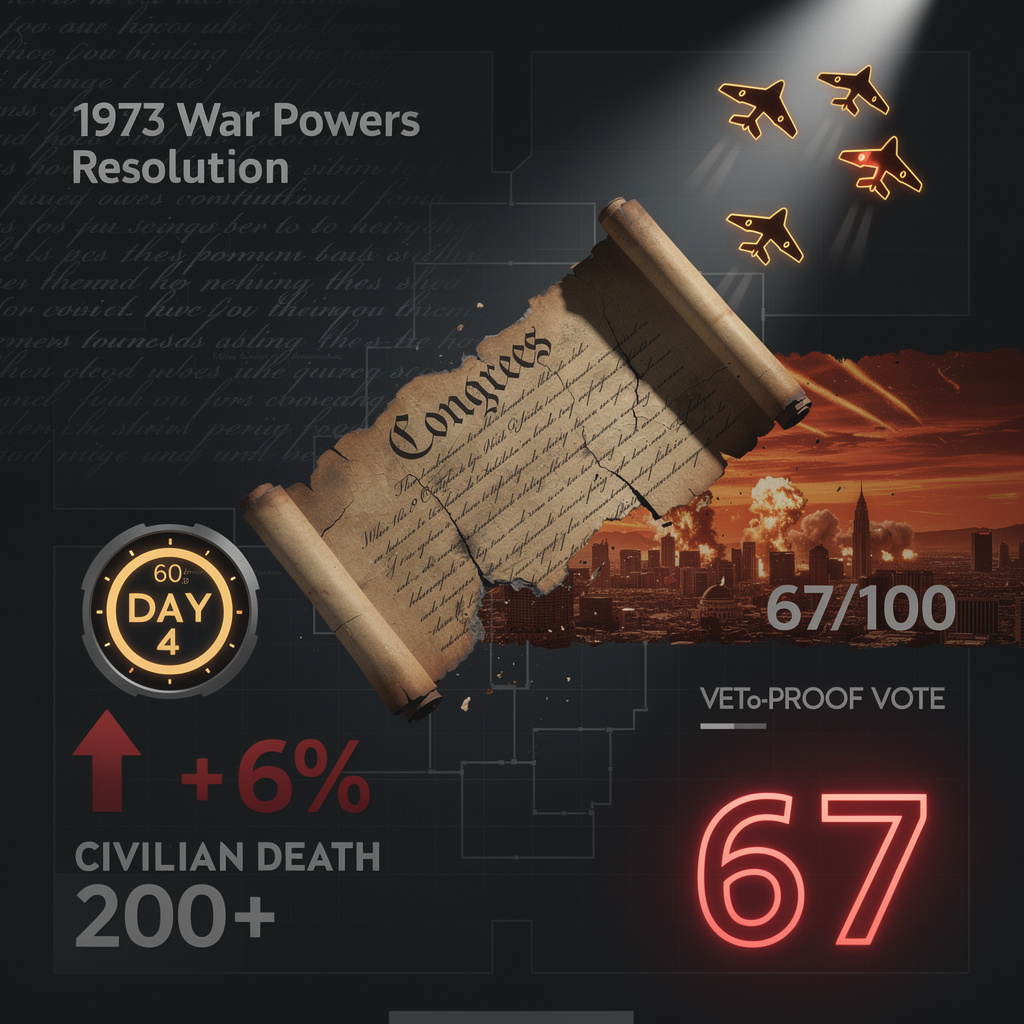
- Constitutional: 50 U.S.C. §1541-48 requires either a declaration or a pull-out after 60 days; day 4 has passed with neither.
- Political: 33 % public approval (YouGov) versus 45 % disapproval; intra-GOP split as Reps. Massie and Graham publicly disagree.
- Financial: Oil spiked 6 %; Pentagon already shopping a >$1 billion supplemental while CBO warns of $2-3 billion more to come.
- Humanitarian: Civilian toll undercuts U.S. moral stance and accelerates refugee flows toward Turkey and Iraq.
What Capitol Hill is actually doing
House progressives Khanna and Massie filed matching WPR resolutions; Kaine did the same in the Senate. Passage needs only a simple majority in each chamber, but a veto-proof override requires 67 senators—math that even Schumer calls “a steep climb.” Meanwhile, GOP leadership stalls floor time, betting the 60-day clock will run while “follow-on sorties” continue.
Timelines to watch
- Next 7 days: House Rules committee must decide whether to allow the Khanna/Massie vote; failure would shield the operation from a roll-call tally.
- 60-day mark (late Apr): If no authorization passes, the White House must either withdraw forces or openly violate the WPR—prime fodder for federal court.
- Jun-Aug recess: Primary season begins; anti-war challengers in both parties plan to wield “no-show” votes as cudgels.
- Nov midterms: Ballot initiatives in eight states will ask voters to endorse a 24-hour WPR-reporting rule, pressuring the next Congress to rewrite war-powers law.
Bottom line
The Capitol has seen this movie before—Vietnam, Grenada, Kosovo, Yemen—but never with live-streamed casualties and a ticking 60-day fuse. If lawmakers cannot muster the votes to reclaim their war-declaring power now, the precedent is set: any future president can bomb first and brief later.
💔 2,500 Missiles Down, 80 Children Dead: Congress Demands War Powers Reset After U.S.-Israel Strike on Iran
2,500 Iranian missiles destroyed — but 80 schoolchildren killed in Minab. 🇮🇷💔 U.S. and Israel struck without Congress’s say. Now lawmakers are scrambling to reclaim their constitutional power… while the president cites "imminent threat." Parents in Iran. Soldiers in the Gulf. Taxpayers footing a $1B bill. Should the president need Congress to go to war — or just a tweet?
On Feb 28 the White House told America it had shredded 2,500 Iranian missiles in a single night. Lawmakers found out the same way the rest of us did—from cable chyrons. Now the Hill wants its pager back.
How the war-powers trap works
The 1973 Act gives any President 48 hours to whisper “hostilities” to Congress and 60 days to keep shooting before lawmakers must vote. Trump used the first half; the second expires in late April. Schumer & Co. answer with H.Con.Res 38: no more money, no more bombs, unless Congress votes yes. The hitch? A discharge petition needs 218 signatures; head-counters say 215 are firm, 3 shy.
What the numbers say
- Constitutional: 227 years of precedent say only Congress declares war; 14 post-9/11 AUMFs say “unless we look away.”
- Human: 80 schoolkids in Minab will never vote; 6 U.S. families buried uniforms last weekend.
- Fiscal: Pentagon burn rate for a month of “Epic Fury” > $1 billion—equal to Pell Grants for 125,000 students.
- Political: 68 % of Republicans cheer, 10 % of Democrats join the chorus; 49 % of the country covers its ears.
Where the votes land
House: discharge petition due by 10 March; whip count shows ≤ 220 yes, still short of veto-proof.
Senate: week of 7 March; 51 R, 47 D, 2 I—resolution dies on the floor or after a pen-stroke in the Oval.
What happens next
- March 2026: symbolic House vote passes, Senate stalls, 60-day clock keeps ticking.
- Summer 2026: Armed Services hearings draft bipartisan “use-it-or-lose-it” AUMF sunset; odds < 30 %.
- 2027 session: if Iran answers in the Strait, oil spikes $20/barrel and reform becomes unavoidable.
Bottom line
The Constitution isn’t a push-notification app, but every President since Nixon has treated it like one. Unless 218 representatives and 67 senators rediscover their spine by April, the 1973 War Powers Act will finish its metamorphosis from guardrail to graffiti—while the rest of us keep counting coffins and zeros on the deficit clock.
💥 82 Senators Backed Stopping Iran Strikes — But Senate Blocked Vote Amid Illegal War Powers Violation
82 senators backed stopping the war… but 67 couldn’t be mustered. 🇺🇸💥 Trump launched strikes on Iran — 200+ dead, no congressional approval. The War Powers Act says he needed it. He didn’t ask. Now Congress won’t vote to stop it — because supermajorities are impossible, and politics is a glitch in the system. Who pays? The 3 dead GIs. The 500+ Iranian civilians. You — when your taxes fund the next ‘emergency’ without a vote. Should your representative need your permission to send troops to war? Or is that just a formality?
The U.S. Senate let S.J.Res. 38 die on the calendar Tuesday, leaving President Trump’s 28 Feb air raids on Iran in constitutional limbo. Only 82 of 100 senators backed the measure—15 short of the 67 needed to survive a veto—while Majority Leader John Thune (R-SD) parked the bill in procedural purgatory. The strike, a joint U.S.–Israeli salvo that killed three Americans and more than 200 Iranians, never met the 48-hour notice or 60-day cap required by the 1973 War Powers Resolution.
How the war-powers trap snapped
- No AUMF: Trump claimed “imminent threat,” but issued no congressional authorization.
- Clock expired: The 60-day limit ran 29 Apr; hostilities continue.
- Gang of Eight bypassed: Intelligence chairs received after-action briefs, not pre-strike notice.
Impacts in one breath
- Constitutional: Article I, §8 bypassed → precedent for unilateral war.
- Legislative: 82 co-sponsors vs. 67-vote cliff → supermajority hurdle blocks future curbs.
- Diplomatic: Russia/China condemn; EU allies warn of “unilateral instability.”
- Human: >500 Iranian civilians injured → regional recruitment surge likely.
- Fiscal: Previous Mideast regimes cost >$2 trn; new open-ended tab unbudgeted.
Response & gaps
- Hearings: Armed Services will grill Pentagon 10 Mar—no subpoena power yet.
- Courts: Hathaway et al. file D.C. suit 15 Mar; standing uncertain.
- House: Companion resolution (H.Con.Res. 38) queued behind appropriations.
Outlook
- 30 days: No vote; Iran retaliates with proxy missile tests.
- 6 months: Reform bill tightens 48-hr rule; likely dies in committee.
- 12 months: Supreme Court could rule on War Powers just as 2026 campaigns heat up.
By refusing to vote, the Senate just handed the next president a loaded commander-in-chief pen—and left Congress holding an empty holster.
In Other News
- Public opinion fractures over Iran war: 70% of Americans oppose U.S.-Israel strikes, 64% say Trump should have sought Congressional approval
- Texas Republican primary ends in deadlock, setting up May 26 runoff between John Cornyn and Ken Paxton over election integrity and Iran policy
- U.S. death toll in Iran conflict rises to six; Wall Street plunges as crude oil surges 8% amid Strait of Hormuz closure threat
- Military Religious Freedom Foundation reports 110+ complaints of Christian nationalist 'Armageddon' theology in U.S. armed forces
Comments ()