AI Slashes Contrail Emissions by 60%—But at What Cost? Global Carriers Face Climate Tradeoff
TL;DR
- AI-driven contrail routing reduces aviation's climate impact by up to 60% through targeted flight path adjustments
- Lockheed Martin unveils Lamprey MMAUV, a modular undersea drone that hitchhikes on ships to extend mission endurance
- United Airlines Boeing 787-9 makes emergency return to LAX after engine fire, 268 passengers evacuated safely
❄️ AI Cuts Aviation’s Warming by 60%—But Only If Flights Are Rerouted Smartly: New Study
80% of aviation’s warming comes from just 2% of flights 🛩️❄️—AI reroutes them 2,000ft up or down to slash 60% of contrail impact. Fuel cost? Less than 0.5%. But forcing planes into inefficient altitudes could undo the gains. Airlines & ATC now face the choice: optimize for climate—or risk climate backlash. Who pays if we wait? — Global carriers, not passengers.
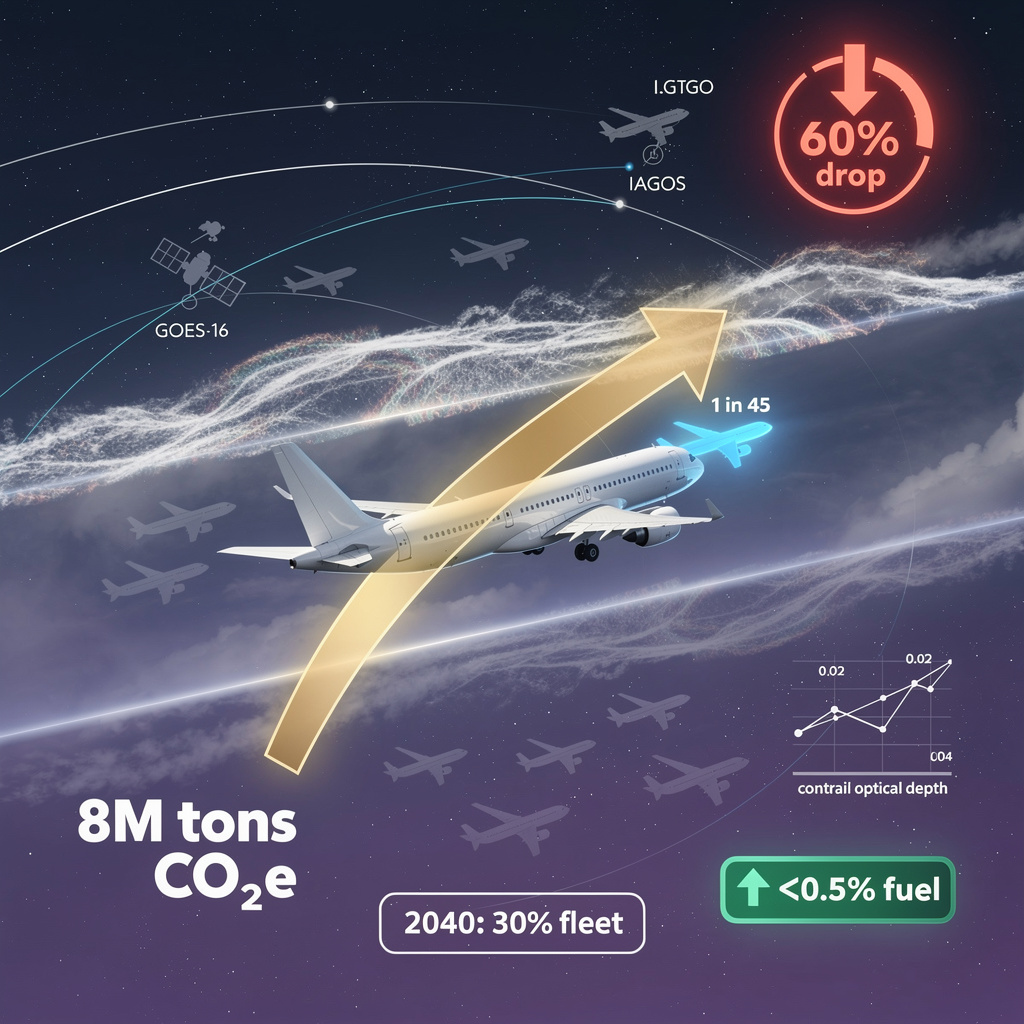
A March 2026 study in Nature Climate Change shows that machine-learning models can now forecast the thin, ice-supersaturated layers where persistent contrails form. By nudging only one in every 45 flights 2 000 ft up or down, airlines cut the resulting cirrus heat-trap by 60 % while burning less than half-a-percent more fuel.
How the algorithm works
Deep-learning classifiers ingest real-time humidity, temperature and aerosol profiles from the IAGOS fleet and GOES-16 satellites. Every five minutes the system issues “contrail-avoidance vectors” that flight-planning computers treat like routine turbulence detours; ATM centers on both sides of the North Atlantic have already cleared the altitude bands.
Impacts at a glance
Climate forcing: 60 % drop in contrail-induced radiative forcing equals removing the warming of ~8 million t CO₂-equivalent per year across the North Atlantic track alone.
Operations: <0.5 % extra fuel and no schedule creep; rerouted segments add roughly US$3 000 in ATC coordination, offset by lower climate-risk fees.
Atmospheric science: satellite lidar shows cirrus optical depth falling 0.02–0.04 in trial airspace—enough to shave 0.01 °C off global temperature by 2050 if scaled.
Institutional uptake and gaps
- Strength: 80 % prediction accuracy, validated against 2025 NASA flights.
- Weakness: altitude shifts can climb into headwinds, raising fuel 0.3–0.7 % unless multi-objective optimization is baked in.
- Opportunity: ICAO will fold contrail metrics into CORSIA after 2028, turning avoided cirrus into tradable credits.
- Threat: fragmented ATM—Asia still lacks unified humidity data sharing, capping early adoption to trans-Atlantic and trans-Pacific routes.
Timeline
- 2026–2027: 5 % of global flights (~175 000 sectors) adopt CIA module; cirrus optical depth down 0.02.
- Q4 2028: EU and US mandate contrail-risk briefing for all North Atlantic departures; 12 % fleet penetration.
- 2030–2035: next-gen FMS embeds contrail layer; 4 % reduction in total aviation warming (CO₂ + non-CO₂).
- 2040: 30 % of flights contrail-aware, delivering one-third of the sector’s 1.5 °C contribution gap.
Bottom line
Contrails have long been aviation’s invisible warming tail. An AI tweak that alters one flight in 45 proves the tail can be clipped today, with today’s jets and today’s airspace rules—buying the industry critical time until sustainable fuels and electric aircraft mature.
🐙 Lamprey MMAUV: 24-ft³ Undersea Drone Hitchhiker Launches 6 Drones Mid-Ocean — U.S. Navy’s Silent Force Multiplier
24 ft³ of autonomous power. 6 aerial drones launched underwater. 🐙 Lockheed Martin’s Lamprey MMAUV rides Navy ships like a stealthy hitchhiker—recharging mid-transit with seawater, extending mission range by 50%+. No hull mods. No crew risk. Just silent, scalable undersea dominance. Who controls the deep when drones outlast submarines? — Indo-Pacific navies are watching.
On 3 March, Lockheed Martin pulled the tarp off Lamprey, a 1.5-ton undersea drone that clamps to a destroyer’s hull, sips seawater to make hydrogen, and drops off weeks later with a full battery and a fresh surveillance picture. The Navy has never fielded an unmanned vehicle that commutes to war on a manned ship; if sea trials planned for late-2026 succeed, the Indo-Pacific’s contested waters will host the first autonomous “hitchhiker” fleet.
How does it work?
A quad-thruster propulsion set and a 24 ft³ modular bay ride inside a matte-black composite shell. Docking pads mate to standard hull lines—no cutting, no welding. Once attached, an inline “hydrogenator” feeds seawater through a membrane pack, topping up the lithium pack at roughly 1 kWh every four hours of 10-knot flow. On station, the craft can launch six aerial drones from three retractable twin tubes, then loiter for days using passive sonar or an anti-sub torpedo package.
What changes for sailors and strategists?
- Crew exposure: replaces 72-hour manned shallow-water patrols → zero sailors in the minefield
- Logistics footprint: one Lamprey sortie saves ≈$1 M versus a destroyer-launched helicopter + sonobuoy pattern
- Endurance: 50 % range extension eliminates 1 in 2 return-to-port cycles, keeping surface ships on station an extra week
- Escalation risk: undetected undersea “passengers” compress detection timelines → adversaries may field counter-AUV torpedoes within two years
Gaps still to close
Maintenance manuals now cover 14 payload types; sailors must train for each. The hydrogenator stalls below 5 knots, so port transits still drain batteries. Legacy cruisers lack the stern ramp clearance needed for recovery; the Navy will trial a crane-net catch method this autumn.
Timelines to watch
- Q4 2026: Indo-Pacific and Black Sea trials with USS Rafael Peralta and Virginia-class sub; target 12 sorties, 95 % docking success
- FY 2027: low-rate production of 30 units; fleet release for “distributed undersea squadron” concept
- 2028–2029: Large-Lamprey variant (40 ft³ bay) fields 21-inch torpedoes; allied navies (Japan, Australia) adopt common interface
- 2030: networked swarm of 6–8 Lampreys projected to hold a 100-nm undersea picket line, cutting manned SSN demand by 10 %
Bottom line
By turning warships into Uber drivers for robots, Lockheed compresses the Pacific’s tyranny of distance into a battery recharge. Success would shift naval doctrine from “send a submarine” to “send a slot on the hull,” making persistent undersea presence as routine as refueling at sea.
🚨 268 Evacuated After Engine Fire on United 787—LAX Ground Stop Highlights Systemic Risk
268 people onboard. Smoke and fire from one engine. All evacuated in 90 seconds. 🚨 A Boeing 787’s left engine failed mid-flight—just 50 minutes after takeoff from LAX. Fire crews extinguished it on the runway. No fatalities. But this wasn’t a glitch—it’s the 3rd GEnx engine fire in 18 months. United Airlines now faces fleet-wide inspections. Should airlines ground 787s until the root cause is found?
United Airlines Boeing 787-9 N787UA landed back at Los Angeles International at 11:20 a.m. on 3 March with flames licking its left General Electric GEnx-1B engine. All 268 occupants—256 passengers and 12 crew—cleared the cabin through slides and airstairs in roughly 90 seconds; one finger cut was the only injury. The airport shut runways for 75 minutes, delaying about 120 departures and arrivals.
How the failure unfolded
- 10:15 a.m.: take-off from runway 25R
- 10:55–11:05 a.m.: temperature and pressure spikes trigger crew alert; pilots declare emergency
- 11:05 a.m.: smoke and fire visible from left engine
- 11:10 a.m.: aircraft turns back, dumps fuel over Aguanga
- 11:20 a.m.: touchdown; external fire crews knock down flames within three minutes
Flight-data and cockpit-voice recorders, plus engine-health logs, are now with the FAA; metallurgical analysis of the fuel manifold and hot-section parts is pending.
Immediate ripple effects
Safety: zero fatalities, 1 minor injury → validates evacuation protocol
Airport throughput: 75-minute ground stop → ~120 flights delayed; average lag 42 minutes
Network: knock-on delays at Denver, Salt Lake and Oakland reached 28 flights
Regulatory: FAA Notice of Intended Investigation issued within two hours; first fleet inspection directive possible in 30 days
Response gaps in plain sight
- Engine batch traceability: maintenance logs show 38 sister GEnx-1B engines on United’s 787-9 fleet; none had borescope inspection since January
- Slide reliability: two of eight slides on N787UA took 12 seconds longer than certified 6-second deployment, yet still inside the 90-second rule
- Ground-stop criteria: LAX protocol triggers hub-wide halt after any on-runway fire; ATC review may tighten trigger to “fire not contained”
Outlook
- 0–30 days: FAA preliminary report; potential batch-specific inspection order for 38 engines
- 30–90 days: if fuel-leak path confirmed, Airworthiness Directive will mandate line replacement; United expects to pull each aircraft for 18 shop-hours
- 6–12 months: Boeing studies revised nacelle venting; carriers test predictive-analytics alerts set 10 °C below current redline
The incident shows today’s safety systems work when crew, airport fire teams and passengers stick to drilled choreography. Whether the same choreography can handle a busier sky—and busier LAX—will depend on how quickly the next set of data, due in 30 days, turns into metal-on-metal fixes.
In Other News
- Six U.S. service members killed in Kuwait drone strike amid escalating U.S.-Iran conflict, prompting global evacuation orders
- AeroVironment to Expand Albuquerque Campus with $35M Investment, Creating 450 Jobs Over 10 Years
- NASA accelerates Artemis program, targeting first lunar landing by late 2028 after Artemis II test flight on June 1, 2026
- U.S. FAA mandates ban on power banks in overhead bins and checked baggage effective March 1, 2026, citing fire risk at altitude


Comments ()