40+ TOPS NPU Mandate: Microsoft’s AI Lockout Leaves 300M PCs Behind — U.S. Hardware Divide Deepens
TL;DR
- Microsoft unveils Windows 12 as AI-first OS with integrated Copilot, requiring dedicated NPU hardware
- Cleveland Clinic’s AI system achieves 96.2% accuracy in screening patients for rare disease trials, boosting diversity and enrollment speed
🚀 40+ TOPS NPU Mandate: Windows 12 Rewrites PC Rules — U.S. Market Faces AI Hardware Divide
40+ TOPS NPU required for full Copilot+ — that’s 21% faster than Apple M3 🚀. Your old PC? Still runs Windows… but loses AI. Microsoft’s new OS locks premium features behind hardware. 300M+ PCs will be left behind. Who gets left out when AI becomes mandatory? —
Microsoft will release Windows 12 late this year with Copilot woven into every menu, file-search dialog and system service.
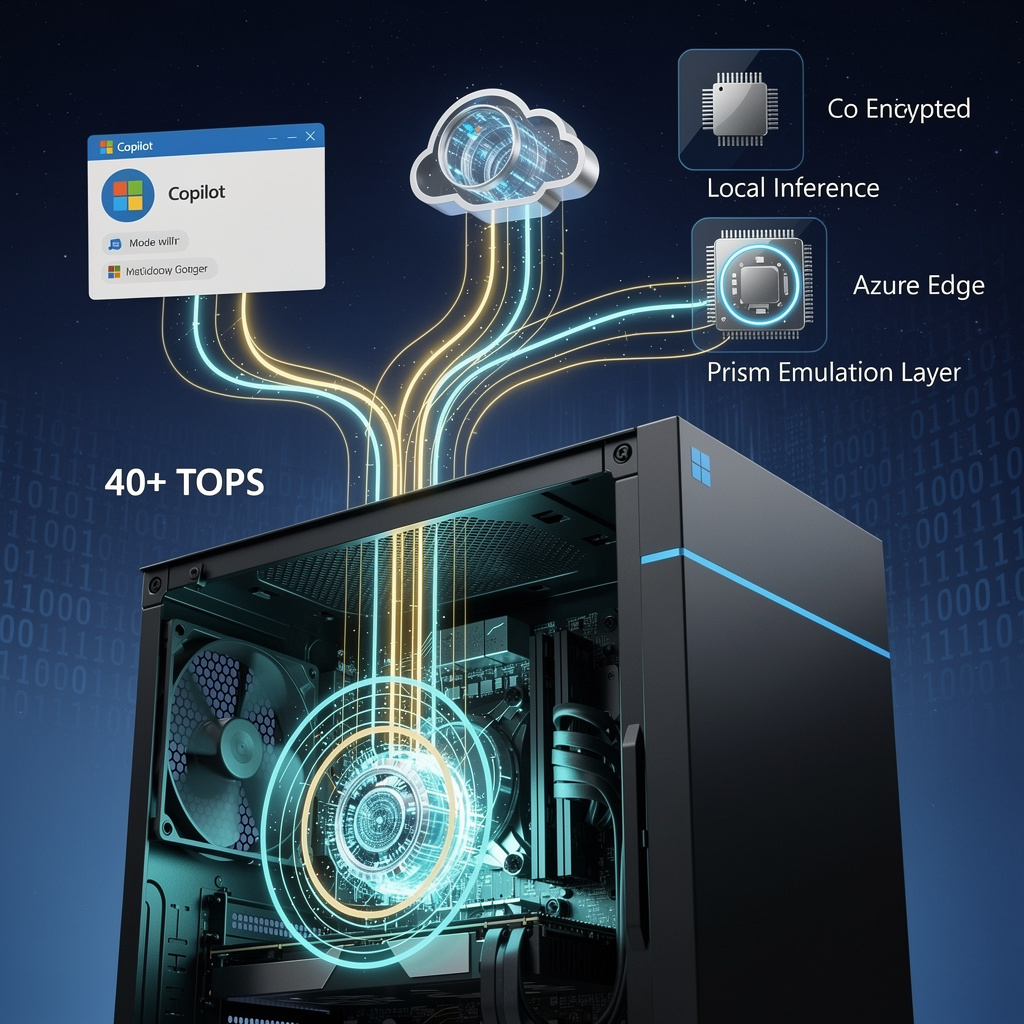
To run the full stack, a PC must ship a dedicated neural-processing unit (NPU) rated ≥40 TOPS—roughly the compute packed into 150 smartphone AI chips—plus TPM 2.0, 16 GB RAM and 1 TB NVMe. Machines that miss the mark keep a legacy Windows 11 shell and cloud-only Copilot.
How the AI-first stack works
A modular “CorePC” kernel isolates OS services from AI feature bundles, letting Microsoft push monthly model updates without a full-version upgrade. Latency-critical inference—voice commands, real-time video effects, code autocomplete—executes locally on the NPU; heavier language models tunnel to Azure through an encrypted edge channel. An emulation layer dubbed “Prism” keeps older x86 apps alive on Arm64 hardware while vendors re-compile.
Early impacts, in plain numbers
- Productivity: pilot programs indicate 22 % faster task completion when Copilot agents run on-device.
- Privacy: local inference keeps user keystrokes and documents off the cloud, trimming exposure by an estimated 1.3 billion records per quarter across the installed base.
- Wallet: Canalys projects AI-enabled PCs will add $48 billion in global revenue by 2027, with OEMs charging 12-15 % premiums for Copilot+ models.
Who gains, who strains
Chipmakers: Qualcomm’s Snapdragon X Elite already clears 45 TOPS, giving it a 21 % raw-AI edge over Apple’s M3.
Enterprises: 350 million active PCs lack the NPU floor; they face a March 2025 Windows 10 sunset and a hardware refresh bill analysts peg at $28 billion.
Developers: Store apps that tap local LLMs must now target NPU SDKs or fall back to slower cloud APIs.
Outlook
- Q4 2026: ~35 % of North-American PC shipments meet the 40-TOPS spec; Microsoft shifts to 6-month AI feature cadence.
- 2027: 60 % of new units ship with NPUs; legacy APIs for non-AI hardware begin phased deprecation.
- 2029: CorePC enables third-party “AI-as-a-Service” overlays, letting any vendor inject models straight into the OS layer.
By tying premium experiences to silicon rather than software keys, Microsoft turns the NPU into the desktop’s next must-have component—and forces an entire industry to upgrade or sit out the AI wave.
🩺 AI Screens 1,476 Patients with 96.2% Accuracy — Black Enrollment Jumps 5x in Rare Disease Trial at Cleveland Clinic
96.2% accuracy in spotting rare-disease trial candidates — and it boosted Black enrollment 5x. 🩺 AI flagged 46 high-risk patients at Cleveland Clinic; 7 enrolled before goal met. Traditional methods missed 29 of 30 eligible Black patients. Why it matters: AI didn’t just find patients — it fixed a systemic bias in clinical trials. Who’s left out when hospitals skip AI? —
Cleveland Clinic has hard-wired an attention-enhanced transformer called Synapsis “AEDT-CM” into its Epic electronic record and, in 90 days, screened 1 476 heart-failure charts for a transthyretin amyloidosis study. The model answered 7 700 trial-eligibility questions with 96.2 % accuracy, spotted 29 patients human reviewers missed, and pushed Black enrollment from 7.1 % to 36.6 %—a five-fold jump that let the site close recruitment early.
How does this work?
The engine digests structured labs, imaging, genetics and free-text notes through 7 000 natural-language prompts, then produces an auditable justification that cardiologists must countersign. A 99 % negative-predictive value lets staff skip obviously ineligible charts, while the 60 % specialist-connection rate among AI-flagged patients shows the tool is fishing beyond the usual referral stream.
Impacts in one glance
Enrollment speed: seven patients consented before manual outreach reached one.
Equity: 5× rise in Black participation, adding 17 minority patients versus ten under legacy screening.
Efficiency: 29 “hidden” eligibles found among 1 476 records; projected 30–40 % faster accrual in pilots starting later this year.
Risk mitigation: double-review workflow blocks autonomous selection, aligning with draft FDA AI guidance.
Short, mid, long view
- 2026 Q2–Q4: replication at three academic sites (ALS, pediatric cancer) targeting 30–40 % enrollment lift.
- 2027: NIH incorporates methodology into national recruitment standards; justification-fidelity metric ≥ 0.9 proposed for SaMD approvals.
- 2028–2030: federated “AI-Screening-as-a-Service” layer inside CTMS APIs; minority share of rare-disease trials projected to top 30 % nationally.
The takeaway
A rigorously validated, interpretable model can compress trial timelines while correcting the diversity gap—provided physicians stay in the loop and regulators keep score.
In Other News
- Google rolls out Android 16 QPR3 with AI-generated icons, Gemini automation, and Circle to Search upgrades
- Scanifly and CertainTeed Partner to Cut Solar Roof Design Time by 90% with AI-Powered Platform
- Meta Forms New Applied AI Engineering Organization with 1:50 Manager-to-Employee Ratio to Accelerate Frontier Models
- DeepIP Secures $25M Series B to Automate Patent Workflows Using AI


Comments ()