440 Drones Shot Down in 24 Hours — Gulf Air Defenses Strain Under Swarm Attacks
TL;DR
- UAE downed 440 drones in 48 hours amid Shahed-136 swarm attacks from Iran targeting Gulf states
- Nevada leads U.S. in UAP sightings with 411 verified reports since 2023, Trump orders Pentagon document release
🚀 440 Drones Downed in 24 Hours — UAE Defends Gulf Skies Amid Iran’s $50K Swarm Attack
440 drones shot down in 24 hours — that’s one every 2 minutes. 🚀 Each cost just $50K. The UAE’s air defenses held — but at what cost? Civilian airports, hotels, and migrant workers bore the brunt. Who’s next when swarm attacks become routine? — Gulf states, are your skies truly safe?
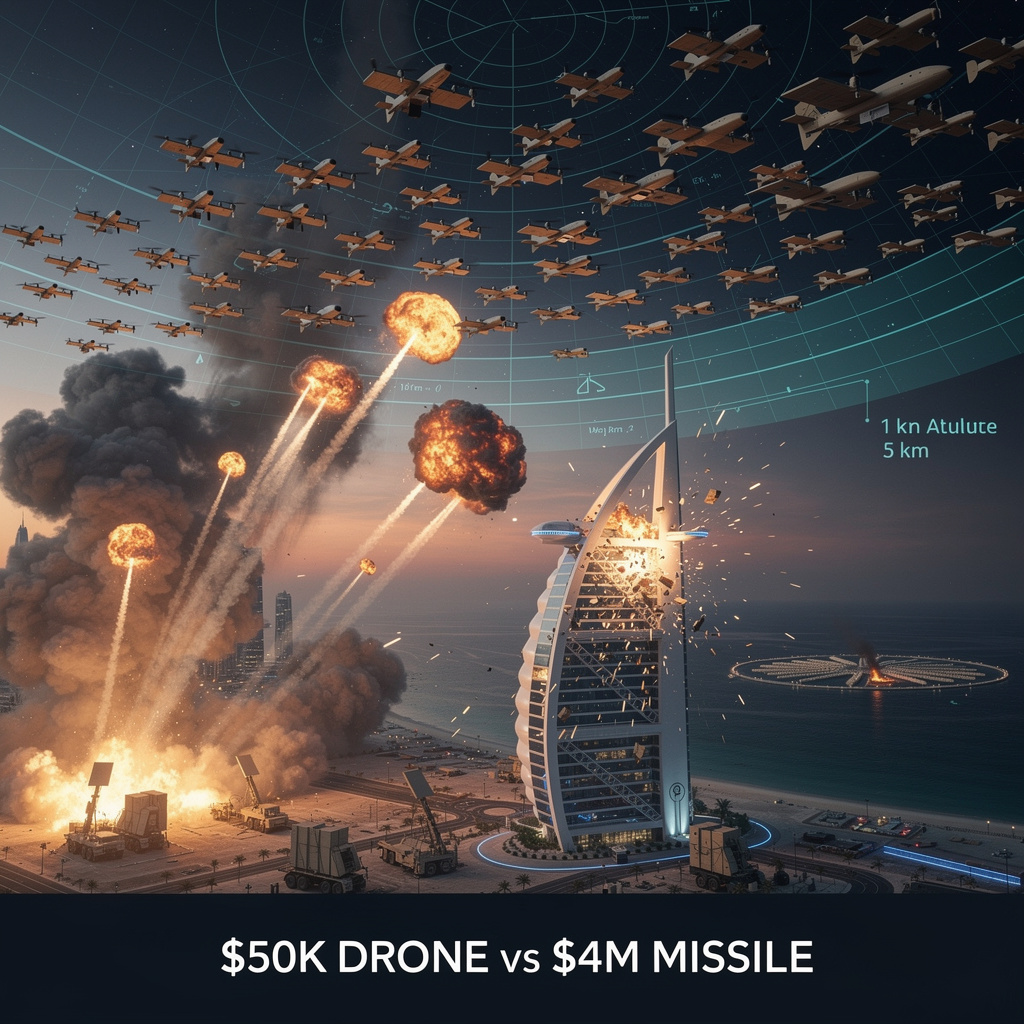
Iran’s Revolutionary Guard fired more than 1,000 Shahed-136 drones at six Gulf states in 48 hours this week; UAE batteries alone splashed 440 of them in a single day. At $50,000 apiece and carrying 50 kg of high explosive, the delta-wing robots arrived in waves 74 knots fast, 5 km high, and 2,000 km from their launch sites—close enough to pepper Dubai’s airport concourse with shrapnel and shut Gulf air-traffic control for 12 hours.
How a $50k drone saturates a $1 billion shield
Each Shahed-136 is built from plywood and fiberglass around a Chinese piston engine, yielding a radar cross-section smaller than a bird. GPS/INS guidance keeps it on a pre-loaded corridor, while a 6-hour endurance lets planners stagger launches into 200-drone pulses. UAE defenders stacked Patriot, NASAMS and F-16 patrols into a single network; the result was 541 confirmed kills, but at the cost of $3–4 million in surface-to-air missiles—an exchange ratio that favors the attacker 60:1.
Impacts in one afternoon
Human cost: 3 migrant workers killed, 58 injured—equivalent to a bus crash every hour.
Infrastructure: debris gashed Burj al-Arab cladding and ignited a Palm Jumeirah hotel fire → $15–20 million in tourism losses.
Military logistics: 165 ballistic missiles diverted 30% of Patriot reloads, cutting magazine depth for future missile storms.
Market signal: Brent crude jumped $2.40 on swarm news, adding $180 million to daily Gulf export value.
Where the shield still leaks
- Radar gap: low-RCS drones slip below 1 km, under Patriot’s 30 m minimum cueing altitude.
- Cost curve: Iran’s 400-unit daily output outpaces combined GCC reload capacity; current stockpile covers only three 1,000-drone salvos.
- Pre-emption lag: CENTCOM’s LUCAS counter-drone task force flew zero confirmed offensive sorties, constrained by rules of engagement.
What comes next
- March–April 2026: expect 500–700 Shahed launches per week; Kuwait already requests two extra Patriot batteries.
- Q3 2026: Shahed-138 (75 kg warhead, 2,500 km range) enters trials, placing Riyadh and Muscat within circle.
- 2027: US Navy to deploy 150 kW laser on Fifth Fleet destroyers, projecting 10-drone kills per $3 diesel gallon.
- 2028: GCC-wide AI radar fusion cell aims for 90% auto-classification; still unfunded.
The takeaway: a plywood drone built for the price of a mid-range sedan is re-writing Gulf air-defense doctrine. Until directed-energy and electronic attack scale up, the region’s $50 billion in Patriot, THAAD and fighter fleets will keep trading million-dollar missiles for bargain-basement robots—an equation no budget can outlast.
🛸 411 UAP Sightings in Nevada — 69% Above U.S. Average — Trigger Trump’s Declassification Order
411 verified UAP sightings in Nevada — 69% above U.S. average — occur near Area 51’s 8,000 sq mi test zone. 🛸 Yet 87% are dismissed as drones, birds, or debris. If 50 unresolved cases aren’t foreign tech… what are they? Military pilots report them daily — are commercial flights at risk? —
Nevada has logged 411 verified Unidentified Aerial Phenomena sightings since 2023—19.1 per 100,000 residents, 69% above the U.S. average—prompting President Trump on 20 Feb 2026 to order the Pentagon and intelligence agencies to release every UAP file. The directive, issued via Truth Social, targets data held by the All-Domain Anomaly Resolution Office (AARO), which has already attributed 87% of 1,652 domestic reports to drones, balloons or birds, leaving roughly 50 cases unresolved.
How the count works
Enigma Labs, a civilian analytics group, cross-checks civilian submissions against military radar, electro-optical and infrared logs; only 68% of Nevada entries passed corroboration, yet the state still tops the per-capita list. Proximity to 8,000-square-mile test ranges—Tonopah, Nellis AFB and the Groom Lake/Area 51 complex—means many “unknowns” may be classified prototypes or experimental UAVs whose radar cross-sections and flight profiles sit outside public libraries.
Impacts so far
- Operational transparency: 757 new Pentagon reports in 13 months overload AARO’s 25-analyst staff → risk of misclassification and mid-air surprise.
- Public trust: 485 service-member submissions in 2024, 364 unresolved → continued FOIA litigation and congressional hearing pressure.
- Industrial secrecy: premature release could expose sensor capabilities → adversaries gain electronic-warfare insights worth an estimated $1–2 B in R&D equivalence.
Response & gaps
AARO plans an updated quarterly report this spring, while Secretary of Defense Pete Hegseth must catalogue holdings within 30 days. No inter-agency protocol yet exists for merging military radar with FAA or commercial ADS-B feeds, so future incidents may still slip through data seams.
What comes next
- Q2 2026: first declassified batch (~250 pre-2020 documents) released with redactions; Nevada dataset re-analysis expected to re-label 70–80% as conventional traffic.
- 2027: proposed “UAP Records Management Office” staffed with 50 analysts; congressional hearings may codify annual public summaries.
- 2028–2029: joint DoD-NASA-FAA sensor fusion pilot could cut unresolved cases to <1% of total reports, integrating commercial satellite constellations for real-time triangulation.
Bottom line
Nevada’s desert airspace doubles as America’s most scrutinised laboratory; turning 411 lingering question marks into verifiable data will either demystify the skies or redefine aerospace threat norms.


Comments ()